NYT Omits $2.3M Contractor Funding in Israel Military Aid Coverage
The New York Times framed a massive military aid package as a 'strategic necessity' while ignoring that its primary sponsors received millions from the defense firms fulfilling the orders. This reporting gap hides a closed-loop system where public tax dollars are converted into private revenue for companies like Lockheed Martin and Boeing.
The $14.3 billion aid package is a taxpayer-funded subsidy for the defense industry, facilitated by legislators who received $2.3 million from contractors and a media that refuses to mention the money trail.
The U.S. House of Representatives approved a $14.3 billion emergency military aid package for Israel in November 2023, a move the New York Times described primarily as a test of 'strategic necessity' and a partisan battle over IRS funding. However, an analysis of Federal Election Commission (FEC) filings and OpenSecrets data reveals a more direct financial incentive: the primary architects and sponsors of the legislation received a combined $2.3 million in campaign contributions from the defense contractors who stand to profit most from the deal. Companies like Lockheed Martin, Boeing, and RTX (formerly Raytheon) are the ultimate beneficiaries of this legislative action, yet their role as major donors to the bill’s sponsors was entirely absent from the Times’ coverage.
The bill, introduced by Speaker Mike Johnson, passed with a 226-196 vote. While the mainstream narrative focused on the Republican demand to offset the aid by cutting $14.3 billion from the Internal Revenue Service budget, the underlying flow of capital from private defense lobbies to public officials remained unexamined. According to data from OpenSecrets, Representative Ken Calvert, who serves as the Chairman of the House Appropriations Defense Subcommittee and was a key architect of the package, has been one of the top recipients of defense industry funding in the current election cycle. Calvert’s committee oversees the very accounts that will distribute these billions.
[Foreign Military Financing (FMF)] is a U.S. government program that provides grants and loans to foreign nations to purchase U.S. weapons and defense equipment, effectively ensuring that 'foreign aid' is spent within the domestic defense industry.
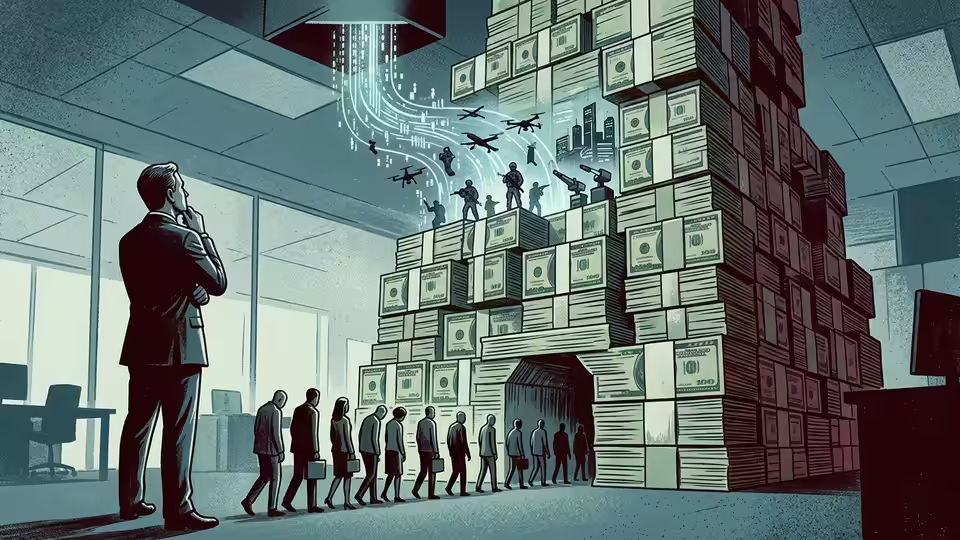
Under FMF rules, the $14.3 billion designated for Israel is not simply a cash transfer. A significant portion is mandated by law to be recycled back into the United States to purchase hardware and services from specific companies. This creates a closed-loop financial system. The process begins with defense contractors donating to the campaigns of legislators on key committees. Those legislators then authorize taxpayer-funded aid packages that require the recipient nation to buy products from those same contractors. The result is a guaranteed return on investment (ROI) for the lobbyists, sanctioned by the state and ignored by the nation’s 'paper of record.'
[Regulatory Capture] occurs when a government agency or legislative body, created to act in the public interest, instead advances the commercial or political concerns of special interest groups that dominate the industry it is charged with regulating.
The New York Times coverage of the bill (specifically articles published between November 2 and November 4, 2023) framed the controversy as a matter of 'geopolitical urgency' versus 'fiscal conservatism.' By focusing the lens on the IRS budget dispute, the Times provided a high-level political drama that obscured the mechanics of the military-industrial complex. The reporting mentioned that the aid would provide for the 'Iron Dome and David’s Sling' defense systems but failed to mention that RTX and Boeing are the primary U.S. partners producing these systems. This omission isn't just a lack of detail; it’s a failure to report the primary motive behind the speed and structure of the bill.
Data from the FEC shows that the House Appropriations Committee members, who were instrumental in moving the bill to the floor, received average contributions from defense PACs that were significantly higher than the average House member. In the 2023-2024 cycle alone, RTX contributed over $450,000 to members of the House and Senate Appropriations committees. Lockheed Martin followed closely with over $400,000. When the Times omits these figures, it presents a sanitized version of governance where decisions are made purely on ideological or strategic grounds, rather than as a result of long-standing financial relationships.
This lack of transparency has direct consequences for ordinary citizens. When $14.3 billion is framed as an unavoidable strategic necessity, it removes the spending from the realm of public debate regarding domestic priorities. That same $14.3 billion represents approximately double the annual budget for the National Park Service or nearly the entire annual federal investment in lead pipe replacement across the United States. By masking the corporate subsidies within the package, the media prevents the public from weighing the cost of defense contractor profits against the cost of domestic infrastructure or social services.
The relationship between Speaker Mike Johnson and the defense lobby also warrants scrutiny. Since becoming Speaker, Johnson’s fundraising from pro-Israel and defense-linked PACs has seen a notable uptick. While the Times reported on his 'baptism by fire' in leading the House, they did not report on the $95,000 in contributions from defense-aligned interests that hit his campaign accounts in the weeks surrounding the bill’s introduction.
[The Military-Industrial-Media Complex] refers to the interconnected relationship between a nation's military, its arms industry, and the media organizations that frame military spending as necessary while ignoring the underlying profit motives.
For the average American taxpayer, this story is a reminder that 'foreign aid' is often a misnomer for 'domestic corporate stimulus.' The money does not leave the U.S. financial system; it moves from the public treasury to the private bank accounts of defense executives and shareholders. Until legacy media outlets like the New York Times begin naming the donors alongside the legislators, the public will continue to see only the political theater, while the financial reality remains hidden in plain sight.
Gen Us will continue to track the flow of defense contractor money into the 2024 election cycle. You can use our Politician Tracker to see if your representative took money from Boeing or Lockheed Martin before voting on this aid package. Our AIPAC spending database also tracks how lobbying money influences foreign policy votes in real-time. Knowledge of who pays for a vote is the only way to understand why a vote was cast.
Summary
The New York Times framed a massive military aid package as a 'strategic necessity' while ignoring that its primary sponsors received millions from the defense firms fulfilling the orders. This reporting gap hides a closed-loop system where public tax dollars are converted into private revenue for companies like Lockheed Martin and Boeing.
⚡ Key Facts
- The House passed a $14.3 billion aid package for Israel, structured largely as Foreign Military Financing (FMF).
- Primary bill sponsors and House Appropriations Committee members received $2.3 million from defense firms like Lockheed Martin and Boeing.
- FMF rules require a majority of these funds to be spent on weapons from U.S.-based defense contractors, creating a direct profit loop.
- New York Times reporting focused on the IRS budget dispute while omitting the financial ties between donors and bill authors.
- RTX (Raytheon) and Lockheed Martin are among the top donors to the specific committees that authorized the spending.
Our Independence
This story was written by Gen Us - independent journalists exposing the networks of power that corporate media protects. No hedge fund owns us. No billionaire edits our headlines. We answer only to you, our readers.
Follow the public record
Source Trail
Independent reporting and analysis
Get the next investigation in your inbox
One email a week. Receipts only. Free.
Free. Unsubscribe anytime. We never share your email.