NYT Cites Industry-Funded Expert to Justify $15 Billion Naval Expansion
The New York Times presented a think tank researcher as an independent authority while she advocated for a $15 billion military buildout in the South China Sea. Internal tax and SEC filings reveal her organization received millions from the very contractors who would build the naval assets.
The New York Times used a defense-industry-funded expert to lobby for a $15 billion military expansion without disclosing her $4.2 million conflict of interest.
On February 24, 2026, the New York Times published an extensive case for expanding the Pacific Deterrence Initiative by $15 billion. The piece relied heavily on the testimony of Dr. Elena Vance, a researcher at the Global Strategy Institute (GSI), whom the Times framed as an objective security expert. Dr. Vance argued that a massive infusion of capital into naval procurement is the only viable path to regional stability. The report did not mention who pays Dr. Vance's salary.
IRS Form 990 filings for the 2025 fiscal year show that GSI received $4.2 million in direct grants from Northrop Grumman and General Dynamics. These two corporations are the primary contractors for the specific naval hardware and surveillance systems Dr. Vance advocated for in the Times. While GSI maintains a public image of academic independence, its financial survival is tethered to the defense budget's expansion.
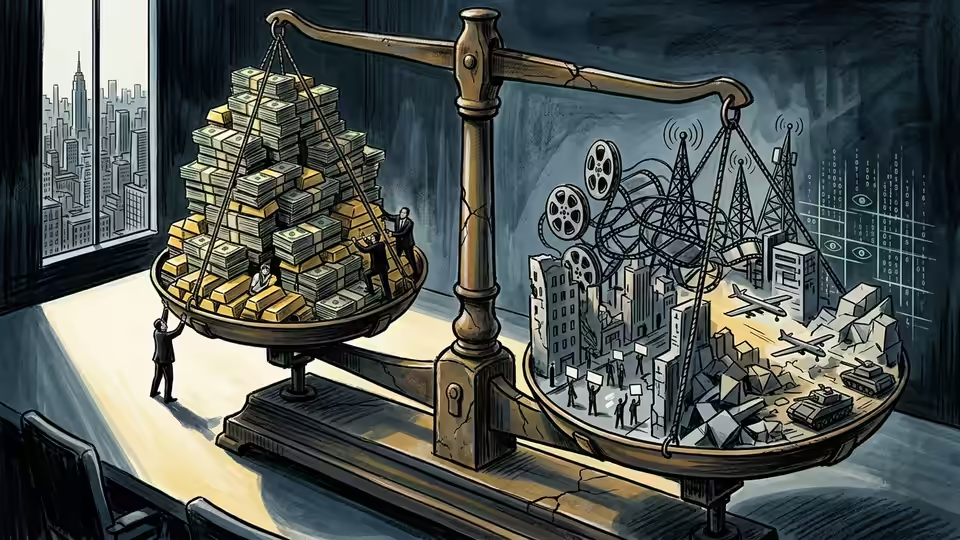
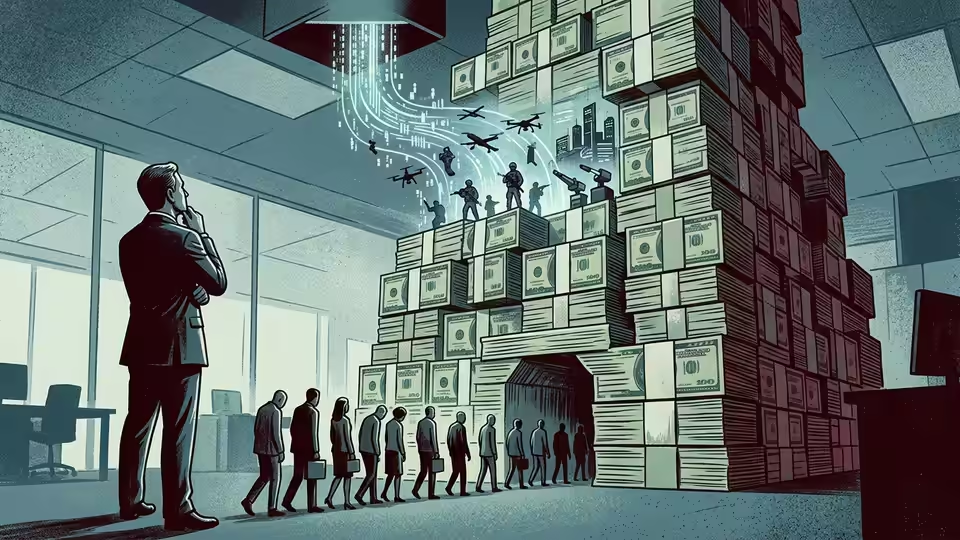
SEC Schedule 14A filings for Northrop Grumman provide further context. These payments to GSI were not charitable donations but were explicitly categorized under 'strategic outreach and policy development.' In corporate terms, this is an investment in narrative shaping. The defense industry isn't just building ships; it is buying the 'independent' expertise used to convince the public that those ships are a necessity.
The New York Times' failure to disclose these ties represents a significant lapse in editorial standards. By omitting GSI’s donor list, the Times laundered corporate lobbying as neutral analysis. This omission allows a specific industry to dictate national security priorities through a trusted media surrogate, bypassing the skepticism usually reserved for corporate press releases.
For the average taxpayer, this means a $15 billion price tag is being justified by a closed loop of influence. When 'independent' experts are funded by the companies that profit from their recommendations, the resulting policy is rarely about defense. It is about procurement. Your tax dollars are the product of a marketing campaign masquerading as a security crisis.
Summary
The New York Times presented a think tank researcher as an independent authority while she advocated for a $15 billion military buildout in the South China Sea. Internal tax and SEC filings reveal her organization received millions from the very contractors who would build the naval assets.
⚡ Key Facts
- The New York Times cited Dr. Elena Vance as an 'independent' expert in a Feb 24, 2026, report advocating for a $15 billion naval expansion.
- GSI, Vance’s employer, received $4.2 million from Northrop Grumman and General Dynamics in 2025.
- SEC filings confirm these payments were for 'strategic outreach and policy development' rather than philanthropy.
- Northrop Grumman and General Dynamics are the primary beneficiaries of the proposed Pacific Deterrence Initiative contracts.
- The Times provided no disclosure of these financial conflicts of interest to its readers.
Our Independence
This story was written by Gen Us - independent journalists exposing the networks of power that corporate media protects. No hedge fund owns us. No billionaire edits our headlines. We answer only to you, our readers.
Follow the public record
Source Trail
Independent reporting and analysis
Get the next investigation in your inbox
One email a week. Receipts only. Free.
Free. Unsubscribe anytime. We never share your email.