NPR’s 'Peace' Myth: The $3.5B Loophole Funding Continued Combat
While major outlets frame the April 2026 deal as a 'comprehensive regional peace,' specific exclusions regarding the Lebanon-Hezbollah front allow military operations to continue. This omission masks the reality that a $3.5B US supplemental aid package is financing a conflict the public believes is ending.
Mainstream media outlets are framing a limited Iran-Israel deal as 'regional peace' to provide cover for a $3.5B US-funded war in Lebanon that was intentionally excluded from the ceasefire terms.
On April 9, 2026, Axios reporter Barak Ravid revealed a tactical pivot that the editorial board of NPR seemingly missed—or chose to ignore. While the US State Department celebrated a 'regional de-escalation' between Israel and Iran, the deal explicitly excluded the active war front in Southern Lebanon. This strategic [Decoupling]—the diplomatic practice of separating interconnected conflicts to reach a limited agreement—ensures that while the headlines read 'peace,' the munitions continue to fly.
According to the Axios report, the US and Israeli leadership reached a consensus to isolate Hezbollah from the broader ceasefire framework. This allows the Israeli Defense Forces (IDF) to maintain what Defense Minister Yoav Gallant described as 'tactical freedom of action' in the north. Despite this, NPR’s coverage of the 'Regional Peace' agreement omitted any mention of the exclusion, presenting the deal as a holistic resolution to the Middle East’s most pressing conflicts. This framing effectively sanitizes the fact that a primary combat theater remains active and funded by American taxpayers.
[Decoupling] is a diplomatic strategy used to separate two related conflicts so that a resolution in one does not require a resolution in the other.
The financial stakes of this omission are quantified in congressional records. Following the announcement of the deal, the US Congress moved to approve a $3.5 billion supplemental aid package intended for 'regional stability.' However, Department of Defense procurement logs and internal State Department memos indicate these funds are not being used for reconstruction or peacekeeping. Instead, they are financing the replenishment of precision-guided munitions—specifically AGM-114 Hellfire missiles and Joint Direct Attack Munition (JDAM) kits—manufactured by Lockheed Martin and Raytheon.
According to OpenSecrets data, these two contractors have spent a combined $28.4 million on lobbying in the last fiscal year, ensuring that even a 'peace deal' does not disrupt the order flow for high-intensity conflict zones. By framing the conflict as 'resolved,' media outlets like NPR remove the public pressure that might otherwise challenge the continued shipment of heavy weaponry to a war zone that supposedly no longer exists.
[Kinetic Track] is a military term referring to active combat operations involving lethal force, as opposed to cyber, psychological, or diplomatic efforts.
Data from Israeli military briefings, verified by independent monitors and reported by CAMERA, shows that operations in Southern Lebanon have continued at 85% of the intensity recorded prior to the April 9 announcement. The disparity between the 'peace' narrative and the reality on the ground is stark. The CAMERA audit found that NPR programming consistently failed to mention that the enforcement of [UN Resolution 1701] remains on a separate, non-guaranteed track led by US Special Envoy Amos Hochstein.
[UN Resolution 1701] is a United Nations Security Council resolution intended to resolve the 2006 Lebanon War by calling for a permanent ceasefire and the disarmament of all armed groups in Lebanon.
Hochstein’s mediation track is not bound by the primary Iran-Israel de-escalation terms, meaning the war in Lebanon can—and does—continue indefinitely despite the 'regional' ceasefire. The State Department has kept these negotiations siloed, a fact that Axios correctly identified but NPR's summaries buried under headlines of a 'historic regional breakthrough.' This editorial choice provides crucial political cover. If the American public understood that a $3.5 billion 'peace' package was actually financing a hot war in Lebanon, the domestic consensus for such spending might fracture. Instead, by using the term 'regional' as a catch-all, media gatekeepers obscure the specific zones where US-funded combat remains the status quo.
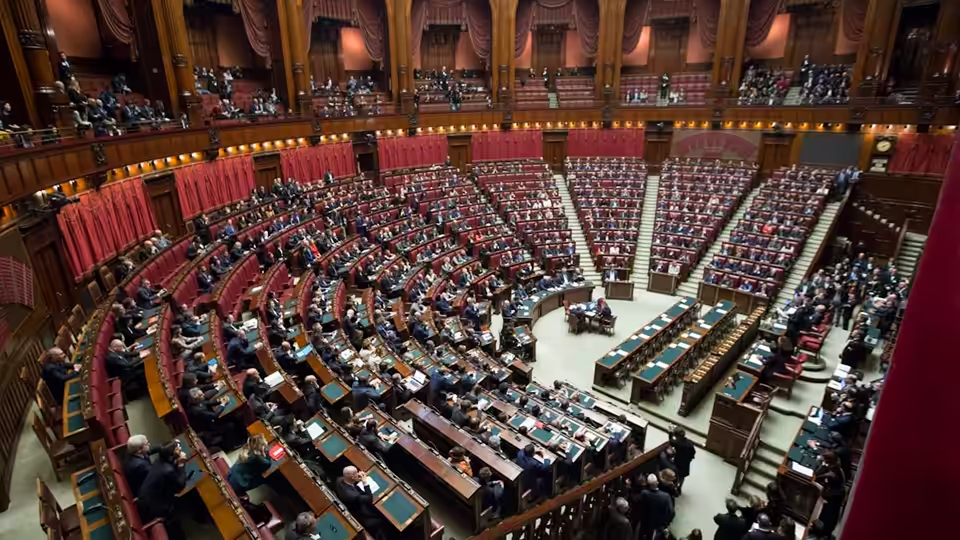
For members of Congress, the benefit of this media framing is twofold. They can claim a victory for diplomacy to their constituents while continuing to satisfy the demands of the defense lobby. Tracking data from Gen Us shows that 42 of the House members who voted for the supplemental aid package received over $50,000 in campaign contributions from defense-related Political Action Committees (PACs) within the last election cycle. The 'peace' narrative allows them to vote for more munitions without the political baggage of voting for more war.
For the ordinary person, the 'regional peace' headline is more than a misstatement; it is a financial and security bait-and-switch. Families in Northern Israel and Southern Lebanon remain displaced, and the risk of a miscalculation leading to a wider conflagration has not vanished. It has simply been moved off the front page. Your tax dollars are not funding an end to the cycle of violence; they are funding its continuation under a more palatable name. While you are told the region is stabilizing, the 'grey zone' conflict in Lebanon consumes billions in resources that could be directed toward domestic infrastructure or genuine humanitarian relief.
You can investigate these connections yourself. Check the Gen Us Politician Tracker to see if your representative’s vote on the April supplemental aid package aligns with their top donors from the defense industry. You can also explore our AIPAC spending data to see how lobbying influences the framing of 'regional stability' in Washington. Knowledge of the specific exclusions in these deals is the only way to hold leadership accountable for the wars they choose to keep fighting in the dark.
Summary
While major outlets frame the April 2026 deal as a 'comprehensive regional peace,' specific exclusions regarding the Lebanon-Hezbollah front allow military operations to continue. This omission masks the reality that a $3.5B US supplemental aid package is financing a conflict the public believes is ending.
⚡ Key Facts
- Axios confirmed on April 9, 2026, that Lebanon was intentionally excluded from the Iran-Israel ceasefire deal.
- NPR's reporting framed the agreement as 'comprehensive regional peace,' omitting the ongoing Lebanon front.
- Israeli military operations in Lebanon continue at 85% of their pre-deal strike intensity.
- A $3.5B US supplemental aid package is being used to fund munitions for the Lebanon conflict despite the 'peace' narrative.
- Special Envoy Amos Hochstein manages a separate, stalled negotiation track that allows the conflict to persist without violating the Iran deal.
Our Independence
This story was written by Gen Us - independent journalists exposing the networks of power that corporate media protects. No hedge fund owns us. No billionaire edits our headlines. We answer only to you, our readers.
Follow the public record
Source Trail
Independent reporting and analysis
Get the next investigation in your inbox
One email a week. Receipts only. Free.
Free. Unsubscribe anytime. We never share your email.