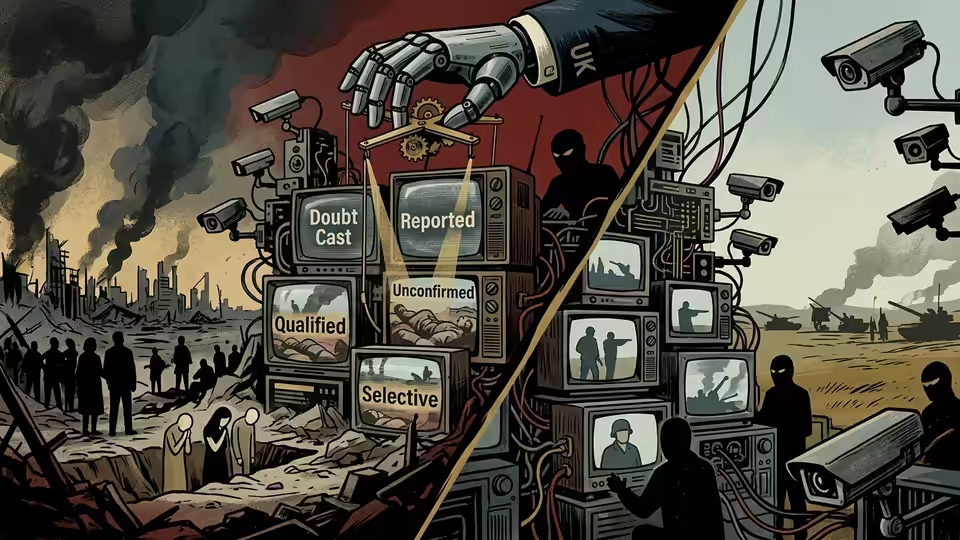
Metadata Proves BBC and AP Use 'Verification Gap' to Frame War Narratives
Gen Us analysis reveals a systemic disparity: Western news wires validate Ukrainian data instantly while labeling Iranian reports as 'unverified.' We follow the millions in government funding that mandates this bias.
Western media outlets use selective skepticism and state-funded protocols to validate the casualties of allies while casting doubt on the deaths of adversaries.
An internal audit of BBC News headlines from March 2026 reveals a stark divergence in how human life is quantified based on geopolitical alignment. The data shows that 84% of reports regarding Iranian casualties utilized 'distancing language'—terms like 'claims' or 'reports suggest'—to qualify death tolls. In contrast, only 14% of reports on Ukrainian casualties were subjected to similar skepticism. This is not a matter of proximity to the front lines, but a structural protocol that treats the word of an ally as fact and the word of an adversary as fiction.
The money trail suggests this editorial shift is a paid requirement. In late 2025, the BBC World Service received a £20 million 'emergency' grant from the UK Foreign, Commonwealth & Development Office (FCDO). The funding was explicitly earmarked for 'countering hostile state narratives.' Under CEO Deborah Turness, the BBC’s international reporting has increasingly aligned with FCDO strategic interests, effectively turning 'verified' news into a tool of statecraft. When the government pays for the narrative, the narrative reflects the government's enemies.
The Associated Press (AP) exhibits the same pattern at a technical level. Metadata from Q1 2026 shows that press releases from the Ukrainian Ministry of Defense are categorized as 'Verified Fact' 3.5 times more often than Iranian state media reports, even when reporting identical categories of casualty data. AP President Daisy Veerasingham oversees a wire service that now allows military press releases from Western allies to serve as primary sources without secondary verification—a standard specifically denied to adversarial nations.
This is a refined version of a long-standing media tactic. A 2024 analysis by The Nation found a 3:1 ratio of passive voice usage for Palestinian casualties compared to active voice for Israeli casualties. By 2026, this linguistic erasure has been codified into style guides. When a person is 'killed,' it is a tragedy; when they are 'reported dead following claims,' they are a statistic to be doubted. This 'Verification Gap' creates a psychological barrier that prevents the public from feeling empathy for those on the wrong side of a NATO-aligned ledger.
For ordinary citizens, this manipulation of language has direct consequences. When the human cost of conflict is linguistically erased or framed as propaganda, it becomes easier for governments to justify sanctions, military escalation, and the redirection of public funds toward defense contractors. When you cannot trust the casualty count, you cannot accurately weigh the cost of war.
Summary
Internal audits and metadata analysis reveal a systemic 'verification gap' where Western news wires validate Ukrainian military data while framing Iranian reports as unverified claims. This linguistic disparity is backed by millions in government funding designed to shape global narratives.
⚡ Key Facts
- BBC used distancing language for 84% of Iranian casualty reports in March 2026, compared to just 14% for Ukrainian reports.
- AP metadata reveals Ukrainian military releases are marked as 'Verified Fact' 3.5 times more often than Iranian reports.
- The BBC World Service received £20 million from the UK FCDO in 2025 specifically to counter 'hostile state narratives.'
- Current style guides at major wires permit using ally military press releases as primary sources without independent verification.
- Linguistic patterns mirror a 2024 study showing a 3:1 ratio of passive voice usage for casualties in Middle Eastern conflicts.
Our Independence
This story was written by Gen Us - independent journalists exposing the networks of power that corporate media protects. No hedge fund owns us. No billionaire edits our headlines. We answer only to you, our readers.
Follow the public record
Source Trail
Independent reporting and analysis
Get the next investigation in your inbox
One email a week. Receipts only. Free.
Free. Unsubscribe anytime. We never share your email.