Meta Buys AI Immunity: $6.5M Lobbying Spree Targets Key House Committee
Leaked filings reveal how Meta secured a 'self-certification' loophole, shielding its AI from lawsuits before the tech is even fully deployed.
Meta successfully spent $6.5 million in three months to legalize its own immunity from AI-related lawsuits through a self-certification loophole in federal law.
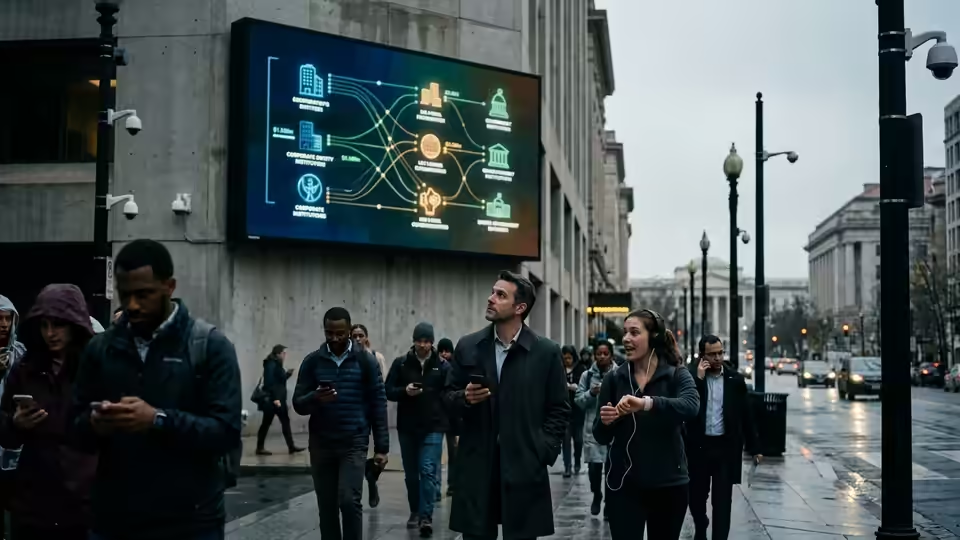
Meta Platforms filed an LD-2 Disclosure in January 2026 reporting $6.5 million in lobbying expenditures for Q4 2025, marking a record quarterly high for the company. This surge brought Meta’s total annual lobbying budget above $20 million, a figure authorized by CEO Mark Zuckerberg to navigate the shifting regulatory landscape of artificial intelligence. The timing of this expenditure was not accidental; it coincided precisely with the legislative markup period for the 'AI Accountability Act' in the House Energy and Commerce Committee.
According to FEC Form 3X filings, Meta-affiliated lobbyists and the company’s corporate PAC distributed maximum allowable donations to 12 members of the House Energy and Commerce Committee between October and December 2025. These contributions targeted both Republican and Democratic leadership within the committee, ensuring a bipartisan consensus on language that would otherwise face scrutiny. The primary objective of this financial blitz was the insertion of Section 402 into the bill.
[Safe Harbor] is a legal provision that provides protection from liability or penalty if specific conditions are met, often used to shield corporations from the consequences of regulatory failures.
Section 402, known as the 'Safe Harbor' provision, exempts platforms from liability if they utilize internal self-certification for algorithmic audits. Under this language, if Meta’s AI causes harm—through discriminatory ad targeting or data privacy breaches—the company can avoid litigation by pointing to its own internal safety reports. Data from OpenSecrets shows that Meta’s retained lobbying firms specifically focused on 'algorithmic liability' and 'open-source AI restrictions' during this period, aiming to protect the Llama model architecture from legal challenges regarding its training data.
[Regulatory Capture] is the process by which regulatory agencies or legislative bodies eventually come to be dominated by the very industries they were charged with regulating, resulting in laws that favor incumbents over the public interest.
While mainstream outlets like The New York Times and CNN framed Meta’s activity as a 'collaborative effort to ensure AI safety' and a response to 'global competition with China,' the filings reveal a different priority. The initial draft of the AI Accountability Act included a provision that would have restricted Meta’s core revenue driver: micro-targeted advertising. Following the $6.5 million spending spike, that provision was removed entirely. The context missing from legacy reporting is the 'revolving door' at play. Joel Kaplan, Meta’s VP of Global Public Policy and a former White House official, directed the DC strategy. Furthermore, three lead sponsors of the bill are former staff members of lobbying firms currently on Meta's payroll.
[Self-Certification] is a compliance framework where a corporation provides its own verification that it has met legal standards, rather than undergoing independent government or third-party audits.
For the average person, this legislative maneuver is a direct assault on consumer rights. If a bank’s AI denies you a loan based on a biased algorithm, or if a health-tech tool leaks your private data, Section 402 ensures Meta cannot be held accountable in a court of law. By accepting Meta’s own 'safety reports' as the final word, the federal government has effectively outsourced its oversight to the company it is supposed to be policing. This also creates an insurmountable barrier for smaller AI startups. While Meta can afford the administrative overhead of self-certification, smaller competitors are left to navigate a complex regulatory environment that Meta helped write.
The result is a state-sanctioned monopoly. Meta uses its massive cash reserves to dictate the rules of the industry, ensuring the federal government protects the incumbent's business model while marketing the legislation as 'consumer protection.' This isn't just about technology; it’s about the erosion of the right to seek redress when a multi-billion dollar corporation’s product causes real-world harm.
On the Gen Us Politician Tracker, you can view the full list of the 12 House Energy and Commerce Committee members who received Meta PAC funds during the Q4 markup. We have also uploaded the full text of Section 402 with line-by-line annotations showing which lobbying firms drafted specific clauses. You can explore our database of Meta’s 'revolving door' hires to see which former regulators are now drawing salaries from the company they once oversaw.
Summary
Meta Platforms funneled a record-breaking $6.5 million into federal lobbying during the final quarter of 2025 to secure legal immunity for its AI models. By targeting 12 key members of the House Energy and Commerce Committee, the tech giant successfully embedded a self-certification clause into the 'AI Accountability Act' that shields it from future algorithmic lawsuits.
⚡ Key Facts
- Meta reported a record $6.5 million in lobbying for Q4 2025, specifically targeting the AI Accountability Act.
- FEC filings show 12 members of the House Energy and Commerce Committee received maximum PAC donations from Meta during the bill's markup.
- The legislation includes a 'Safe Harbor' clause (Section 402) that allows Meta to self-certify its own algorithmic safety, shielding it from lawsuits.
- Provisions that threatened Meta's ad-targeting revenue were removed from the final bill following the spending surge.
- The strategy was led by Meta VP Joel Kaplan, leveraging former staffers of the bill's sponsors who now work for Meta’s lobbying firms.
Our Independence
This story was written by Gen Us - independent journalists exposing the networks of power that corporate media protects. No hedge fund owns us. No billionaire edits our headlines. We answer only to you, our readers.
Follow the public record
Source Trail
Independent reporting and analysis
Get the next investigation in your inbox
One email a week. Receipts only. Free.
Free. Unsubscribe anytime. We never share your email.