Meta and Anthropic’s $20M Lobbying Blitz Targets Their Own Competitors
Leaked details of the 'AI Safety and Licensing Act' reveal how tech giants are spending record sums to build a regulatory moat that effectively outlaws startup competition.
Meta and Anthropic are spending record millions to pass 'safety' laws that mandate expensive audits and liability for open-source AI, effectively bankrupting their smaller competitors.
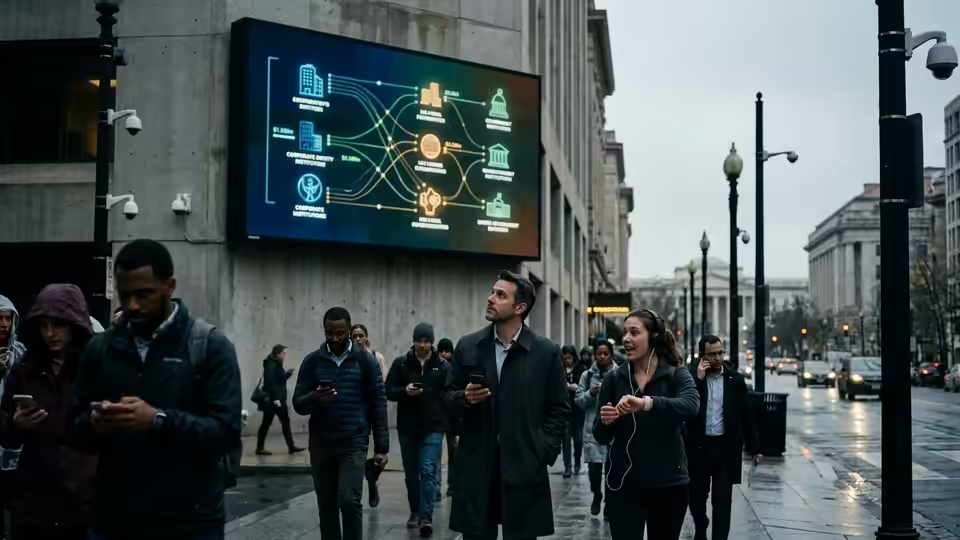
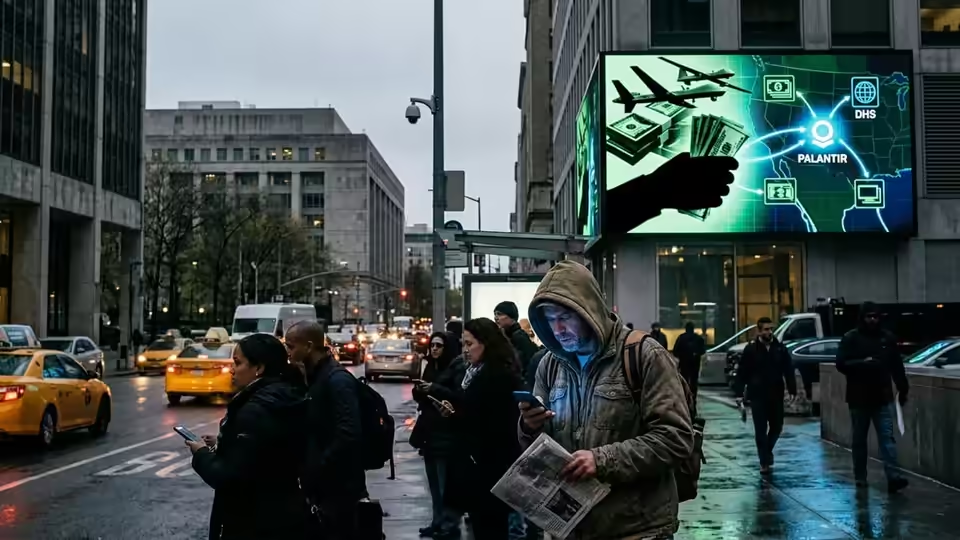
Meta Platforms, Inc. reported a record $7.1 million in lobbying expenditures for the first quarter of 2026, according to mandatory LD-2 filings submitted to the Secretary of the Senate. This figure represents the highest quarterly spend in the company’s history, part of an aggregate $20 million industry-wide blitz designed to influence the trajectory of the 'AI Safety and Licensing Act.' While mainstream outlets frame this spending as a proactive attempt by 'Big Tech' to cooperate with safety oversight, a closer look at the money trail suggests a more calculated motive: the elimination of competition.
Anthropic, often branded as a safety-first alternative to OpenAI, increased its lobbying spend by 400% year-over-year, hitting $1.6 million in Q1 2026. This surge in spending directly coincided with the markup sessions for the AI Safety and Licensing Act in the House Committee on Energy and Commerce. Federal Election Commission (FEC) records show that during this same reporting cycle, Meta and Anthropic-linked PACs distributed a combined $450,000 in contributions to key members of the House Energy and Commerce Committee—the very body responsible for drafting the bill's final language.
[Regulatory Capture] is the process by which a regulated industry gains influence over the government body responsible for its oversight, resulting in policies that favor the industry's leaders at the expense of the public or smaller competitors.
The legislation currently under debate introduces a mandatory licensing regime for any AI model exceeding specific compute thresholds. [Compute Thresholds] are technical limits based on the amount of raw processing power used to train an AI model, often used as a proxy for the model's potential capabilities or risks. According to internal drafts of the bill, these thresholds are calibrated to exempt existing products from Meta and Anthropic, while requiring future rivals to undergo expensive, third-party safety audits that can cost upwards of $2 million per model version.
What the mainstream narrative consistently omits is the 'liability clause' hidden deep within the bill’s text. This clause makes the act of hosting open-source model weights a high-liability offense. [Model Weights] are the numerical parameters that determine how an AI model makes decisions; when these are 'open-source,' it allows any developer to run the model on their own hardware without paying a central authority. By attaching legal liability to the hosting of these weights, the bill would effectively shut down decentralized innovation hubs like Hugging Face, forcing developers back into the high-cost, subscription-based ecosystems controlled by the firms currently spending millions on K Street.
The 'Safety' branding serves as an effective political shield. However, the data reveals a revolving door of influence. At least three senior policy advisors for the AI Safety and Licensing Act are former employees of the firms outspending their rivals in lobbying. This proximity ensures that the 'safety' requirements—such as 24/7 compute monitoring—are not just expensive, but specifically tailored to the infrastructure already owned by Meta and Anthropic. For a startup, implementing these monitoring systems requires a billion-dollar balance sheet that does not yet exist.
For the ordinary person, this is not just a battle between tech billionaires. It is the architectural blueprint for a digital monopoly. When competition is legislated out of existence, the remaining firms have no incentive to keep subscription costs low or respect user privacy. The licensing act includes provisions for 'continuous monitoring' of AI outputs, a requirement that mandates more invasive data harvesting under the guise of safety. If you use a licensed AI tool, your data must be audited to ensure it complies with government-approved safety guidelines, ending any hope of independent, uncensored AI tools for the public.
This isn't about preventing a robot uprising. It's about who gets to hold the keys to the most profitable technology of the century. While the public is told these laws are meant to protect them, the $20 million spent this quarter suggests the primary beneficiary is the bottom line of a few specific boardrooms. You can track the specific committee members who received these donations and their voting records on our Gen Us Politician Tracker.
Summary
AI giants are setting record lobbying spends to influence the 'AI Safety and Licensing Act,' a bill that analysts say creates a 'regulatory moat' around current incumbents. By funding high-barrier licensing requirements, these firms are effectively legislating their open-source and startup competition out of the market.
⚡ Key Facts
- Meta reported a record-breaking $7.1M in lobbying for Q1 2026, while Anthropic increased its spend by 400% to $1.6M.
- Aggregate AI industry lobbying surpassed $20M in a single quarter for the first time in history.
- FEC records reveal $450,000 in PAC contributions were funneled to members of the House Committee on Energy and Commerce during the bill's markup.
- The 'AI Safety and Licensing Act' contains specific liability clauses that would effectively criminalize the hosting of open-source model weights.
- Compute thresholds in the bill are calibrated to protect current incumbents while creating multi-million dollar entry barriers for startups.
- The legislation’s requirements for 'safety monitoring' mandate increased data harvesting from end-users.
Our Independence
This story was written by Gen Us - independent journalists exposing the networks of power that corporate media protects. No hedge fund owns us. No billionaire edits our headlines. We answer only to you, our readers.
Follow the public record
Source Trail
Get the next investigation in your inbox
One email a week. Receipts only. Free.
Free. Unsubscribe anytime. We never share your email.