Manhattan DA Dismisses Felony Hate Crime Charges Against Journalist Documenting Gaza Protest
Manhattan District Attorney Alvin Bragg has finally dropped the charges against photojournalist Alexa Wilkinson, ending a messy six-month felony prosecution that had First Amendment advocates up in arms. Wilkinson was targeted after filming a July 2024 protest where the New York Times building was vandalized. While the DA originally framed this as a targeted attack, the core of the case was a failed attempt to stick hate crime enhancements on a journalist who didn't actually participate in the property damage. Gen Us highlights the missing context regarding New York’s sealing laws and the specific legal theories the DA used to justify a home raid and property seizure against a member of the press.
Manhattan DA Alvin Bragg dropped felony hate crime charges against a journalist who filmed vandalism at the New York Times building, ending a six-month ordeal that experts call a major overreach into press freedom.
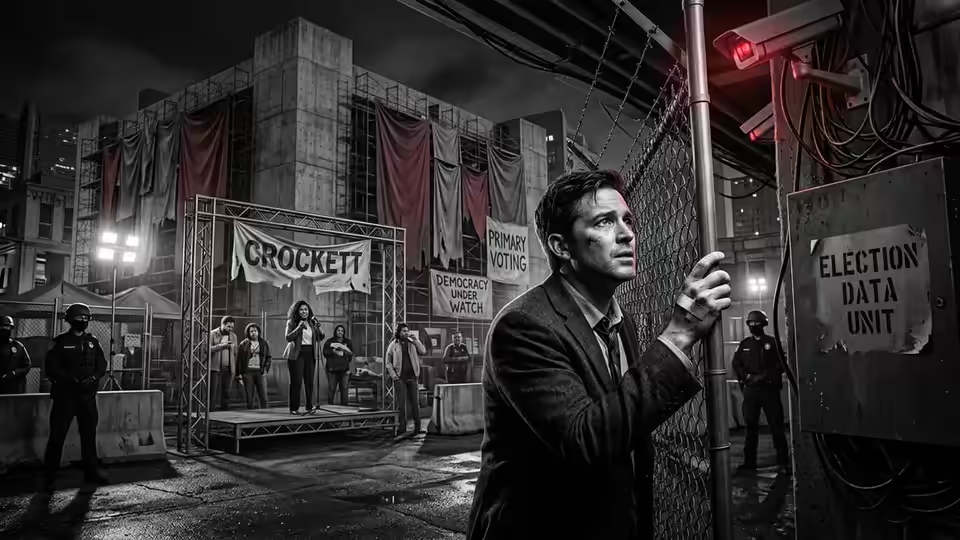
The Manhattan District Attorney’s office just walked away from its case against Alexa Wilkinson, a Hudson Valley-based photojournalist who was staring down years in prison for a felony hate crime. The whole thing started back in July when the New York Times building was spray-painted with "NYT LIES; GAZA D." Wilkinson wasn't the one holding the spray paint, but prosecutors went after them anyway, citing their presence at the scene and some vague "communications." Now that the case is dismissed and sealed, it's clear that months of digging didn't give prosecutors what they needed to prove that filming a crime is the same thing as committing a hate crime.
Using hate crime statutes here was a massive stretch. Usually, a hate crime requires proof that a victim was picked because of a protected characteristic. By charging Wilkinson with a felony for documenting vandalism against a corporate entity like the New York Times, Bragg’s office tried to turn those protections into a weapon against a reporter. It worked, at least for a while. This legal tactic gave the NYPD the green light to kick in Wilkinson's door, ransack their home, and walk off with thousands of dollars in professional gear—cameras and tools that sat in a police locker for months, effectively killing Wilkinson’s career.
“The dismissal confirms that after months of investigation, prosecutors could not prove that documenting a crime constitutes a hate crime.”
There’s a pretty glaring gap between the Alvin Bragg who ran for office and the one who actually runs it. Bragg campaigned on a platform of holding the powerful accountable and ending over-prosecution, yet his team spent significant resources chasing an independent reporter for documenting a protest against a major media institution. And then there’s the New York Times. The paper often talks a big game about global press freedom, but it served as the complainant in this case. Its own security footage was the primary evidence used to justify the initial raid on Wilkinson's home.
We still don't know what those "communications" were that supposedly triggered the hate crime label. Because of New York’s CPL 160.50, records for dismissed cases are now sealed. That protects the defendant's privacy, sure, but it also gives the DA’s office a shield. It prevents the public from seeing exactly how they justified such an aggressive prosecution in the first place. We don't know if the DA actually had evidence that later fell apart, or if the charges were just a "placeholder" used to justify seizing Wilkinson's digital devices for intelligence gathering.
For any independent journalist covering protests in New York, the message is loud and clear. Even if the charges don't stick, the process is the punishment. You get your home raided, your tools taken, and a felony hanging over your head for half a year. As the 2024 election cycle heats up, the use of "hate crime" labels to bypass First Amendment protections is becoming a potent tool for prosecutors looking to suppress coverage of demonstrations they don't like.
Summary
Manhattan District Attorney Alvin Bragg has finally dropped the charges against photojournalist Alexa Wilkinson, ending a messy six-month felony prosecution that had First Amendment advocates up in arms. Wilkinson was targeted after filming a July 2024 protest where the New York Times building was vandalized. While the DA originally framed this as a targeted attack, the core of the case was a failed attempt to stick hate crime enhancements on a journalist who didn't actually participate in the property damage. Gen Us highlights the missing context regarding New York’s sealing laws and the specific legal theories the DA used to justify a home raid and property seizure against a member of the press.
⚡ Key Facts
- Photojournalist Alexa Wilkinson was arrested and charged with a felony hate crime following a protest at the New York Times building.
- A judge dismissed the charges against Alexa Wilkinson on the motion of Manhattan District Attorney Alvin Bragg's office.
Manhattan DA Dismisses Felony Hate Crime Charges Against Journalist Documenting Gaza Protest
Network of Influence
- Pro-Palestinian activist groups
- The Democratic Socialists of America (DSA) and related political factions
- Critics of District Attorney Alvin Bragg and the New York Times
- Independent or alternative media outlets positioning themselves against 'mainstream' media
- The specific content of the 'communication' that led to the hate crime charge is not fully detailed, only alluded to.
- The legal threshold for a hate crime in New York state often involves targeting specific groups, which the DA's office initially alleged but later failed to prove to their own satisfaction.
- The article does not mention that cases are legally 'sealed' as a standard privacy protection for individuals whose charges are dismissed, rather than as an act of secrecy by the DA.
The article frames the arrest of a journalist during a protest as a systemic, politically motivated assault on press freedom by a 'blue city' establishment, drawing a direct parallel to the tactics of Donald Trump to highlight perceived hypocrisy.
See how the story connects.
Select any actor or numbered connection, then inspect the evidence before drawing a conclusion.
Jacobin Foundation Parent company Jacobin
Follow the public record
Source Trail
Independent reporting and analysis
Get the next investigation in your inbox
One email a week. Receipts only. Free.
Free. Unsubscribe anytime. We never share your email.