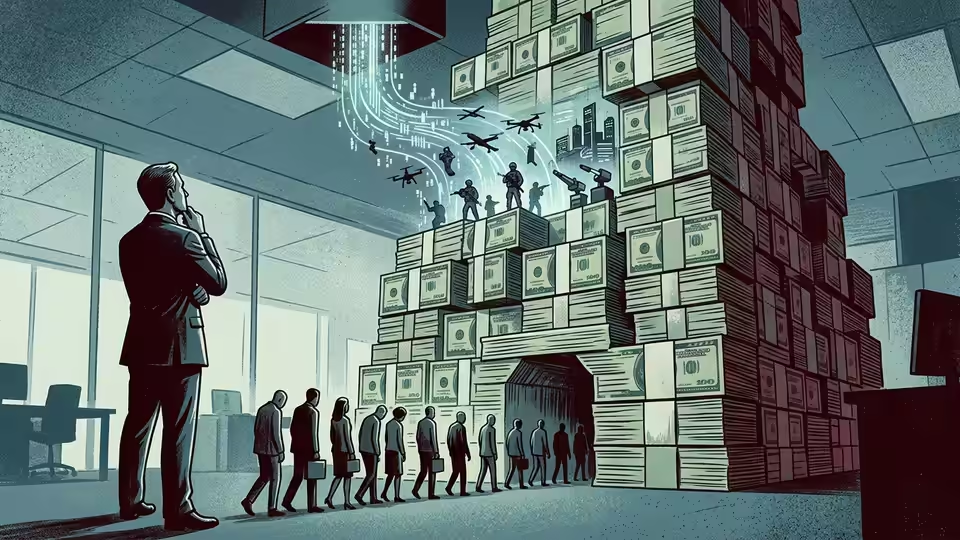
Lockheed’s 'Monopoly Premium': How Proprietary Software Locked Out Taxpayer Savings
The Air Force bypassed competition for a $1.9B contract by citing Lockheed's proprietary software, effectively forcing taxpayers to pay a 'monopoly premium' for the C-130J fleet.
The Air Force used a legal loophole regarding 'proprietary data' to hand Lockheed Martin a $1.9 billion, 10-year maintenance monopoly, effectively banning competition and ensuring taxpayers pay a premium.
On April 14, 2026, the Air Force Life Cycle Management Center (AFLCMC) finalized contract FA8625-26-D-0001, a $1.9 billion commitment to Lockheed Martin for the maintenance of the C-130J Maintenance and Training Systems (MATS) IV. While the sheer scale of the contract is significant, the mechanism of its award reveals a systemic failure in military procurement. The contract was awarded as a 'sole-source' agreement, bypassing the federal requirements for competitive bidding designed to ensure the best value for public funds. By utilizing a specific legal exception, the Pentagon has essentially granted Lockheed Martin a 10-year monopoly over a program that other aerospace firms are technically capable of servicing but are legally barred from touching.
The Department of the Air Force justified this lack of competition through a document known as a JOFOC. [JOFOC] is a Justification for Other Than Full and Open Competition, a formal document required by the Competition in Contracting Act (CICA) whenever a government agency chooses not to seek competitive bids. In JOFOC #FA8625-26-D-0001, the Air Force admits that Lockheed Martin is the 'only one responsible source' because the corporation maintains exclusive ownership of the technical data and software source code required to operate the training systems. This is a classic example of what industry analysts call 'vendor lock-in.' [Vendor Lock-In] is a situation where a customer is dependent on a single vendor for products and services because they cannot switch to another vendor without substantial costs or legal barriers.
Following the money trail reveals that this 'proprietary data' loophole is not an accidental oversight, but a core component of Lockheed Martin's financial strategy. According to Lockheed Martin's Q1 2026 SEC 10-Q filings, the company explicitly categorizes its proprietary technical assets as a 'primary driver' for long-term service revenue growth. By retaining the intellectual property (IP) rights to the software that runs the C-130J, Lockheed ensures that even if a competitor could perform the physical maintenance for 30% less, they cannot legally access the digital tools required to do the job. The government, having failed to secure these data rights during the initial multi-billion dollar acquisition of the aircraft, is now a captured customer.
The financial implications for the American public are stark. Without downward price pressure from competing firms, Lockheed is free to set rates that include 'monopoly rents.' [Monopoly Rents] are the extra profits a company earns because it has no competition, allowing it to charge prices far above what a competitive market would allow. While the exact percentage of this 'monopoly premium' is redacted in the public version of the JOFOC, historical audits by the Government Accountability Office (GAO) suggest that competitive contracts typically yield 15% to 25% savings compared to sole-source awards. On a $1.9 billion contract, that represents between $285 million and $475 million in potential waste—money that could have been allocated to veterans' healthcare or crumbling civil infrastructure.
This procurement pattern is sustained by a well-funded influence machine in Washington. Data from OpenSecrets and FEC filings show that Lockheed Martin's Political Action Committee (PAC) and employees contributed over $4.2 million to members of the House and Senate Armed Services Committees during the 2024-2025 election cycle. These committees are responsible for overseeing the very transparency regulations that the 'proprietary data' loophole sidesteps. For example, Representative Ken Calvert (R-CA), Chairman of the House Defense Appropriations Subcommittee, has consistently received top-tier funding from Lockheed Martin, according to TrackAIPAC and OpenSecrets records. When procurement laws are written or amended, the definition of 'proprietary data' remains broad enough to allow these billion-dollar handoffs to continue unchecked.
The human impact of these deals is often buried under jargon. To the average citizen, this isn't just a contract; it is a transfer of public wealth. When the Pentagon pays $1.9 billion for a service that could cost $1.5 billion, the $400 million difference is a 'tax' paid by the public to bolster Lockheed Martin’s shareholder dividends. The AFLCMC's signature on FA8625-26-D-0001 effectively signs away the government's right to shop for a better deal for the next decade. Small and mid-sized aerospace firms—the supposed engine of American innovation—are left on the sidelines, unable to compete because they don't own the 'keys' to the software.
Mainstream coverage of the C-130J program often focuses on the aircraft's impressive tactical capabilities or its role in humanitarian missions. What these reports leave out is the administrative architecture of the 'permanently captive' fleet. By allowing defense contractors to retain the rights to manuals and code paid for with public money, the Department of Defense has created a system where the hardware is owned by the public, but the right to fix it is owned by a private corporation. This is not just a maintenance contract; it is a ten-year annuity for Lockheed Martin, funded by the American taxpayer.
At Gen Us, we believe in radical transparency regarding where your money goes. You can use our Gen Us Politician Tracker to see if your local representative sits on the committees that approved this procurement strategy and how much they have received from Lockheed Martin's lobbyists. You can also explore our 'Proprietary Loophole' database to see other sole-source contracts currently draining the federal budget. Information is the only tool for accountability. If the government won't shop around for a better deal, it’s up to the public to demand they do.
Summary
The Department of the Air Force awarded a 10-year, non-competitive maintenance contract to Lockheed Martin by citing proprietary ownership of software data. This move effectively blocks third-party aerospace firms from bidding, leaving taxpayers to pay a 'monopoly premium' on the C-130J fleet.
⚡ Key Facts
- Lockheed Martin was awarded a $1.9 billion sole-source contract (FA8625-26-D-0001) on April 14, 2026, for C-130J maintenance.
- The contract uses the 'Only One Responsible Source' exception because Lockheed holds proprietary rights to the software and technical data.
- The agreement locks taxpayers into a 10-year commitment without any competitive bidding or price transparency.
- SEC filings from Q1 2026 show Lockheed views these proprietary data rights as a primary driver for their service revenue growth.
- Lockheed Martin's PAC and employees contributed over $4.2 million to key defense committee members in the most recent cycle.
Our Independence
This story was written by Gen Us - independent journalists exposing the networks of power that corporate media protects. No hedge fund owns us. No billionaire edits our headlines. We answer only to you, our readers.
Follow the public record
Source Trail
Get the next investigation in your inbox
One email a week. Receipts only. Free.
Free. Unsubscribe anytime. We never share your email.