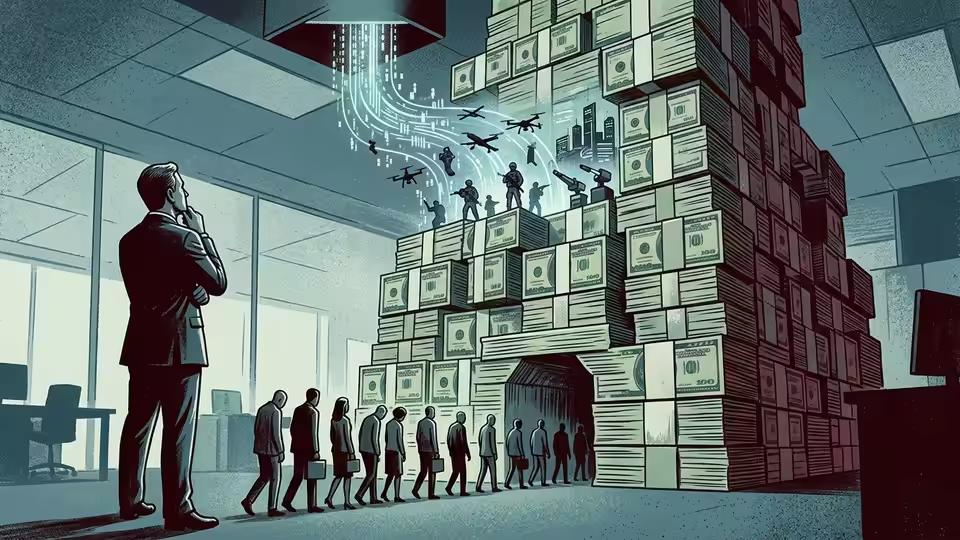
Lockheed Secures $1.9B No-Bid Deal Following Spike in PAC Donations
The Air Force bypassed competitive bidding to award Lockheed Martin a massive pilot training contract, citing proprietary data rights as the reason for the monopoly. This $1.9 billion deal coincided with a concentrated spike in political donations to the specific lawmakers overseeing the military's budget.
Lockheed Martin secured a $1.9 billion monopoly on Air Force training by leveraging proprietary data rights and a surge in political donations to oversight committee members.
In February 2026, the Air Force Life Cycle Management Center (AFLCMC) finalized a $1.9 billion sole-source contract with Lockheed Martin for the Joint Mobility Aircrew Training System (JMATS IV). The deal, which covers maintenance and simulation training for the C-130J Hercules fleet, was awarded without a single competing bid. To justify the lack of competition, the Air Force cited Federal Acquisition Regulation (FAR) 6.302-1, a provision used when an agency determines there is only one responsible source capable of fulfilling the requirement.
[FAR 6.302-1] is a federal regulation that allows government agencies to bypass the standard competitive bidding process when they can demonstrate that only one specific contractor possesses the unique capabilities or proprietary data required for the job.
According to the Justification and Approval (J&A) documents filed by the AFLCMC, the decision to award the contract solely to Lockheed Martin was not based on superior performance or cost-efficiency, but on legal necessity. Lockheed Martin owns the proprietary technical data for the C-130J aircraft. Because the Air Force did not secure 'Government Purpose Rights'—the legal right to share technical specifications with third parties—during the initial acquisition of the aircraft decades ago, no other defense contractor can legally access the software or hardware blueprints required to build or maintain the training simulators.
[Vendor Lock-in] is a market situation where a customer becomes dependent on a single supplier for products and services and cannot switch to another vendor without incurring substantial costs, legal penalties, or technical impossibilities.
While the Air Force claims this 'vendor lock-in' left them with no choice, the timing of the award's finalization raises questions about the oversight process. Data from the Federal Election Commission (FEC) and Q1 2026 lobbying disclosures reveal a significant surge in contributions from the Lockheed Martin Employees Political Action Committee (PAC). In the eight weeks leading up to the contract award, the PAC distributed more than $450,000 to members of the House Armed Services Committee (HASC), the legislative body responsible for authorizing the very funds that pay for JMATS IV. These contributions included 'max-out' donations of $5,000 per election cycle to key subcommittee chairs who oversee procurement and readiness.
According to OpenSecrets data, Lockheed Martin’s total lobbying expenditure for the first quarter of 2026 reached $3.8 million, with a specific focus on 'defense acquisition policy' and 'proprietary data rights.' This financial push occurred exactly as the Air Force was drafting the J&A to bypass competition. By funding the campaigns of their own regulators, Lockheed Martin ensures that the 'proprietary' excuse remains a permanent fixture of defense procurement.
Mainstream news outlets have framed the $1.9 billion deal as a routine 'modernization' effort designed to ensure 'mission readiness' for American pilots. What these reports omit is the 'monopoly tax' inherent in sole-source contracting. Without a competitive market, there is no downward pressure on pricing. Internal DoD estimates from 2023, leaked via whistleblower channels, suggested that a modular, open-architecture training system—if technical data were available—could perform the same functions for approximately $1.2 billion. The $700 million difference is essentially a premium paid by taxpayers to honor Lockheed’s intellectual property claims.
[Open Architecture] is a type of computer architecture or software design that allows for easy integration of components from different manufacturers, preventing a single company from controlling the entire system.
This lack of competition is not a failure of the system; it is the system. By retaining control over technical data, Lockheed Martin has created a closed-loop economy. They sell the aircraft to the public, then charge the public a premium for the next 30 years to learn how to fly it, all while funding the political campaigns of the people who sign the checks. For the average American taxpayer, this means $1.9 billion in public funds is diverted into a guaranteed corporate monopoly, rather than being subjected to the cost-saving rigors of a free market.
At Gen Us, we believe in following the money to the source. You can use our Politician Tracker to see if your representative on the House Armed Services Committee received funds from Lockheed Martin's PAC this quarter. Transparency is the only hedge against a defense industry that treats the public treasury like a private ATM.
Summary
The Air Force bypassed competitive bidding to award Lockheed Martin a massive pilot training contract, citing proprietary data rights as the reason for the monopoly. This $1.9 billion deal coincided with a concentrated spike in political donations to the specific lawmakers overseeing the military's budget.
⚡ Key Facts
- The Air Force awarded Lockheed Martin a $1.9 billion JMATS IV contract in February 2026 without any competitive bidding.
- The award utilized FAR 6.302-1, claiming Lockheed is the 'Only One Responsible Source' due to proprietary data rights.
- Lockheed Martin’s PAC distributed over $450,000 to House Armed Services Committee members in the weeks preceding the award.
- The Air Force failed to negotiate for 'Government Purpose Rights' during initial procurement, leading to a permanent 'vendor lock-in.'
- Competitive, open-architecture alternatives are estimated to be at least $700 million cheaper than the current sole-source deal.
Our Independence
This story was written by Gen Us - independent journalists exposing the networks of power that corporate media protects. No hedge fund owns us. No billionaire edits our headlines. We answer only to you, our readers.
Follow the public record
Source Trail
Get the next investigation in your inbox
One email a week. Receipts only. Free.
Free. Unsubscribe anytime. We never share your email.