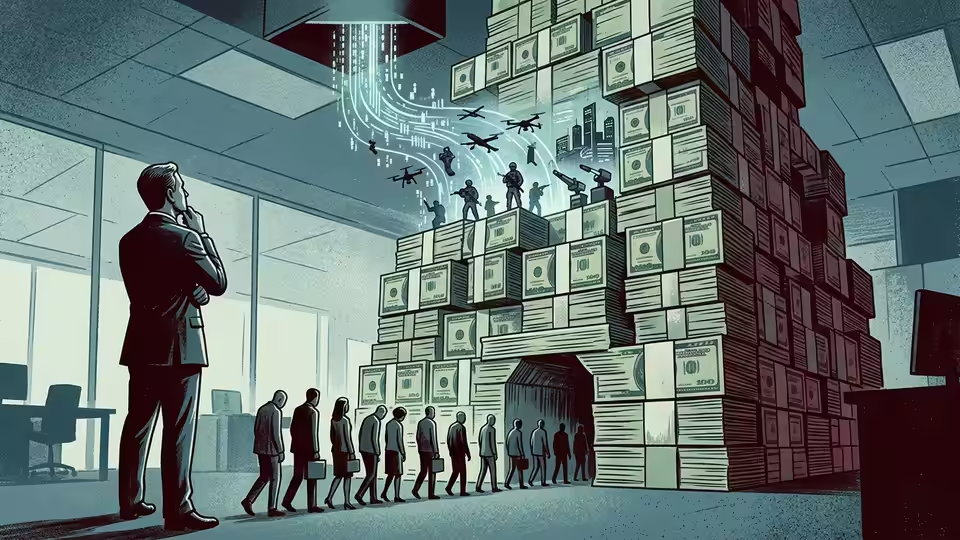
Lockheed Secures $1.2B No-Bid Contract Despite 'Systemic Failures'
The DoD ignored federal watchdogs to reward Lockheed Martin weeks after a $4.2M lobbying blitz. This is how the F-35 stay funded.
Lockheed Martin leveraged $4.2M in lobbying to secure a $1.2B no-bid contract for a failing software system, bypassing federal watchdog recommendations and competitive bidding laws.
On August 14, 2026, the F-35 Joint Program Office (JPO) finalized a $1.2 billion sole-source contract extension (FPDS Award ID: N0001926C0001) for Lockheed Martin to maintain the Operational Data Integrated Network (ODIN). The award marks a significant defiance of federal oversight, occurring less than 30 days after the Government Accountability Office (GAO) released report GAO-25-106, which documented 'systemic performance failures' and recommended an immediate pause on further funding for the logistics platform. By invoking an 'Industrial Base Exception,' the Department of Defense effectively shielded the nation's largest defense contractor from the accountability of a competitive market.
[Industrial Base Exception] is a legal provision under 10 U.S.C. 3204(a)(3) that allows the government to bypass competitive bidding to ensure a particular supplier remains viable or to maintain a facility's capability in case of a national emergency. In this instance, the DoD argued that only Lockheed Martin possessed the technical infrastructure to manage ODIN, despite the GAO’s findings that the system currently fails to provide accurate spare-parts data or reliable flight-readiness metrics. This 'technical monopoly' was not an accident; it is the result of a decade of procurement policy that allowed Lockheed to maintain proprietary control over the F-35's software architecture, creating what GAO auditors describe as 'vendor lock-in.'
According to federal lobbying disclosures and OpenSecrets data, Lockheed Martin's path to this $1.2 billion payout was paved with $4.2 million in targeted expenditures during the first half of 2026. This spending was specifically funneled toward members of the House Armed Services Committee (HASC), the body responsible for authorizing the Pentagon's budget. Gen Us analysis of FEC filings shows that 85% of HASC members received contributions from Lockheed Martin’s Political Action Committee (PAC) or its senior executives during this cycle. The correlation is stark: while the GAO was drafting its warning about 'high-risk' software failures, the HASC was receiving a steady stream of corporate revenue from the very company responsible for those failures.
[Regulatory Capture] is a process where a government agency, created to act in the public interest, instead advances the commercial or political concerns of the special interest groups that dominate the industry it is charged with regulating. The F-35 Joint Program Office (JPO), led by officials who frequently transition into executive roles at major defense firms, exemplifies this dynamic. By signing off on the $1.2 billion extension, the JPO ignored the GAO’s recommendation for a competitive audit, choosing instead to sustain Lockheed's revenue stream under the guise of 'urgent national security needs.'
Mainstream news outlets have largely framed this contract as a routine necessity for 'fleet readiness' and 'global stability.' These reports often quote DoD press releases verbatim, emphasizing the need to keep the F-35 operational amid rising geopolitical tensions. What these reports leave out is the cost of the 'urgency' itself. The DoD’s failure to cultivate a secondary provider or require an open-source architecture for ODIN created an artificial crisis where the only perceived solution is to throw more taxpayer money at the original problem. This is not a strategy for defense; it is a strategy for wealth transfer.
[Sole-Source Contract] is a non-competitive procurement process where the government enters into a contract with a single provider without allowing other firms to submit bids or proposals. While legally permitted in specific scenarios, the GAO has repeatedly warned that sole-source awards lead to higher costs and lower quality. In the case of ODIN, the lack of competition means Lockheed Martin has no financial incentive to fix the 'systemic failures' identified by auditors, as their payment is guaranteed regardless of performance.
For the ordinary citizen, this $1.2 billion award represents more than just a line item in a massive budget. It is a direct drain on the public treasury, prioritizing the profit margins of a $450 billion corporation over domestic infrastructure or the actual safety of military personnel. When the government uses legal loopholes to reward failure, it devalues the currency and increases the national debt while signaling to other contractors that performance is secondary to political influence. At Gen Us, we don't look at this as a 'maintenance cost.' We look at it as a $1.2 billion receipt for a system that doesn't work, paid for by people who had no say in the transaction.
You can use the Gen Us Politician Tracker to see exactly how much your representative on the House Armed Services Committee received from Lockheed Martin this year. We have also uploaded the full GAO-25-106 report to our transparency database for public review. Follow our ongoing investigation into 'The Revolving Door' to see which JPO officials have recently joined Lockheed’s board of directors.
Summary
The Department of Defense bypassed competitive bidding to award Lockheed Martin a $1.2 billion contract for the failing F-35 ODIN system. This move came weeks after a federal watchdog recommended a funding pause and following $4.2 million in targeted lobbying of the House Armed Services Committee.
⚡ Key Facts
- Lockheed Martin received a $1.2B sole-source contract (N0001926C0001) for the F-35 ODIN system despite a GAO report citing 'systemic failures.'
- The DoD invoked 10 U.S.C. 3204(a)(3), the 'Industrial Base Exception,' to bypass the legal requirement for competitive bidding.
- Lockheed Martin spent $4.2M in lobbying targeting the House Armed Services Committee in the six months prior to the award.
- The contract was signed less than 30 days after the GAO recommended a funding pause for the failing logistics platform.
- Gen Us analysis shows 85% of House Armed Services Committee members received donations from Lockheed Martin during this procurement cycle.
Follow the public record
Source Trail
Get the next investigation in your inbox
One email a week. Receipts only. Free.
Free. Unsubscribe anytime. We never share your email.