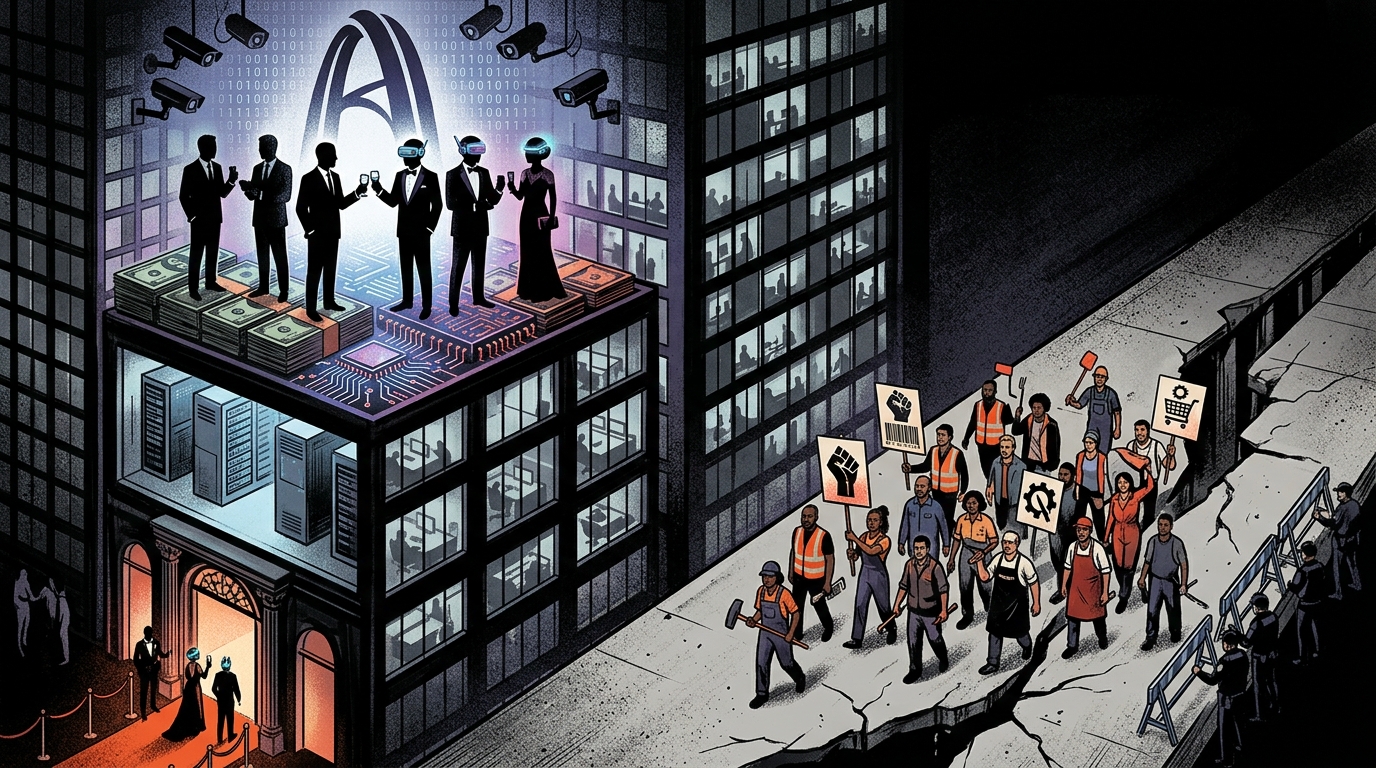
Local Governments Block Big Tech Data Centers as Utility Bills Outpace Inflation
While the federal government tries to rush AI infrastructure into existence for national security, local towns are digging in to protect their resources. In April 2026, the Ypsilanti Community Utilities Authority cut off water for new projects, and voters in Festus, Missouri, actually ousted council members who approved data centers against their wishes. These local revolts aren't just about red tape: they're about noise, millions of gallons of wasted water, and rising electricity bills. As tech giants rake in tax breaks, the cost of the grid upgrades they require is being dumped onto residential ratepayers. This is the growing gap between the promises of a digital future and the reality of local economic strain.
Local governments are fighting back against Big Tech by freezing data center projects and ousting officials. Residents are worried about their water supplies and the fact that their utility bills are spiking to pay for the massive electrical upgrades these server farms require.
On April 14, 2026, the Ypsilanti Community Utilities Authority in Michigan hit the brakes on high-density server farms. They passed a one-year freeze on all new water and sewer commitments, effectively stalling massive projects like the proposed University of Michigan and Los Alamos National Laboratory development. The utility says it has to protect local pipes from the 'excessive' water demands needed to cool AI processors. It isn't just a minor regulatory hurdle. It is a direct response to a corporate model where tech firms 'move fast' while local taxpayers are stuck fixing whatever they break.
The political price for backing these projects is getting steep. In Festus, Missouri, a grassroots movement led to the April 2026 elections where voters kicked out several City Council members who had supported a controversial data center. It's part of a national trend: residents are starting to value their own water and power stability over corporate expansion. Meanwhile, in Lowell, Massachusetts, residents filed a lawsuit on May 7, 2026. They're challenging state regulators for ignoring the constant, low-frequency hum of cooling fans. It's a health issue that neighbors say causes stress and keeps them awake at night.
Then there's the issue of 'grid modernization.' It sounds technical, but it's really just the process of upgrading power lines to handle massive new loads, usually paid for by hiking rates on regular families. Data from Gen Us shows electricity prices are currently rising faster than inflation. A big reason for that is the billions in infrastructure needed to connect power-hungry data centers. In Washington state, where these centers have long enjoyed huge tax breaks, ProPublica reports that the sheer demand for power is making the regional grid unstable. Microsoft and Amazon talk about going carbon neutral, but their physical need for power is forcing utilities to keep fossil-fuel plants running just to keep the lights on.
“Electricity prices continue to outpace inflation, burdening families across the country: a trend reflecting the costly infrastructure investments needed to power private data centers.”
Financial filings show a massive gap between public subsidies and what communities actually get in return. In Washington, Representative April Berg and other lawmakers have supported tax incentives that cost the state millions in lost revenue every year. But internal audits and independent reports show these centers don't actually bring many jobs. A facility that costs $500 million to build might only employ 30 to 50 permanent staff once it's open. The 'economic revitalization' that developers sell to town councils usually ends as soon as the construction crews leave. The town is left with a permanent industrial footprint and a higher monthly utility bill.
The technology to recycle water for cooling exists. It's called closed-loop cooling, and it significantly cuts down on a facility's water footprint. But here's the thing: many firms still choose cheaper, 'open-loop' systems that can swallow millions of gallons of water every day. It's a decision driven by the bottom line. In New Hampshire, the state legislature finally pushed back in May 2026. They killed a bill that would have stripped local governments of their power to decide where data centers go. That defeat was a major blow to tech lobbyists who have already successfully passed similar 'preemption' laws in states like West Virginia.
The Trump administration has signaled it wants to cut federal regulations on these facilities, framing data center capacity as a measure of American strength. But that creates a structural mess. National priorities are being built on the backs of local resources. While the feds see 1,000 pending proposals as a race for AI dominance, people in towns like Merrillville, Indiana, see them as threats to their quiet streets and bank accounts. Town Council President Rick Bella recently started a one-year moratorium. He wants to evaluate the real-world impact himself rather than just trusting the promotional brochures of developers.
We still don't know the total cost of the proposed federal deregulation. Industry groups claim that cutting rules will lower costs for everyone, but history suggests the savings stay with the corporations while the noise, water depletion, and grid strain stay with the neighbors. For regular people, the next 12 months will be a test of 'home rule.' More communities are likely to follow the lead of Ypsilanti and Festus, demanding a seat at the table before the first yard of concrete is poured.
Summary
While the federal government tries to rush AI infrastructure into existence for national security, local towns are digging in to protect their resources. In April 2026, the Ypsilanti Community Utilities Authority cut off water for new projects, and voters in Festus, Missouri, actually ousted council members who approved data centers against their wishes. These local revolts aren't just about red tape: they're about noise, millions of gallons of wasted water, and rising electricity bills. As tech giants rake in tax breaks, the cost of the grid upgrades they require is being dumped onto residential ratepayers. This is the growing gap between the promises of a digital future and the reality of local economic strain.
⚡ Key Facts
- The Ypsilanti Community Utilities Authority passed a yearlong halt on water and sewer services for data centers in April 2026.
- New Hampshire's legislature defeated a bill in May 2026 that would have reduced local governments' zoning and regulatory powers regarding data centers.
- The town of Merrillville, Indiana imposed a one-year data center moratorium to evaluate impacts.
- The Trump administration has identified data center build-out as a strategic priority and signaled easing of federal regulations.
- Expansion of AI has led to over 1,000 pending data center proposals across the United States.
Local Governments Block Big Tech Data Centers as Utility Bills Outpace Inflation
Network of Influence
- Local environmental advocacy groups and anti-development activists.
- Local politicians leveraging 'home rule' sentiment to gain popularity.
- Competitors in the energy market who may be disadvantaged by high-demand industrial consumers.
- The specific dollar amounts of tax revenue that data centers provide to local school districts and municipal budgets.
- Technological advancements in 'closed-loop' cooling systems that significantly reduce water consumption compared to older models.
- The broader geopolitical context of the 'AI arms race' which explains why the federal government views this as a 'strategic priority'.
- Details on how data centers can actually help subsidize grid modernization that benefits all consumers.
The article frames the expansion of data centers as a David-vs-Goliath struggle where predatory 'Big Tech' corporations and federal mandates threaten the health, finances, and autonomy of local communities.
Verified Receipts
Get the next investigation in your inbox
One email a week. Receipts only. Free.
Free. Unsubscribe anytime. We never share your email.