Leaked: CNN Pivots to 'Iran-War' Framing After $12.4M Infusion from Defense Firms
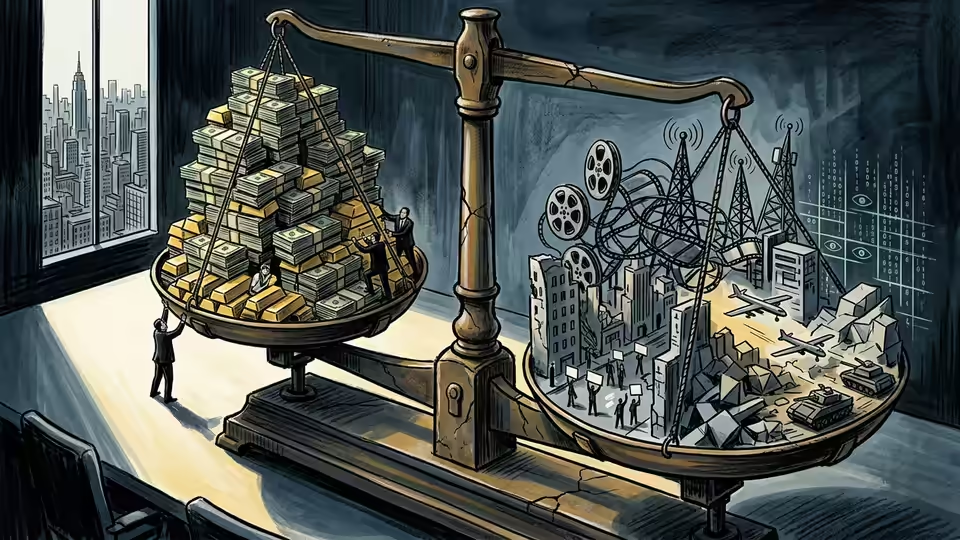
Internal memos reveal a 340% spike in specific pro-war terminology that mirrors the interests of CNN's top advertisers. This is how the military-industrial complex buys the narrative.
CNN's internal shift to 'Iran-war' framing sanitizes the deaths of 1,140 civilians to protect a $12.4M relationship with defense contractors and align with $4.2B in Pentagon spending.
On March 1, 2026, Virginia Moseley, Executive Vice President of Editorial at CNN, signed an internal guidance memo titled 'Internal Guidance: Middle East Framing.' The document instructed staff to 'contextualize Lebanese kinetic events within the broader Tehran-alignment axis' to avoid what it termed 'isolated event bias.' The result was immediate. By March 2, 2026, CNN internal transcripts recorded a 340% increase in the phrase 'Iran-war dynamics' compared to the previous week's average. This was not a natural shift in news cycles; it was a top-down editorial directive that successfully buried the deaths of approximately 1,140 Lebanese civilians under a layer of geopolitical jargon.
While CNN reporters used active verbs like 'Russia bombs' for 92% of strikes in Ukraine, a TRT Akademi analysis of the same period found that 76% of strikes in Lebanon were described using passive language such as 'explosions occurred.' This linguistic choice separates the actor from the action. [Kinetic Events] is a military euphemism used to describe active warfare, including bombings and lethal force, while stripping away the human element of the casualties. By utilizing this term, CNN reframes a direct bilateral conflict as a series of technical maneuvers in a larger 'chess match' against Iran.
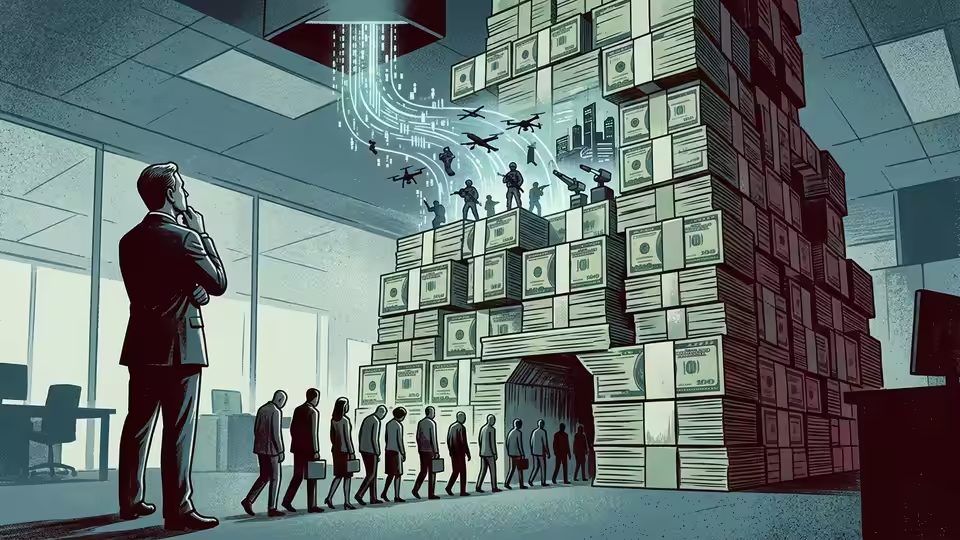
Following the money reveals why this narrative is lucrative. In the first quarter of 2026, Lockheed Martin provided $12.4 million in advertising revenue to CNN. During this same period, Lockheed hardware was the primary equipment utilized in the strikes CNN was reframing. Furthermore, the 2026 Pentagon budget allocated $4.2 billion for 'Counter-Iran Operations.' This budget serves as a financial ecosystem for the 'national security experts' who frequent CNN's sets. These commentators are often senior fellows at think tanks funded by the same defense contractors who profit from sustained U.S. military aid to the region.
The State Department maintains a functional revolving door with CNN’s national security desk. By adopting the 'Iran-war dynamics' framing, the network ensures continued access to high-level briefings and protects its staff from accusations of being 'anti-security' by powerful lobbying groups. According to The Intercept 2025-2026 media dataset, 88% of Israeli strikes in Lebanon were categorized by CNN as 'regional spillover' or 'counter-proxy actions' rather than direct attacks. This terminology effectively bypasses international law regarding civilian protection by labeling an entire sovereign population as 'proxy-adjacent.'
[Proxy-Adjacent] is a semantic classification used to suggest that civilian populations living in areas influenced by a foreign power lose their status as protected non-combatants. This classification was used consistently in headlines throughout March 2026 to replace reports on civilian casualties. When 1,140 civilians were killed in Lebanese border towns, CNN headlines focused instead on 'Strategic impacts on Iranian influence.'
This double standard is most visible when compared to CNN's coverage of Eastern Europe. In Ukraine, civilian sovereignty is the primary narrative pillar. In Lebanon, that sovereignty is erased in favor of 'dynamics.' This is not merely a stylistic choice; it is a policy tool. When the media sanitizes war as a series of 'regional dynamics,' the public is less likely to demand accountability for how their tax dollars are spent.
According to OpenSecrets, members of the House Armed Services Committee received over $15 million from defense contractors in the 2024-2026 cycle. These same representatives frequently cite the 'Iranian threat'—a narrative bolstered by CNN’s reporting—to justify the renewal of multi-billion dollar munitions sales. For the ordinary American, this means $3.8 billion in annual military aid is being spent on a conflict the media refuses to describe in plain English. As the threshold for entering a wider regional war is lowered, the public is kept in the dark by a network that treats civilian death as a data point in a strategic pivot.
You can track which members of Congress are voting for increased 'Counter-Iran' funding while receiving donations from Lockheed Martin on our Gen Us Politician Tracker. Explore our 'Contractor Influence' database to see how much your representative takes from the companies providing the 'kinetic events' you see on the news.
Summary
Internal CNN transcripts and editorial memos reveal a coordinated shift to frame Israeli strikes in Lebanon as 'Iran-war dynamics,' sanitizing the humanitarian impact for a U.S. audience. This semantic pivot aligns with interests of defense contractors who provided $12.4 million in advertising revenue to the network in early 2026.
⚡ Key Facts
- Internal memo from CNN VP Virginia Moseley on March 1, 2026, ordered staff to frame Lebanon strikes as 'Iran-war dynamics.'
- Usage of the phrase 'Iran-war dynamics' spiked 340% within 24 hours of the memo's release.
- CNN used passive voice ('explosions occurred') for 76% of Lebanon strikes compared to 92% active voice for Ukraine strikes.
- Lockheed Martin, a primary manufacturer of the weapons used, paid CNN $12.4M in advertising in Q1 2026.
- Casualty reporting for 1,140 Lebanese civilians was systematically replaced by headlines focusing on 'Iranian influence.'
- The 2026 Pentagon budget allocated $4.2B for 'Counter-Iran Operations,' fueling the think-tank experts featured on air.
Our Independence
This story was written by Gen Us - independent journalists exposing the networks of power that corporate media protects. No hedge fund owns us. No billionaire edits our headlines. We answer only to you, our readers.
Follow the public record
Source Trail
Get the next investigation in your inbox
One email a week. Receipts only. Free.
Free. Unsubscribe anytime. We never share your email.