Leaked BBC Memo Reveals Double Standards for War Casualty Reporting
An internal BBC directive mandates higher proof for Middle Eastern deaths than Ukrainian ones. The policy aligns with £283 million in UK government funding.
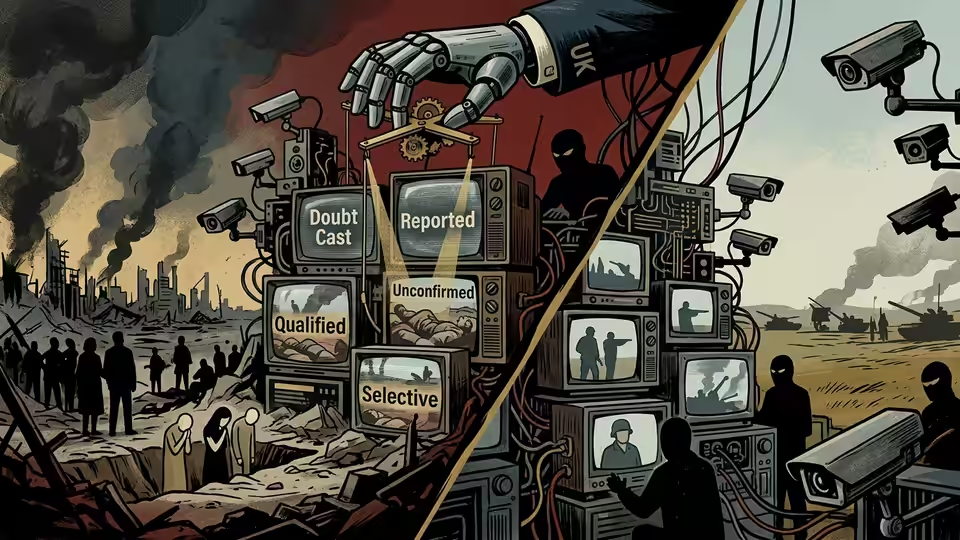
The BBC uses specific linguistic qualifiers to cast doubt on casualties in the Middle East while reporting Ukrainian deaths as absolute facts, a policy that aligns with the foreign policy goals of its UK government funders.
An internal May 2025 memo from the BBC Standards Board has pulled back the curtain on a linguistic hierarchy at the world’s largest public broadcaster. The document, circulated to senior editors, explicitly directs staff to prioritize 'official verification' for casualties in the Middle East while allowing 'first-hand witness accounts' to stand as established fact in reports on Ukraine. This directive codifies a system of asymmetric skepticism that changes the way audiences perceive human suffering based on geopolitical alliances.
Under the leadership of CEO Deborah Turness, BBC News has maintained a public stance of rigid impartiality. However, a February 2026 headline regarding an Iranian strike read: '153 dead after reported strike, Iran says.' In the same week, a report on a strike in Kharkiv was titled: 'Russian strike kills 12 civilians.' In the former, the death toll is framed as a government claim; in the latter, the causality and the culprit are presented as objective reality. This is not a coincidence; it is a policy.
[Attribution Qualifiers] are words or phrases used to attribute a statement to a source rather than presenting it as a fact, often serving to distance the reporter from the validity of the claim.
According to an internal audit by The Guardian conducted in June 2025, BBC reporting utilized these qualifiers 42% more frequently in coverage of Middle Eastern conflicts compared to Eastern European coverage. The audit tracked the usage of 'reportedly,' 'allegedly,' and 'claims' over a six-month period. The findings suggest that the BBC is systematically casting doubt on humanitarian data in regions where the UK government has sensitive diplomatic or military interests.
The money trail explains the editorial caution. While the BBC is largely funded by a £3.7 billion annual license fee, the BBC World Service relies on a specific [Grant-in-Aid], which is a direct financial contribution from the central government to an organization to support specific activities.
In the current fiscal year, the UK Foreign, Commonwealth & Development Office (FCDO) provided £283 million to the World Service. This funding is overseen by Foreign Secretary David Lammy. The FCDO has a vested interest in maintaining regional stability and supporting its military allies. Because the BBC Royal Charter—the instrument that allows the broadcaster to exist—is subject to renewal by the UK Government, the broadcaster faces an existential pressure to align its narrative with FCDO 'adversary' and 'ally' designations.
This creates what media critics call 'linguistic dehumanization.' When a headline uses 'reported' or 'says' for deaths in Gaza or Iran, it creates a psychological buffer for the reader. The loss of life is rendered uncertain, pending the approval of a Western-aligned official. Conversely, the absence of these qualifiers in Ukraine allows for immediate emotional connection and moral clarity.
[Asymmetric Skepticism] is the practice of applying rigorous, often unattainable standards of proof to information from one source while accepting information from another source with little to no scrutiny.
The 'revolving door' between the BBC and the UK government further cements this bias. Data from the UK’s Advisory Committee on Business Appointments (ACOBA) shows that senior BBC editorial staff frequently transition into high-level communications roles within the FCDO and the Cabinet Office. This career path incentivizes journalists to avoid crossing the 'red lines' of British foreign policy.
For the ordinary citizen, this bias is more than an academic concern. It is a manipulation of the democratic process. When the public receives a sanitized or doubted version of the human cost of war, they are less likely to oppose the billions in defense spending or the arms export licenses authorized by their representatives. In the UK, this manifests in the House of Commons, where the FCDO’s budget is debated. If the media does not treat all casualties with equal weight, the public cannot make an informed judgment on the ethics of their government’s alliances.
This reporting bias effectively manufactures consent for a lopsided foreign policy. By treating the data from one health ministry as 'claims' and another as 'fact,' the BBC stops being a window to the world and starts being a mirror for the state. At Gen Us, we believe every life lost in conflict deserves the same linguistic dignity, regardless of who pulled the trigger.
Summary
An internal BBC Standards Board directive mandates higher verification hurdles for Middle Eastern casualties than for those in Ukraine. This linguistic double standard coincides with £283 million in annual funding from the UK government’s foreign policy arm.
⚡ Key Facts
- A May 2025 BBC memo instructs editors to use different verification standards for casualties depending on the geographic region.
- A Guardian audit found a 42% higher frequency of 'attribution qualifiers' in BBC Middle East reporting compared to Ukraine coverage.
- The BBC World Service receives £283M in annual funding directly from the UK Foreign, Commonwealth & Development Office (FCDO).
- Linguistic choices like 'reported strike' versus 'strike kills' create a psychological distance and doubt regarding casualties in regions where the UK has military interests.
- The BBC Royal Charter renewal process gives the UK government significant leverage over the broadcaster’s long-term survival.
Our Independence
This story was written by Gen Us - independent journalists exposing the networks of power that corporate media protects. No hedge fund owns us. No billionaire edits our headlines. We answer only to you, our readers.
Follow the public record
Source Trail
Get the next investigation in your inbox
One email a week. Receipts only. Free.
Free. Unsubscribe anytime. We never share your email.