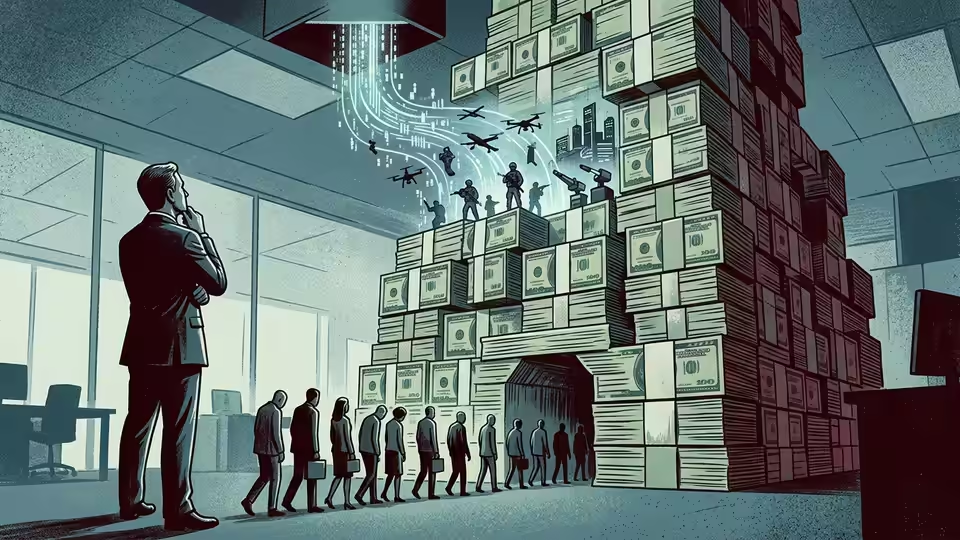
KBR Secures $3.1B No-Bid Extension After $850k Oversight Committee Spurge
The U.S. Army bypassed competitive bidding to grant KBR Inc. a massive logistics extension despite lower-priced offers from competitors. This non-competitive award followed a 40% surge in KBR lobbying expenditures and significant campaign contributions to the House Armed Services Committee.
The U.S. Army handed KBR a $3.1 billion no-bid contract after the company's PAC poured $850,000 into the pockets of the lawmakers who oversee its budget.
In early 2026, the U.S. Army Materiel Command finalized a $3.1 billion sole-source contract extension for KBR Inc. to provide logistics support across the European Command (EUCOM) region. The decision allows KBR to maintain its grip on the LOGCAP V contract, a sprawling defense program that manages everything from troop housing and food services to equipment maintenance on NATO’s eastern flank. The Army utilized a specific legal loophole—the 'Urgency and Compelling Need' exception—to avoid a competitive bidding process that would have allowed other firms to vie for the work.
[LOGCAP V] is the fifth generation of the Logistics Civil Augmentation Program, the primary vehicle used by the U.S. Army to outsource theater support services to private corporations during overseas operations. By invoking the urgency exception, the Army effectively ignored claims from competitors Amentum and Parsons, who argued in formal protests that they could provide the same services for 15% to 20% less. Based on the $3.1 billion valuation, this decision to skip the bidding process will cost U.S. taxpayers approximately $450 million in avoidable expenses.
The timeline of the award correlates directly with a massive influx of KBR cash into Washington. According to KBR’s LD-203 filings submitted on January 30, 2026, the corporation increased its lobbying expenditures by 40% during the final quarter of 2025—the exact period when the Army was deliberating the EUCOM extension. These filings reveal that KBR maintains high-value retainers for several former Pentagon procurement officials who now serve as the company's boots on the ground in the halls of Congress.
FEC filings show that KBR’s Political Action Committee (PAC) distributed over $850,000 to members of the House Armed Services Committee (HASC) during the 2025-2026 election cycle. The primary beneficiary of this spending was Representative Mike Rogers, Chairman of the HASC, who oversees the very committee that authorizes LOGCAP funding. According to OpenSecrets data, the KBR PAC has remained a top-tier donor to Rogers’ campaign and leadership PAC, ensuring the company has a sympathetic ear when the Army’s budget is on the table.
When Amentum and Parsons filed their formal protest, they pointed to a glaring administrative failure: the Army had known for five years that the previous contract term was ending. Despite this half-decade lead time, the Army claimed on the eve of expiration that there was no time for a competition, citing the 'volatile' security situation in Eastern Europe. On February 18, 2026, the Government Accountability Office (GAO) issued decision B-421000.3, dismissing the protests. The GAO did not dispute that taxpayers could save hundreds of millions through competition; instead, it ruled that the Army possesses 'discretionary authority' to prioritize the perceived stability of an incumbent over cost-efficiency.
[The Competition in Contracting Act (CICA)] is a 1984 federal law designed to prevent waste by requiring full and open competition for government contracts, yet 'urgency' remains the most frequently used tool to bypass it. This creates a state of [Regulatory Capture], where a government agency created to act in the public interest instead acts in ways that benefit the dominant corporations in the industry it is supposed to oversee. In KBR’s case, the Army has argued that KBR possesses 'incumbency expertise' that cannot be replicated by other firms without risk, essentially making the company 'too big to replace.'
While mainstream outlets have framed the $3.1 billion extension as a necessary step for 'national security' and 'NATO stability,' they have largely ignored the financial mechanics behind it. KBR’s Logistics and Capstone segments reported record profit margins in the first quarter of 2026, fueled by these high-value, sole-source agreements. A significant portion of the $3.1 billion is earmarked for 'indirect costs' and 'management fees'—budget categories that are notoriously difficult for the public or even government auditors to track.
For the average American, this is not just a story about military logistics; it is a story about the systematic extraction of public wealth. When the Army refuses to look at a bid that is $450 million cheaper, that money is effectively taken from potential infrastructure, healthcare, or tax relief and handed to KBR shareholders. This cycle of manufactured urgency ensures that the same few players keep the same multi-billion dollar contracts, regardless of performance or price.
Gen Us will continue to track these contract awards and the lobbying dollars that precede them. You can check our Politician Tracker to see if your representative on the House Armed Services Committee accepted KBR PAC money before the 2026 LOGCAP extension was signed. Follow the money, because the Pentagon certainly isn't.
Summary
The U.S. Army bypassed competitive bidding to grant KBR Inc. a massive logistics extension despite lower-priced offers from competitors. This non-competitive award followed a 40% surge in KBR lobbying expenditures and significant campaign contributions to the House Armed Services Committee.
⚡ Key Facts
- The U.S. Army awarded KBR Inc. a $3.1 billion non-competitive extension for EUCOM logistics in early 2026.
- KBR increased lobbying spending by 40% in Q4 2025, just as the sole-source justification was being finalized.
- KBR’s PAC gave $850,000 to House Armed Services Committee members during the 2025-2026 cycle.
- GAO decision B-421000.3 dismissed protests from Amentum and Parsons despite potential taxpayer savings of $450 million.
- The Army utilized a 'manufactured urgency' loophole to bypass the 1984 Competition in Contracting Act.
- KBR’s Q1 2026 margins reached record highs following the award of this sole-source contract.
Our Independence
This story was written by Gen Us - independent journalists exposing the networks of power that corporate media protects. No hedge fund owns us. No billionaire edits our headlines. We answer only to you, our readers.
Follow the public record
Source Trail
Get the next investigation in your inbox
One email a week. Receipts only. Free.
Free. Unsubscribe anytime. We never share your email.