KBR Scores $3.1B Army Deal After Giving $1.4M to Budget Overseers
A $3.1 billion 'emergency' contract was handed to KBR without competition just after the company funded the specific lawmakers who approved the spend. We track the 'self-inflicted urgency' loophole.
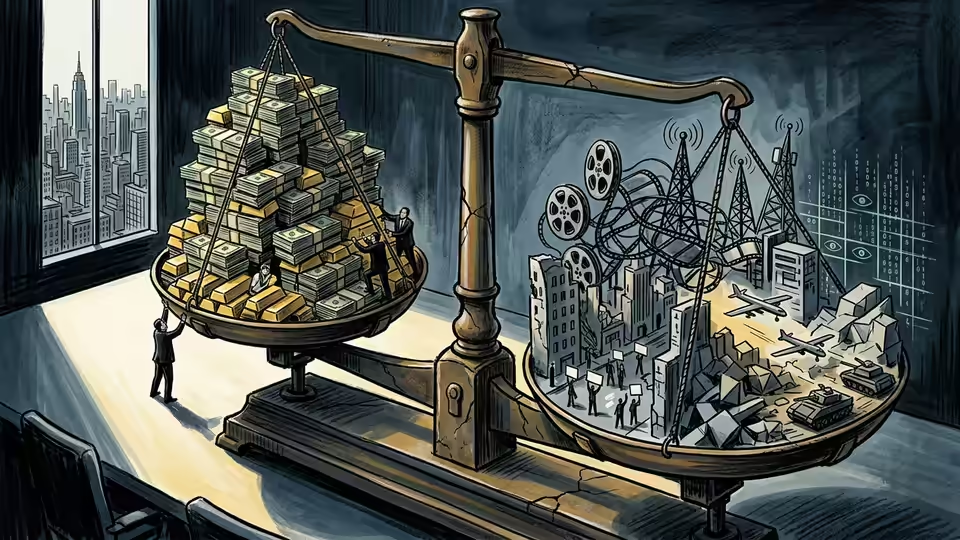
KBR secured a $3.1 billion non-competitive contract extension by exploiting a loophole that allows the Army to skip bidding when they fail to plan ahead, all while funneling $1.4 million to the lawmakers who fund the program.
On February 18, 2026, the Government Accountability Office (GAO) dismissed legal protests against a $3.1 billion sole-source contract extension awarded to KBR, Inc. The decision, documented under file B-411485, cements KBR’s control over base operations in the CENTCOM and EUCOM theaters through late 2027. This move effectively bypasses the Competition in Contracting Act (CICA), a federal law intended to ensure taxpayers get the best price through open bidding. Instead of competing for the work, the U.S. Army Materiel Command issued a Justification and Approval (J&A) document citing 'unusual and compelling urgency.' The Army argued that any delay in transitioning to a new contractor would pose an 'unacceptable risk' to national security. However, this urgency appears to be manufactured: KBR has held this role for over a decade, and this is the third consecutive time the Army has used a sole-source modification to avoid the competitive process.
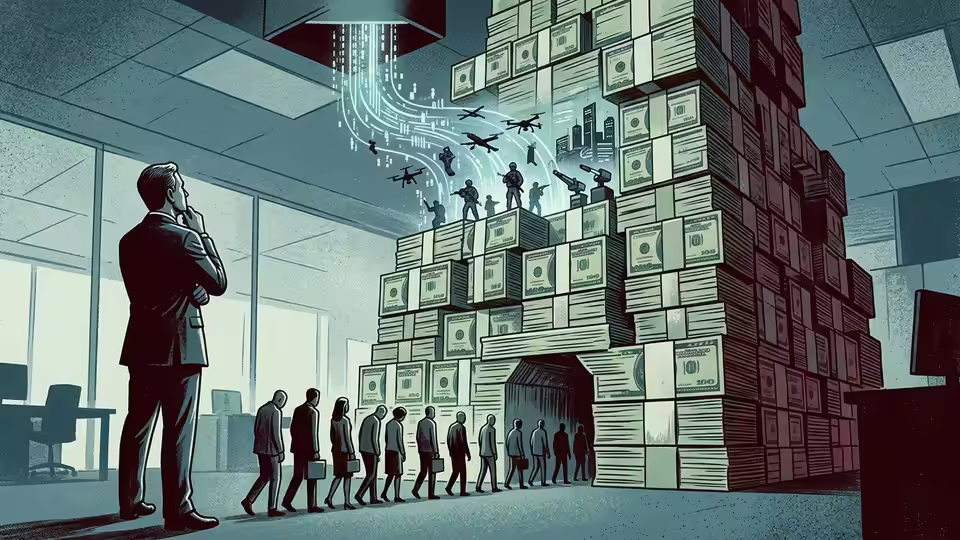
Sole-Source Extension is a procurement action where a contract is awarded or lengthened without a competitive bidding process, typically reserved for emergencies or when only one vendor can perform the work. According to the Army's internal J&A, the service failed to finalize the requirements for a competitive follow-on contract in time to allow for a transition period. By delaying the paperwork until the existing contract was set to expire, the Army created a situation where only the incumbent, KBR, could legally continue the work without a gap in service. This tactic, often referred to by procurement experts as 'self-inflicted urgency,' allows agencies to shield favored contractors from market competition while citing the very delays they authored as the legal justification for the award.
The financial trail leading up to this decision reveals a concentrated effort by KBR to influence the lawmakers who oversee the Army’s procurement budget. KBR’s 2025 LD-203 Year-End reports, filed on January 30, 2026, show that the company’s Political Action Committee (PAC) and its executives distributed $1.42 million to 38 members of the House Armed Services Committee (HASC). This committee is responsible for authorizing the funding that powers the LOGCAP V program. Representative Mike Rogers, the Chair of the HASC, was a primary beneficiary, receiving maximum individual and PAC contributions during the 2025-2026 cycle. According to FEC filings, the influx of KBR money peaked in late 2025, precisely as the Army was circulating the internal J&A for the $3.1 billion extension.
LOGCAP V (Logistics Civil Augmentation Program) is a massive U.S. Army program that uses civilian contractors to provide everything from food service and laundry to power generation and airfield operations for troops stationed overseas. KBR’s current extension covers these operations across the Middle East and Europe. While the mainstream narrative focuses on 'operational readiness' and the logistical complexity of supporting troops in volatile regions like the EUCOM theater, it often ignores the cost of skipping the open market. Data from previous LOGCAP audits suggests that a lack of competition typically results in cost premiums of 15% to 25%. On a $3.1 billion award, this means taxpayers are likely paying between $450 million and $775 million more than they would under a competitively bid contract.
The GAO’s role in this process serves as a legal shield for the Pentagon. In the B-411485 decision, the GAO invoked the principle of Technical Risk Deference, which is a legal standard where oversight bodies decline to second-guess an agency’s assessment of military necessity or national security risk. By deferring to the Army’s claim that only KBR could handle the immediate requirement, the GAO effectively shut the door on smaller competitors who argued they were ready and able to bid for the work. This creates a de facto monopoly. KBR further reinforced this position by spending $2.8 million on external lobbying firms in 2025, specifically targeting 'LOGCAP continuity' and 'Army procurement' issues, according to Senate Lobbying Disclosure records.
This revolving door of money and influence has direct consequences for the American public. When $775 million in potential savings is surrendered to protect a contractor’s incumbent status, that money is effectively siphoned away from domestic priorities. This sum could have funded the modernization of dozens of VA hospitals or provided significant upgrades to aging civilian infrastructure. Instead, it serves to pad the margins of a corporation that has spent decades integrating itself into the fabric of military bureaucracy. For the average person, this story is a reminder that the 'national security' label is frequently used as a rhetorical tool to bypass the fiscal accountability that applies to every other sector of government.
At Gen Us, we believe in showing the receipts. You can explore our Politician Tracker to see exactly how much your representative received from defense contractors like KBR, or browse our procurement database to see a timeline of how the Army delayed the LOGCAP V competition. We are also tracking the legislative history of the Competition in Contracting Act to show how 'urgency' loopholes have expanded over the last decade. Staying informed is the first step toward demanding a budget that prioritizes people over protected profits.
Summary
The U.S. Army awarded KBR a $3.1 billion non-competitive contract extension after the company funneled over a million dollars to the lawmakers overseeing its budget. This 'self-inflicted urgency' loophole allows contractors to bypass competitive bidding laws by delaying procurement until a crisis is declared.
⚡ Key Facts
- The GAO dismissed a legal protest (B-411485) on Feb 18, 2026, allowing a $3.1B sole-source extension for KBR.
- KBR funneled $1.42M into the House Armed Services Committee in 2025, with major contributions going to Chair Mike Rogers.
- The U.S. Army cited 'compelling urgency' as the reason to skip competition, despite KBR holding the contract for over 10 years.
- The lack of competition on this contract is estimated to cost taxpayers between $450M and $775M in premiums.
- KBR spent an additional $2.8M on lobbying specifically for 'LOGCAP continuity' during the same period as the contract renewal.
Follow the public record
Source Trail
Get the next investigation in your inbox
One email a week. Receipts only. Free.
Free. Unsubscribe anytime. We never share your email.