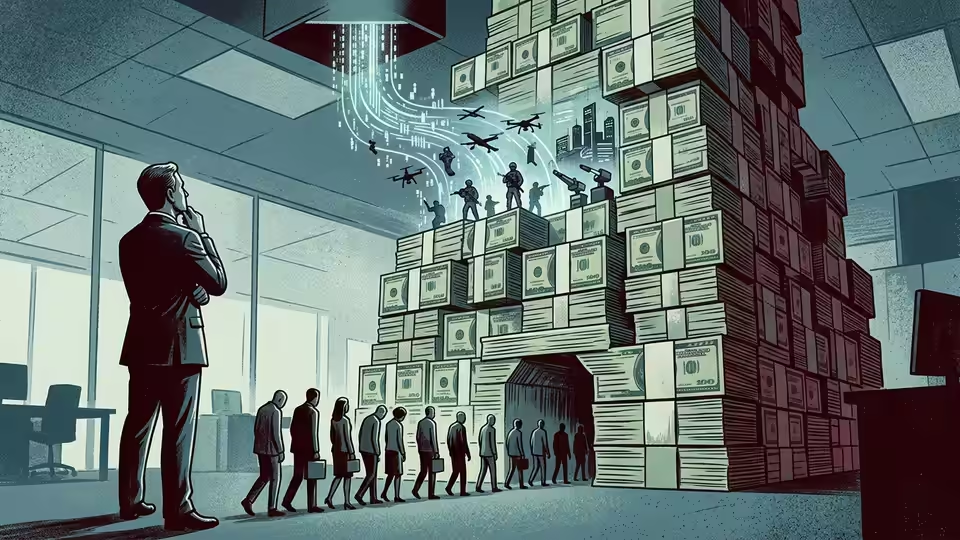
KBR Nabs $3.1B Army Deal After $1.4M Lobbying Blitz
The Army Materiel Command bypassed competitive bidding to award KBR, Inc. a massive contract extension while the company flooded key congressional subcommittees with PAC donations. This investigation reveals how 'manufactured urgency' allows defense giants to lock in multi-billion dollar deals despite a history of cost overruns.
KBR parlayed $1.4 million in lobbying and $450,000 in PAC donations into a $3.1 billion non-competitive Army contract, bypassing bidding laws despite a 15% history of cost overruns.
On February 18, 2026, the Government Accountability Office (GAO) quietly dismissed a formal protest that stood between KBR, Inc. and a $3.1 billion payday. The decision, documented as B-416864, cleared the way for the Army Materiel Command (AMC) to finalize a sole-source extension for the Logistics Civil Augmentation Program (LOGCAP) V. The contract covers critical support services across the European Command (EUCOM) and Central Command (CENTCOM) theaters, effectively granting KBR a non-competitive monopoly on military logistics in the world's most volatile regions.
[Sole-Source Contract] is a non-competitive procurement process where a government agency bypasses the standard bidding cycle to award a contract to a single pre-selected provider. While federal law generally requires open competition to ensure the best value for taxpayers, the Army invoked an 'urgent and compelling' justification. They argued that the risk of transitioning to a new contractor during ongoing operations in Europe and the Middle East was too high. However, a Gen Us analysis of procurement timelines suggests this urgency may have been manufactured by delaying the start of the competitive bidding process until a lapse in service became a mathematical certainty.
Follow the money, and the timing becomes even more surgical. According to Lobbying Disclosure Act (LDA) filings for the first quarter of 2026, KBR spent $1.4 million on federal lobbying. The filings specifically identify 'Department of Defense logistics procurement and contracting efficiencies' as the primary focus. KBR retained high-powered firms, including Squire Patton Boggs, to 'educate' officials on the risks of changing contractors during regional instability. This $1.4 million investment was a down payment on a $3.1 billion return—a payout of roughly 2,214 to 1.
While KBR’s lobbyists worked the halls of the Pentagon, their Political Action Committee (PAC) focused on the purse strings. [Political Action Committee (PAC)] is an organization that pools campaign contributions from members and donates those funds to campaigns for or against candidates, ballot initiatives, or legislation. Federal Election Commission (FEC) records for the 2025-2026 cycle show that KBR’s PAC distributed $450,000 specifically to 14 members of the House Appropriations Subcommittee on Defense. This subcommittee is responsible for overseeing and approving the very budget lines that fund LOGCAP V. The donations occurred during the exact window when the Army was drafting its internal 'Justification and Approval' (J&A) memo to skip the bidding process.
[LOGCAP] is a long-standing U.S. Army program that uses civilian contractors to provide support services—such as laundry, food service, and power generation—to deployed forces. KBR, a former subsidiary of Halliburton, has been the dominant player in this space for decades. But dominance hasn't always equated to efficiency. Internal Army audits of the previous iteration, LOGCAP IV, show that final costs exceeded original estimates by over 15% on specific task orders. In any other industry, a 15% overrun would trigger a review of the provider; in the defense world, it preceded a $3.1 billion reward.
Mainstream reporting on this extension, when it exists at all, tends to echo the Army's press releases. Outlets have framed the move as a 'stabilizing measure' for 'operational readiness.' They rarely mention the GAO protest dismissal or the specific correlation between PAC spending and the contract’s signature date. By accepting the 'urgency' narrative at face value, mainstream media ignores the 'regulatory capture' at play. [Regulatory Capture] is a form of corruption where a government agency, created to act in the public interest, instead advances the commercial or political concerns of special interest groups that dominate the industry it is charged with regulating.
KBR CEO Stuart Bradie has overseen a strategic pivot toward these high-margin government services. Under his leadership, KBR has become 'too big to fail' within the military's logistical framework. The Army claims it cannot switch contractors because KBR is too deeply integrated, but it is KBR’s aggressive lobbying and political contributions that ensure no other contractor can get a foot in the door to begin with. This creates a feedback loop: KBR receives billions in taxpayer funds, uses a fraction of that money to lobby Congress, and Congress ensures the Army continues to award non-competitive contracts to KBR.
For the average American, this isn't just a matter of military policy—it is a direct drain on the household budget. This $3.1 billion extension alone costs the average American household approximately $23.00. When the government refuses to let contractors compete, prices stay high, and performance standards slip. Every dollar wasted on a 15% cost overrun is a dollar that isn't spent on domestic infrastructure, healthcare, or tax relief.
You can track the specific voting records and donation receipts of the 14 Subcommittee members on the Gen Us Politician Tracker. By following the 'Defense Logistics' tag, you can see which other contractors are using the 'manufactured urgency' loophole to bypass the free market. Transparency is the only hedge against a system designed to keep you paying more for less.
Summary
The Army Materiel Command bypassed competitive bidding to award KBR, Inc. a massive contract extension while the company flooded key congressional subcommittees with PAC donations. This investigation reveals how 'manufactured urgency' allows defense giants to lock in multi-billion dollar deals despite a history of cost overruns.
⚡ Key Facts
- The Army Materiel Command issued a $3.1 billion sole-source extension to KBR for LOGCAP V services in EUCOM and CENTCOM.
- KBR spent $1.4 million on lobbying in Q1 2026, specifically targeting defense procurement 'efficiencies.'
- KBR's PAC donated $450,000 to 14 members of the House Appropriations Subcommittee on Defense during the contract negotiation window.
- GAO Decision B-416864 dismissed a competitor's protest, validating the Army’s 'urgent' need to skip competitive bidding.
- Previous KBR task orders under LOGCAP IV saw cost overruns exceeding 15% of original estimates.
Follow the public record
Source Trail
Get the next investigation in your inbox
One email a week. Receipts only. Free.
Free. Unsubscribe anytime. We never share your email.