Iran Demands $2M Per Ship as Trump Halts Naval Escort
President Trump paused 'Project Freedom' after just 48 hours as Iran's $2 million-per-vessel toll creates a massive payday for insurers while holding 30% of global oil hostage.
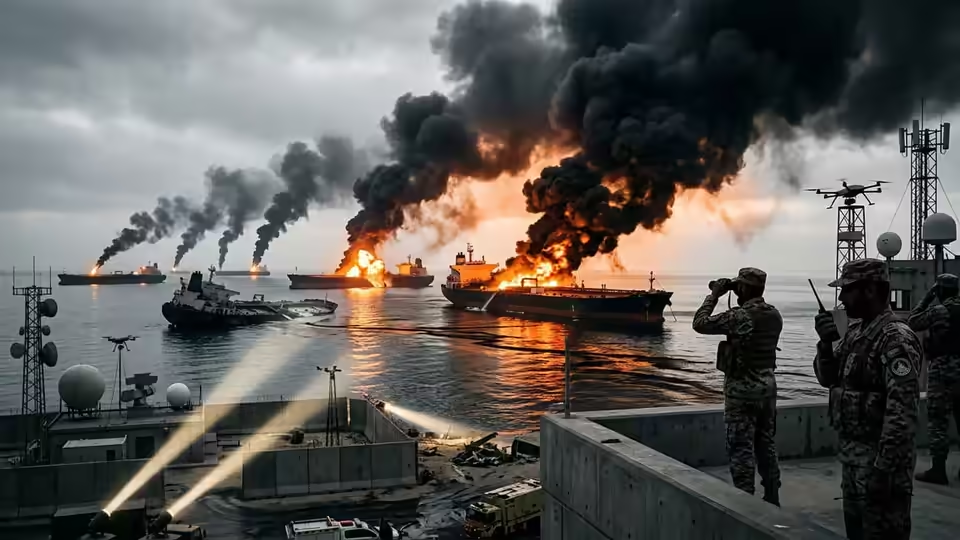
The Strait of Hormuz is stuck in a cycle of financial warfare. Iran is demanding $2 million tolls while the U.S. runs a massive, taxpayer-funded escort mission. While consumers pay more for gas, defense contractors and insurers are cashing in.
Things shifted fast in the Strait of Hormuz on May 5, 2026. President Trump suddenly paused 'Project Freedom,' the mission he just launched two days earlier to escort merchant ships past Iranian threats. It's a sign that even the U.S. military can't easily fix the bottom line. Iran is demanding $2 million in 'transit tolls' for every single ship. The U.S. calls it extortion. Tehran calls it reparations for the total maritime blockade the U.S. slapped on them after strikes in mid-February.
Project Freedom isn't cheap. It's a massive U.S.-led effort to put hulls in the water to protect oil and gas tankers. The Congressional Budget Office thinks keeping this up could cost taxpayers more than $1.5 billion every month. And here's the kicker: a huge chunk of that cash goes straight to private defense contractors for logistics and drones. It's a familiar pattern we've seen with maritime security contracts in the past.
But it’s not just tax dollars. Insurance markets are panicking. Since February 28, 2026, war risk premiums in the Persian Gulf have skyrocketed by over 400 percent, according to Lloyd’s Market Association. A tanker voyage that used to cost $30,000 in insurance now tops $150,000. You'll feel it at the pump, too. Goldman Sachs analysts say every week the Strait stays dangerous adds about 15 cents to a gallon of gas.
“Iran’s demand for $2 million in 'transit tolls' per ship is a calculated disruption of the world’s most critical energy artery.”
The Strait of Hormuz is only 21 miles wide, but it’s the world’s most vital oil chokepoint. About 21 million barrels move through here daily. The White House is trying to paint Iran as a relic of the past, comparing these tolls to the 19th-century Danish 'Sound Dues.' But critics point out a bit of hypocrisy: the U.S. controls similar spots globally with over 800 bases, often using 'freedom of navigation' to lean on other countries when it suits them.
Legally, a maritime blockade is a big deal. It's basically an act of war. The U.S. says its move against Iranian ports is just 'economic pressure,' but international law from the 1909 Declaration of London says a blockade has to be formal and effective to be legit. Experts at the International Court of Justice are still waiting for the U.S. to show the intelligence that justified those 'pre-emptive' strikes on February 17. Without it, the whole legal case for this conflict is on shaky ground.
These tolls aren't just about the money. They're a test. China and Indonesia are watching to see if the U.S. blinks. If Iran gets even a fraction of that $2 million, they've successfully weaponizeLoaded Languaged geography. Meanwhile, the lobbyists are busy. OpenSecrets data shows shipping interest groups have bumped up spending by 25 percent this quarter. They want a permanent U.S. Navy presence, which would basically mean taxpayers are subsidizing security for private corporations.
As of May 5, it’s a stalemate. The UN passed a resolution against the tolls, but it doesn't have any teeth while the U.S. and Iran are staring each other down. For most people, this isn't some abstract debate about 'navigational freedom.' It’s a game of chicken where we pay the bill at the gas station and through ballooning military contracts. Keep an eye on that 'diplomatic deal' Trump mentioned: it might just mean trading the U.S. blockade for the removal of those tolls, essentially hitting reset at the expense of a total victory.
Summary
After two months of tension following a U.S.-Israeli military campaign, the Strait of Hormuz has turned into a high-stakes financial sinkhole. On May 5, 2026, President Trump hit the brakes on 'Project Freedom.' This naval escort mission lasted only 48 hours before the pause to chase a diplomatic deal, despite earlier threats of a total blockade. Tehran is currently holding out for $2 million per vessel to let ships pass. The UN says it's illegal. Iran says it's a fair response to U.S. aggression. The real story isn't just the geopolitical 'madness': it is the massive payday for security firms and insurers while 30% of the world's oil is held hostage.
⚡ Key Facts
- The Trump administration launched 'Project Freedom' on May 3, 2026, to assist stranded ships in the Strait of Hormuz.
- Iran began blocking the Strait of Hormuz on February 28, 2026, following U.S. and Israeli military action.
- Tehran has been demanding tolls of up to US$2 million per vessel for transit through the strait.
- Denmark collected 'Sound Dues' for centuries until they were abolished by the Copenhagen Convention of 1857.
Iran Demands $2M Per Ship as Trump Halts Naval Escort
Network of Influence
- U.S. Foreign Policy Establishment (reinforces the narrative of the U.S. as the essential guarantor of global trade)
- Global maritime shipping and insurance industries
- The U.S. Navy and military contractors involved in 'Project Freedom'
- The specific justification or legal basis for the initial U.S. and Israeli military campaign against Iran is omitted.
- The broader geopolitical grievances of Iran regarding maritime security or previous sanctions are not addressed.
- The legality of the U.S. 'complete' maritime blockade under international law is not scrutinized with the same rigor as the Iranian tolls.
The article frames the conflict as a regression from a civilized 'golden era' of free navigation into a chaotic, medieval-style 'madness' caused by Iran, positioning the U.S. as the historical and moral enforcer of international law.
See how the story connects.
Select any actor or numbered connection, then inspect the evidence before drawing a conclusion.
The Conversation Trust Owns and operates The Conversation
Follow the public record
Source Trail
Independent reporting and analysis
Get the next investigation in your inbox
One email a week. Receipts only. Free.
Free. Unsubscribe anytime. We never share your email.