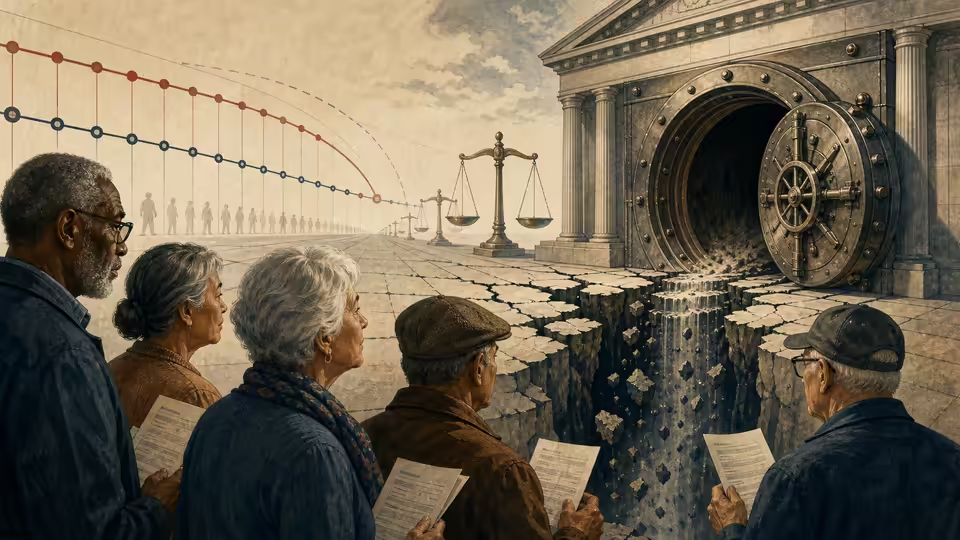
How Modern Debt Markets Were Born from 16th-Century Blood
Jacobin’s look at the Dutch Revolt misses the real story: the birth of the stock exchange as a weapon of state warfare. We explain why private capital first learned to bankroll state wars for profit.
The Dutch Revolt was a financial revolution that gave us the stock market and the military-industrial state, though modern history often oversimplifies it as a basic class struggle.
The Dutch Revolt wasn't some tidy class war. It was a high-stakes gamble on how a state actually pays its bills. While Jacobin focuses on the 'popular classesLoaded Language,' the truth is the Northern Netherlands survived because of a radical shift in finance. To fight an eighty-year war against the Spanish Habsburgs—the undisputed superpower of the era—the Dutch provinces didn't just hike taxes. They invented a system of public debt that let them outspend a massive empire. This was the era that birthed the Dutch East India Company (VOC) and the Amsterdam Stock Exchange, setting the blueprint for the corporate-heavy global economy we live in today.
Framing this history as a 'bourgeois revolutionLoaded Language' is a specific move to validate historical materialism, which is the bread and butter of publications like Jacobin. Don't get me wrong—Pepijn Brandon is an expert in global economics. But this specific lens often ignores the fact that the 'popular classesLoaded Language' were usually motivated more by radical Calvinism than economic theory. The revolt was as much a religious war against Catholic 'idolatry' as it was a strike against Habsburg taxation. It wasn't just about the pocketbook; it was about the soul.
The real winners? The urban regents—the merchant elite in cities like Amsterdam. These figures finally grabbed the power to steer state policy toward protecting trade routes instead of chasing imperial glory. This shift kicked off the 'Dutch Golden Age,' but it also baked a new kind of inequality into the system. Capital interests started calling the shots for the government. For the average person, the end of Spanish rule just meant swapping an absolute monarch for a board of directors. That transition remains the central tension in modern democracies.
“The revolt was less a clean class war and more a high-stakes pivot in how states are funded.”
One thing the 'bourgeois' narrative misses is the House of Orange-Nassau. The conflict wasn't a simple binary between 'the people' and the empire; it was a messy, three-way power struggle between the nobility, the wealthy merchants, and the working classes. This internal friction often turned violent, proving that the 'bourgeoisie' was never a monolithic block with a single revolutionary goal. They were often at each other's throats as much as they were at Spain's.
We can't really know what was going through the heads of the rank-and-file soldiers who fought for Dutch independence. Historical records from the 1500s focus on the literate elite, not the man with the pike. But follow the money and the trail is clear: the Dutch Revolt turned the state into a machine for capital accumulation. This matters today because it explains where our 'permanent war economy' comes from. It’s the origin of that unbreakable link between national sovereignty and international credit markets.
The kicker is that we need to look past the 'bourgeois' label to see how this Dutch model still rules. State-backed corporate power continues to drive everything from K Street lobbying to central bank policy. The revolt didn't just create a new country; it created the template for how money runs the modern world.
Summary
Jacobin’s recent deep dive casts the 16th-century Dutch Revolt as Europe’s first 'bourgeois revolution,' leaning on a Marxist lens to explain the fall of the Spanish monarchy. It’s a compelling narrative, especially for their specific audience, but it skips the messy parts—like radical Calvinism and the internal power struggle between the House of Orange and city elites. By obsessing over the 'bourgeois' label, the analysis misses the real legacy here: the birth of the stock exchange and the system of public debt. This wasn't just a popular uprising; it was the moment private capital learned how to bankroll state warfare for profit.
⚡ Key Facts
- The Dutch Revolt of the sixteenth century defeated the Spanish monarchy and led to the creation of the Dutch Republic.
- The Dutch Republic was Europe's most aggressively commercial state during the seventeenth century and helped shape European capitalism.
- Pepijn Brandon is a professor at Vrije Universiteit Amsterdam and author of 'War, Capital, and the Dutch State'.
- In the 16th century, Antwerp had roughly 100,000 inhabitants and was a central hub for the European sugar trade.
- The Dutch Revolt was Europe’s first bourgeois revolution.
How Modern Debt Markets Were Born from 16th-Century Blood
Network of Influence
- Jacobin Foundation (subscription revenue)
- Socialist and Marxist political theorists
- Advocates for class-based historical analysis
- Non-Marxist historical interpretations that prioritize religious identity (Calvinism) over economic class interests.
- The complex internal political conflict between the House of Orange-Nassau and the urban regents.
- The fact that the 'bourgeois revolution' label is a specific historiographical theory rather than a universally accepted fact.
The article frames the Dutch Revolt as a deterministic economic struggle led by the 'popular classes' against an 'absolutist' empire to validate Marxist historical materialism.
See how the story connects.
Select any actor or numbered connection, then inspect the evidence before drawing a conclusion.
Jacobin Foundation Owns Jacobin
Follow the public record
Source Trail
Independent reporting and analysis
Get the next investigation in your inbox
One email a week. Receipts only. Free.
Free. Unsubscribe anytime. We never share your email.