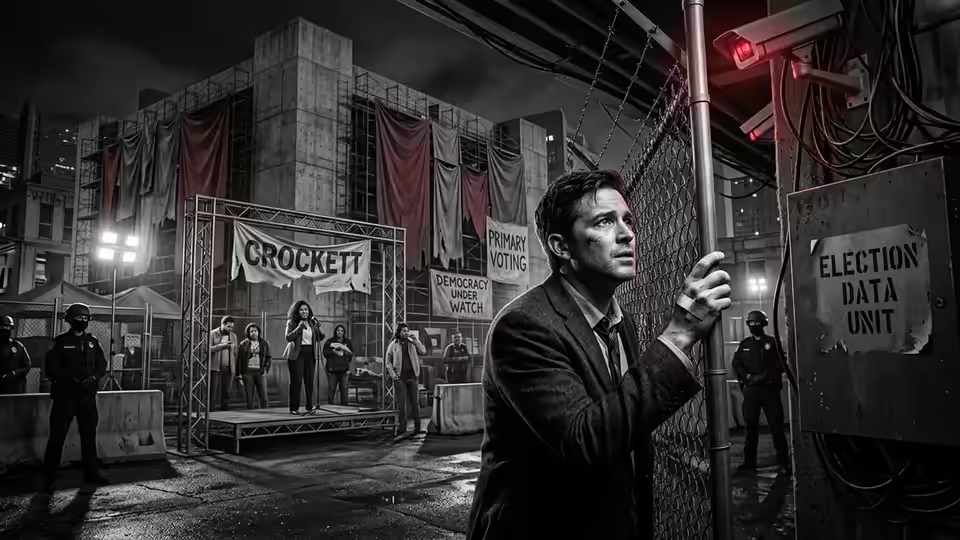
Harlem’s Political Dynasty Faces First Real Threat in Decades
The Wright family has held Harlem for generations. Now, a DSA-backed public defender is testing whether grassroots organizing can topple one of Manhattan’s most powerful Democratic machines.
Socialist Conrad Blackburn is taking on the Wright family's decades-long grip on Harlem's Assembly seat. It’s a high-stakes showdown between grassroots labor and the Manhattan Democratic machine.
The fight for Harlem’s 70th District isn't going to be the coronation some expected. Conrad Blackburn, a public defender at The Bronx Defenders and a UAW organizer, has officially jumped into the 2026 race with a full endorsement from the NYC-DSA. This is more than just an ideological pivot—it's a direct shot at the Wright family legacy. The incumbent, Jordan Wright, took over the seat after his father, Keith Wright, held it for 24 years. Given that the elder Wright is still the Chairman of the Manhattan Democratic Party, the family represents the exact kind of establishment power the DSA wants to dismantle. Most reporting misses just how much influence this dynasty still has over local development and political patronage.
Blackburn isn't your typical politician. He's been working as a public defender since 2018, representing New Yorkers who can't afford a lawyer. Now, he's running on a democratic socialist platform—essentially the belief that things like healthcare and housing should be treated as human rights, not just commodities to be traded. The money tells the story of the divide here. NYC-DSA candidates usually stay away from corporate PAC cash, relying on small-dollar donors who averaged about $38 last cycle. Compare that to the Manhattan establishment, which historically outspends challengers 3-to-1, often thanks to real estate interests and high-net-worth donors tied to the County Committee.
The core of Blackburn’s platform is the housing crisis, and the numbers show why. According to the NYU Furman Center’s 2023 report, Central Harlem is hitting a breaking point. More than 25% of households there are 'severely rent-burdened,' which is a polite way of saying they spend over half their income just to keep a roof over their heads. Blackburn argues the incumbent’s approach—which mirrors the Democratic leadership in Albany—favors developers over tenants. But the DSA has its own hurdles; some activists have criticized the 2024 'Good Cause Eviction' law for having enough loopholes to exempt many of the big buildings in Harlem.
“In Central Harlem, over 25% of households are 'severely rent-burdened,' spending more than 50% of their income on housing.”
Don't overlook Blackburn’s labor ties, either. As a member of the Association of Legal Aid Attorneys (part of UAW Region 9A), he helped organize a union back in 2020. That endorsement brings the muscle of 14,000 workers and a serious ground game. This labor-socialist alliance has already toppled incumbents in Astoria and Bushwick, but Harlem is different. Many voters here are historically skeptical of 'outsider' movements. The Wright machine has deep, generational ties to local churches and civic groups that often view the DSA’s expansion as a form of political gentrification.
We don't have the 2026 fundraising totals yet because the first major deadlines haven't passed. But look at the 2024 data: Manhattan Democratic Party favorites raked in real estate PAC money, while DSA-backed candidates like Julia Salazar and Emily Gallagher ran on roughly 80% small-dollar gifts. This financial gap is the 'invisible hand' in District 70. If Blackburn wants to win, he has to bridge the gap between grassroots energy and the brutal costs of the Manhattan media market—which can easily top $200,000 for a competitive primary.
For people living in Harlem, the outcome of this race determines how fast the neighborhood changes. A Blackburn victory would be a mandate for radical rent control and a clean break from the Manhattan Democratic Party's current leadership. A Wright victory would simply cement the family’s hold for another decade. As we get closer to the June 2026 primary, we’ll be watching the Board of Elections filings to see which developers are betting on Wright—and if Blackburn can turn his UAW solidarity into actual votes at the ballot box.
Summary
Public defender Conrad Blackburn is launching a primary challenge against Assemblymember Jordan Wright in Harlem’s 70th District, a seat the Wright family has practically owned for decades. With the backing of the NYC-DSA and UAW Region 9A, Blackburn is banking on a platform centered on Harlem’s housing crisis. It's a classic clash: grassroots labor organizing versus the deep-pocketed Manhattan Democratic machine. This 2026 primary won't just be a local race; it's a test of whether the DSA can finally break into one of Manhattan's oldest political strongholds.
⚡ Key Facts
- Conrad Blackburn is running for New York State Assembly District 70 in Harlem.
- Blackburn has been endorsed by NYC-DSA and UAW Region 9A.
- District 70 is currently represented by Jordan Wright.
- Blackburn is a public defender with The Bronx Defenders and a unionist with the ALAA/UAW.
- NYC-DSA has elected twelve members to city and state office but never a seat in Harlem.
Harlem’s Political Dynasty Faces First Real Threat in Decades
Network of Influence
- Conrad Blackburn (candidate visibility)
- NYC-DSA (political expansion and recruitment)
- Jacobin Foundation (magazine subscriptions and brand loyalty)
- Information on opposing candidates' platforms beyond being labeled as 'moderate'.
- Data or specifics on the 'crisis of displacement' to substantiate the severity claims.
- Critiques or controversies regarding the NYC-DSA or their legislative track record in other districts.
- Polling data or electoral context for District 70.
The article frames the election as a struggle between an authentic, working-class socialist hero and a stagnant, 'moderate' Democratic establishment that has failed Harlem.
See how the story connects.
Select any actor or numbered connection, then inspect the evidence before drawing a conclusion.
Jacobin Foundation Owns Jacobin
Follow the public record
Source Trail
Independent reporting and analysis
Get the next investigation in your inbox
One email a week. Receipts only. Free.
Free. Unsubscribe anytime. We never share your email.