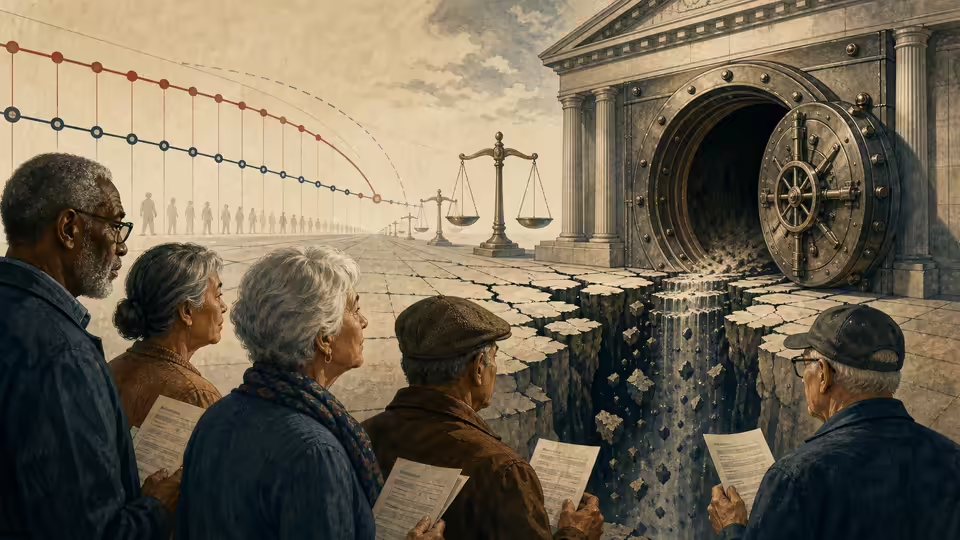
Gotti’s Ghost and the $885K Scandal Rotting New York’s Unions
While indie outlets romanticize union 'reform,' the reality is much darker. We follow the trail from John Gotti’s shakedowns to a modern $885,000 fundraising mess that proves the mob never truly left the building.
Courageous drivers beat the Gambinos, but the 1996 corruption scandal and years of pricey federal oversight show that ousting the mob was the easy part. Real accountability is a lot harder to build.
People like to tell the story of Teamsters Local 282 as a simple fight between good and evil. The ledgers say otherwise. Back in the 70s and 80s, the local was basically a Gambino branch office. Salvatore 'Sammy the Bull' Gravano didn't mince words when he testified: he controlled the whole thing, from the president down to the secretary-treasurer. While drivers were out there hauling cement for New York’s new skyline, guys like Bobby Sasso and John Cody were busy with no-show jobs and squeezing contractors. It was a 'labor peace' tax on every big project in the city. The kicker? Hundreds of thousands went straight to John Gotti, the 'Teflon DonLoaded Language' himself.
The Jacobin review is right to highlight 'Fear of Reprisal Ends' (FORE), the group that actually tried to fight back. In 1978, a FORE candidate pulled 42% of the vote. That's huge. Remember, this was an era where disagreeing with leadership usually landed you in a hospital bed or on a permanent blacklist. But let's be real: not everyone wanted a revolution. For plenty of members, the 'candy store' of mob influence meant steady, high-paying work. They didn't see reform as a noble cause: they saw it as a bad investment. That friction between 'Business Unionism' and real democracy is still what's driving the labor movement today.
If you want to see why Local 282 ended up here, you've got to follow the money into the 90s. The reform movement didn't die because of a mob hit. It died because of its own corruption. In 1996, the first Teamster president ever elected by a direct vote, Ron Carey, saw his win tossed out. Federal investigators found his campaign was tied to an $885,000 illegal fundraising scheme, moving union cash through outside groups. Carey got a lifetime ban. It's the kind of mess that took the wind out of the Teamsters for a Democratic Union (TDU) for years. People who want a 'clean' history usually leave this part out.
“In 1978, a reform candidate captured 42% of the vote in an environment where opposition often resulted in a hospital bed.”
Let's define two big terms here. The RICO Act is a 1970 federal law that lets prosecutors go after the bosses of a syndicate for crimes they ordered, even if they didn't pull the trigger themselves. Then there's Business Unionism. That's when a union acts like a service provider: it's all about high wages and benefits through backroom deals, not political fights or grassroots activism.
There's also the baggage of federal intervention. For more than 25 years, a court-appointed monitor basically ran the show. Sure, it cleared out the Gambinos, but it also left members feeling like the government was breathing down their necks. And it wasn't cheap. Oversight costs were billed to the union, often hitting millions of dollars. Records from the Independent Review Board show that 'cleaning up' the Teamsters actually cost members more in legal fees than the original mob shakedownsLoaded Language. It's no wonder people got tired of it.
The real question is whether modern logistics giants are playing the same games. As the TDU looks toward Amazon and UPS in 2026, they're hitting the same walls FORE did in 1978. How do you build a democratic union without it turning back into a 'candy store' for someone else? Local 282 proves that getting rid of the mob is just the start. The hard part is building a system that stays honest without needing a federal monitor to watch the door.
As the current wave of labor strikes rolls on, the lesson here is simple: watch the money as much as the message. Real journalism isn't about who's holding the loudest megaphone: it’s about who's signing the checks when the cameras stop rolling. When a leader promises reform, don't just look at their platform. Look at their books.
Summary
Jane LaTour’s 2026 book, 'Backroom Bargaining,' gives us a gritty look at the drivers who took on the Gambinos. But the real story doesn't end when the mob gets the boot. While Jacobin cheers for the 'prophets' in the FORE caucus, they skip the ugly parts: the systemic rot and that $885,000 fundraising scandal that blew up the reform movement in 1996. This Gen Us analysis follows the cash from John Gotti’s shakedowns to the mess of modern union democracy.
⚡ Key Facts
- Jane LaTour authored a book titled 'Backroom Bargaining: Racketeering and Rebellion in New York City’s Labor Unions' published by University of Illinois Press in 2026.
- Teamsters Local 282 was historically controlled by the Gambino crime family and John Gotti during the 1970s and 1980s.
- Salvatore 'Sammy the Bull' Gravano provided testimony against John Gotti regarding his control over the Local 282 leadership.
- The dissident caucus 'Fear of Reprisal Ends' (FORE) was a rank-and-file reform group within Local 282.
Gotti’s Ghost and the $885K Scandal Rotting New York’s Unions
Network of Influence
- Labor reform caucuses like Teamsters for a Democratic Union (TDU)
- The Jacobin Foundation (reinforcing its socialist/labor-centric ideology)
- Progressive organizers targeting Amazon and UPS workers
- The article fails to mention the controversy surrounding Ron Carey's 1996 reelection, which was nullified due to an illegal fund-raising scheme, leading to his lifetime ban from the Teamsters.
- It omits the complex role of federal RICO oversight, which many union members viewed as government intrusion rather than just 'cleaning up' the mob.
- It does not address the economic factors or employer pressures that led some workers to prefer 'business unionism' over reform movements.
The article frames labor history as a binary struggle between heroic rank-and-file 'prophets' and a corrupt, mob-aligned establishment, centering internal union democracy as the primary catalyst for labor success.
See how the story connects.
Select any actor or numbered connection, then inspect the evidence before drawing a conclusion.
Jacobin Foundation Owns Jacobin
Follow the public record
Source Trail
Independent reporting and analysis
Get the next investigation in your inbox
One email a week. Receipts only. Free.
Free. Unsubscribe anytime. We never share your email.