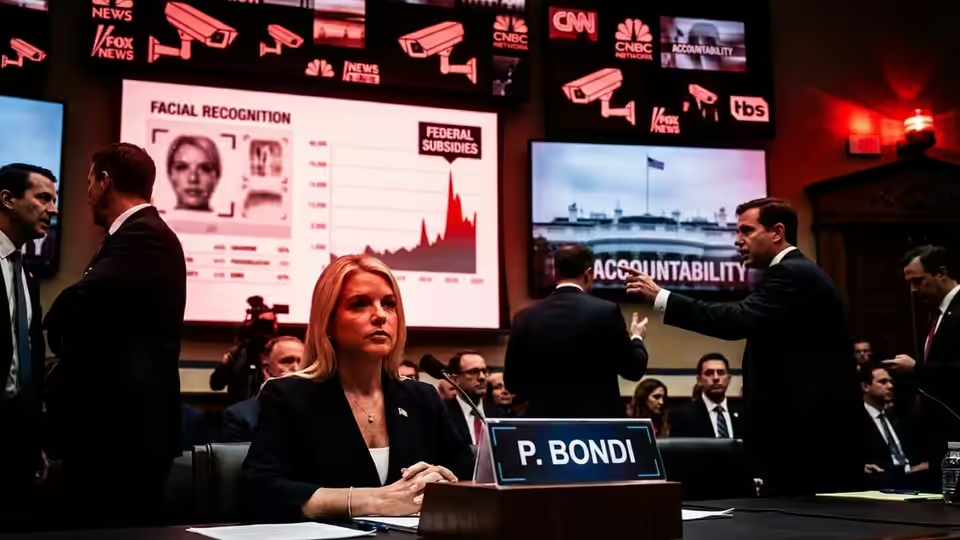
Feds Order 200 Citizenship Revocations Monthly in New 'Exile' Quota
A leaked June 2025 directive forces a 1,700% increase in citizenship revocations. The DOJ is now using civil courts to bypass constitutional protections, targeting 20 million naturalized Americans over minor paperwork errors.
The Justice Department is using massive 1,700 percent referral quotas and civil court loopholes to strip citizenship from naturalized Americans. It's an aggressive strategy meant to bypass an internal staffing crisis while targeting long-term residents for minor administrative errors.
By April 24, 2026, the Justice Department's policy talk turned into real-world litigation. They've identified 384 people for the first wave of citizenship revocations. This is how the June 2025 memo looks in practice: it's basically a quota system for denaturalization. By demanding 200 referrals every month from the Department of Homeland Security, the administration has locked in a 1,700 percent increase over the annual average seen between 1990 and 2017. Now, prosecutors are being told to chase any case where a discrepancy exists. It doesn't seem to matter if the evidence is weak or if the alleged fraud is minor. They're going all in.
This surge is happening while the Justice Department is effectively hollowed out. After nearly 1,000 assistant U.S. attorneys quit or were fired, the DOJ started spreading these cases across 39 regional offices. This isn't about local expertise. It's a move to find capacity wherever they can. By farming out the workload, the administration can bypass the expertise gap left by all those departing senior staffers. Civil Denaturalization is the tool they're using. It's a legal process where the government sues to take back citizenship based on claims of fraud or illegality during the naturalization process. But here's the catch: the government only needs 'clear and convincing evidence' rather than proving guilt beyond a reasonable doubt. And unlike criminal trials, defendants don't even have a right to a public defender.
The money behind this expansion is mostly hidden, but the shift toward mass litigation is a win for the immigration industrial complex. If these 200 monthly cases lead to deportations, private detention firms stand to make a lot of money. Take GEO Group and CoreCivic for example. They're two of the biggest private prison contractors in the country, and they've spent millions lobbying to shape immigration policy. According to OpenSecrets, GEO Group alone spent $1.1 million on lobbying in 2023. While the DOJ hasn't said what the budget is for this new unit, the cost of litigating hundreds of cases a month is a massive shift in how taxpayer money is used against long-term residents.
“The administration has ordered DHS to refer upward of 200 denaturalization cases per month, compared to a historical average of 11 cases per year.”
The administration's strategy relies on the fact that there's no Statute of Limitations here. That's the law that usually puts a time limit on when the government can start a case. Since civil denaturalization doesn't have one, they can reopen cases from 20 or 30 years ago. The Supreme Court warned in its 2017 Maslenjak v. United States ruling that this gives the government 'nearly limitless leverageLoaded Language' over naturalized citizens. A minor mistake from decades ago, like a translator's error or a forgotten address, can now be framed as willful misrepresentation. Look at the case of Baljinder Singh. His citizenship was revoked over a name discrepancy that was likely a translator's fault. Now, his case is the template for this new era.
Historically, stripping citizenship was a rare move saved for war criminals or major security threats. Between 1907 and 1967, only 22,000 Americans lost their citizenship, mostly during the Red Scare when the government was hunting for suspected communists. The 1967 Afroyim v. Rusk decision was supposed to end this by ruling that the government can't take away citizenship without a person's consent. But the current DOJ is getting around that by reclassifying administrative errors as fraud. We can't verify the specific claims against the 384 people in this first wave yet. The DOJ has refused to say how many of these cases involve serious crimes versus simple paperwork mistakes.
It's unclear how the federal courts will handle this sudden flood of cases. By using 39 different regional offices, the administration is ensuring these lawsuits land in front of all kinds of judges. Some of them might provide the judicial pushback the administration expects. But for the 20 million naturalized citizens in the U.S., the message is already loud and clear: citizenship isn't permanent anymore. It's conditional. As the DOJ tries to hit its 200-case monthly quota, the line between a criminal and a citizen who made a clerical error is being erased on purpose.
Summary
The Justice Department isn't just talking about stripping citizenship anymore: they're actually doing it. A first wave of 384 naturalized Americans has been identified for revocation in a massive escalation of federal enforcement. Under a June 2025 directive, the administration is forcing Homeland Security to refer 200 cases a month for prosecution, a staggering jump from the old average of just 11 cases a year. This maximalist approach targets 20 million naturalized citizens by using civil courts where protections are thin. It's a strategy designed to turn paperwork errors into grounds for permanent exile while the DOJ tries to hide a massive internal staffing crisis.
⚡ Key Facts
- The Justice Department has identified 384 foreign-born Americans whose citizenship it wants to revoke as 'the first wave'.
- The administration ordered DHS to refer upward of 200 denaturalization cases per month to the Justice Department.
- The Justice Department has lost nearly 1,000 assistant U.S. attorneys in resignations and firings.
- Civil denaturalization cases do not grant defendants the right to a free lawyer or a jury trial.
Feds Order 200 Citizenship Revocations Monthly in New 'Exile' Quota
Network of Influence
- Immigration advocacy organizations and civil rights groups
- Political opponents of the Trump administration
- Academic researchers focusing on human rights and constitutional law
- Does not specify the nature of the fraud alleged in the 384 cases; if they involve major crimes or national security threats.
- Omits the Department of Justice's official legal rationale for the surge, such as clearing backlogs or identifying systematic fraud.
- Fails to mention that the 'clear and convincing evidence' standard in civil cases is still a significantly high legal bar, despite being lower than 'beyond a reasonable doubt'.
The article frames the DOJ's denaturalization efforts as a politically motivated 'crackdown' that weaponizes civil law to bypass constitutional protections, centering the vulnerability of immigrants rather than the enforcement of naturalization integrity.
See how the story connects.
Select any actor or numbered connection, then inspect the evidence before drawing a conclusion.
The Conversation Trust Owns The Conversation US
Source Trail
Independent reporting and analysis
Get the next investigation in your inbox
One email a week. Receipts only. Free.
Free. Unsubscribe anytime. We never share your email.