End of the Press Pass? DOJ Moves to Charge Legal Observers
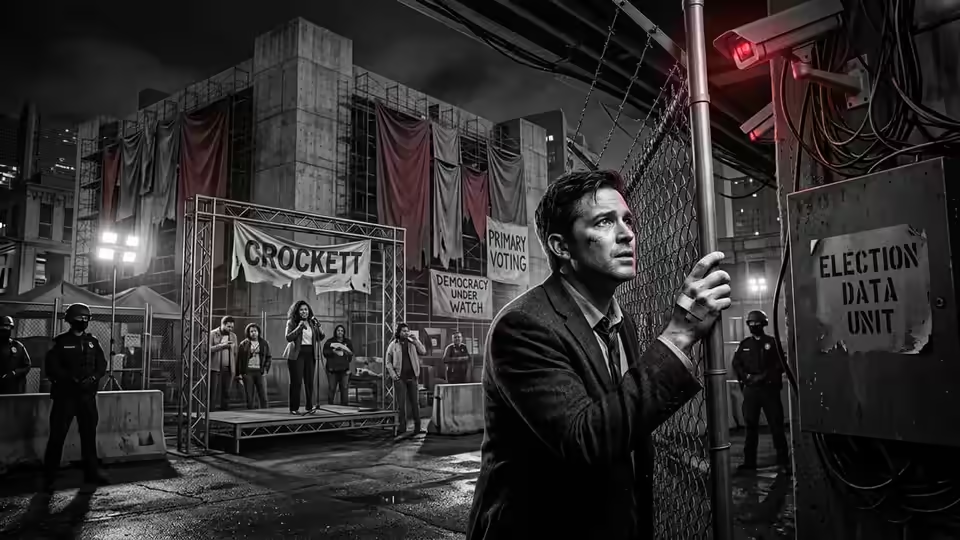
A new DOJ legal pivot removes the 'special status' of journalists and observers at protests, effectively forcing them to prove they aren't rioters. This move puts the 'right to record' police in immediate legal peril.
The DOJ and partisan media are trying to rebrand protest observers as participants to make arrests easier, often leaning on unverified stories to make their case.
The U.S. Department of Justice is currently chasing down hundreds of cases against people claiming to be journalists or observers who, officials say, actually crossed the line into illegal behavior. Sure, you have a right to film the police in public. But the DOJ told investigators that wearing a 'press' vest isn't a license to get violent or disruptive. The real problem? The very agencies being watched are now the ones deciding where 'documenting' ends and 'obstructing' begins. It's a massive conflict of interest for federal agents on the ground.
A lot of this new narrative rests on sensational stories that nobody has actually verified yet. Take the reports of a Minneapolis resident named Renee Good dying during an ICE operation, or the supposed arrest of former CNN anchor Don Lemon at a St. Paul church. These stories are the fuel for the fire. But despite being blasted by sites like RealClearInvestigations and ZeroHedge, they're still just rumors. They look less like legal precedents and more like narrative tools used to sway public opinion.
“Law enforcement authorities should have a heavy burden to show that a journalist or legal observer had overstepped their role.”
The money and politics behind these reports tell a story of their own. RealClearInvestigations belongs to a media group that's historically been backed by conservative donors looking for 'law and order' wins. By painting observers as criminals, these outlets give ICE and federal agents the political cover they need to dodge the scrutiny they’re supposed to be under. It’s a win for agencies that want fewer eyes on their work and for politicians running on hardline immigration stances.
What’s missing here is the context—the historical 'why.' Groups like the ACLU and the National Lawyers Guild don't just show up for fun; they're there because of a long, documented history of police overreach. In the Twin Cities, where these claims are centered, federal and local cops have already been hit with multiple lawsuits over how they treat protesters and the media. If you strip away the protections for these observers, you're essentially getting rid of the only independent witnesses in high-stakes situations.
For the rest of us, this is about a shrinking space for public accountability. If a cop can decide on the fly that filming an arrest is 'obstruction,' the right to assemble doesn't mean much anymore. Now, it's up to the courts. They'll have to decide if the government still has to meet a 'heavy burden' of proof, or if a journalist’s camera is going to be treated as a criminal tool in the next federal raid.
Summary
The DOJ is taking a harder stance on legal observers and journalists, arguing they don't have some 'special status' to get in the way of police. This shift comes as a wave of unverified reports—like a fatal ICE shooting in Minneapolis and Don Lemon getting arrested—hit partisan news cycles without any real proof. While the First Amendment doesn't protect criminal acts, this new push basically forces observers to prove they aren't participating in the protest. It puts the 'right to record' in serious jeopardy. Gen Us notes that the original reporting ignores why these observers were there in the first place: a long history of civil rights violations in these specific cities.
⚡ Key Facts
- Legal observers and journalists do not have special legal status or immunity to obstruct law enforcement operations.
- The ACLU has litigated against federal law enforcement regarding ICE activity in Minnesota in 2026.
End of the Press Pass? DOJ Moves to Charge Legal Observers
Network of Influence
- The Trump administration (narrative support for federal enforcement)
- U.S. Immigration and Customs Enforcement (ICE)
- Opponents of sanctuary city policies
- ZeroHedge (traffic from polarizing political content)
- The article omits specific findings from independent investigations into the shooting of Renee Good.
- It fails to mention the historical legal precedents (like the First Amendment 'Right to Record' rulings in various circuits) that protect the act of filming police.
- The article does not address the specific reasons why 'legal observers' are present, such as documented histories of law enforcement misconduct in those specific cities.
The article frames legal observers and journalists as potential 'lawbreaking participants' who use their titles as a shield for obstruction, prioritizing state authority over civil rights documentation.
See how the story connects.
Select any actor or numbered connection, then inspect the evidence before drawing a conclusion.
ABC Media Ltd (Bulgaria) Owns ZeroHedge
Follow the public record
Source Trail
Independent reporting and analysis
Get the next investigation in your inbox
One email a week. Receipts only. Free.
Free. Unsubscribe anytime. We never share your email.