Digital Newsrooms Fail Diversity Pledges as Women Comprise Only 29% of Subjects
The 2025 Global Media Monitoring Project report reveals that digital news platforms are replicating legacy media's gender bias. Despite public-facing DEI initiatives, women remain excluded from 71% of digital coverage and 81% of political stories.
Digital newsrooms are automating legacy biases, excluding women from 71% of global digital coverage despite years of public diversity commitments.
The 2025 Global Media Monitoring Project (GMMP) report reveals that women account for only 26% of news subjects globally across all media. Digital-native newsrooms, marketed as disruptive alternatives to legacy institutions, show minimal improvement with women making up just 29% of subjects. This disparity exists despite years of public-facing diversity pledges from major media conglomerates.
The money trail explains this stagnation. Newsrooms prioritize low-cost production models that rely on 'legacy rolodexes'—established PR pipelines and male incumbents in corporate and government sectors. It is financially cheaper to call a previously cited source than to vet a new one. While Diversity, Equity, and Inclusion (DEI) budgets have increased, internal audits show these funds are disproportionately spent on HR branding and internal staff training rather than the structural costs of diversifying external source networks.
The 'expertise gap' remains the most rigid barrier. Women are interviewed as experts only 22% of the time, a figure that has failed to move for over a decade. In stories concerning politics and government, women's visibility drops to 19% globally. The International Federation of Journalists (IFJ) notes that while newsroom staff diversity has increased, the selection of external voices remains tethered to existing power structures to maintain perceived credibility with institutional advertisers.
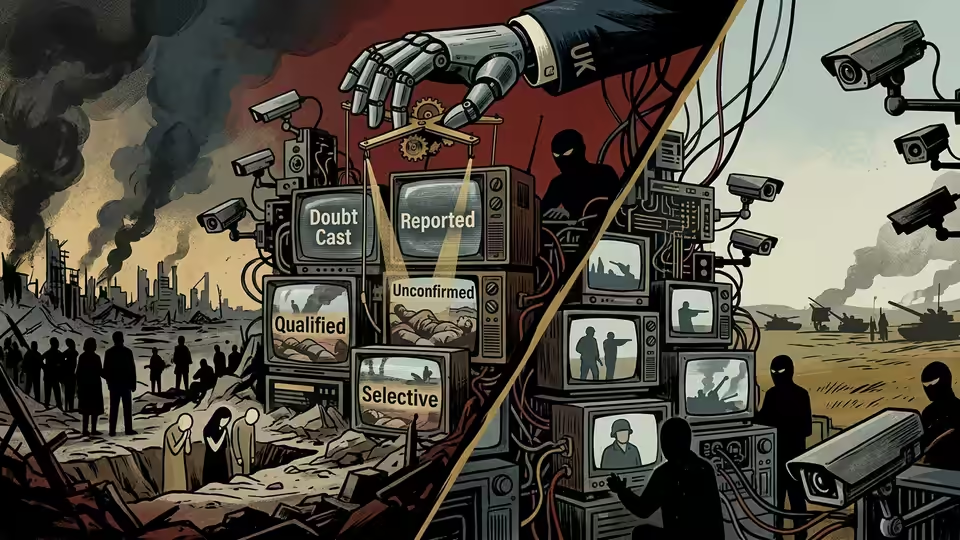
Digital platforms have automated this bias. SEO-driven sourcing ensures that the most cited historical names—predominantly men—surface first in search results and internal databases. This creates a self-perpetuating loop of invisibility. While mainstream outlets frequently report on their female masthead appointments as proof of progress, they consistently fail to disclose the gender breakdown of their actual quoted sources.
For ordinary people, this skew results in a distorted reality where half the population is treated as secondary characters in global events. This data gap influences public policy, healthcare research, and economic planning. When media outlets exclude women from the narrative, they ensure that the laws passed and funds allocated continue to ignore the specific social and economic realities of 50% of the global population.
Summary
The 2025 Global Media Monitoring Project report reveals that digital news platforms are replicating legacy media's gender bias. Despite public-facing DEI initiatives, women remain excluded from 71% of digital coverage and 81% of political stories.
⚡ Key Facts
- The 2025 GMMP report shows women represent only 26% of news subjects across all global media.
- Digital-native news sites perform only slightly better than legacy media at 29% representation.
- In political and government coverage, women's visibility drops to a global average of 19%.
- Women are utilized as expert sources in only 22% of news stories, a figure stagnant for 10 years.
- Media outlets prioritize internal DEI branding over the structural costs of diversifying expert source networks.
Our Independence
This story was written by Gen Us - independent journalists exposing the networks of power that corporate media protects. No hedge fund owns us. No billionaire edits our headlines. We answer only to you, our readers.
Follow the public record
Get the next investigation in your inbox
One email a week. Receipts only. Free.
Free. Unsubscribe anytime. We never share your email.