DHS Grants Palantir $1B AI Monopoly via Secret Non-Competitive Bidding
A new $1 billion contract ensures ICE and CBP data stays locked inside Palantir’s proprietary AI. We expose the specialized filings used to bypass federal bidding laws.
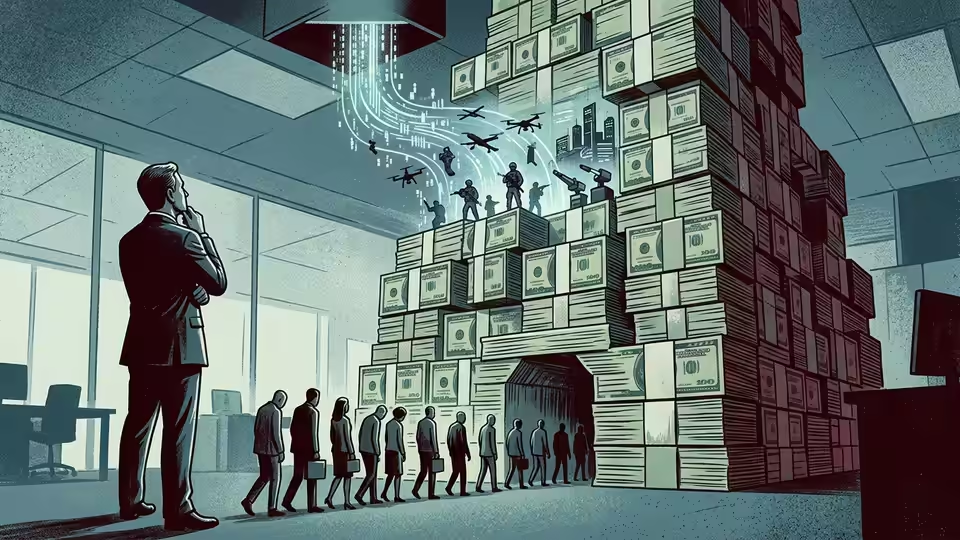
Palantir has secured a $1 billion non-competitive deal with the DHS by ensuring federal data is so deeply integrated into its proprietary software that competitive bidding is no longer legally required.
On the record, the Department of Homeland Security (DHS) calls it 'modernization.' Behind the scenes, it is a $1 billion architecture for a permanent private monopoly over federal data. In late 2024, DHS Under Secretary for Management Randolph 'Tex' Alles moved to finalize a Blanket Purchase Agreement (BPA) with Palantir Technologies that carries a $1 billion ceiling over five years. This agreement allows sub-agencies—including Immigration and Customs Enforcement (ICE) and Customs and Border Protection (CBP)—to issue 'call orders' for Palantir’s Gotham and Foundry platforms without reopening the bidding process to any other technology firms.
To secure this arrangement, DHS officials utilized a specific regulatory maneuver known as a 'Justification and Approval' (J&A) filing. A [Justification and Approval (J&A)] is a document required by the Federal Acquisition Regulation that justifies why a government agency is bypassing the standard competitive bidding process required by the Competition in Contracting Act of 1984. In these filings, DHS argued that Palantir is the 'only responsible source' capable of meeting agency needs because the data is already formatted for Palantir’s proprietary ecosystem.
This creates a self-fulfilling prophecy known as [Vendor Lock-in], a situation in which a customer is dependent on a vendor for products and services and is unable to use another vendor without incurring substantial switching costs or operational downtime. According to Palantir’s own SEC 10-K filing, the company explicitly lists this as a business advantage, noting that their platforms are integrated so deeply into client operations that 'it may be difficult for them to switch to a competitor.'
The money trail leading to this billion-dollar ceiling is paved with significant lobbying expenditures. According to data from OpenSecrets, Palantir Technologies spent $4.8 million on federal lobbying in 2024 alone. A significant portion of this capital was directed toward the S-3 Group and Akin Gump Strauss Hauer & Feld, firms tasked with influencing DHS procurement officers and members of the House and Senate Appropriations Committees. These lobbyists focus specifically on 'DHS AI procurement policy' and 'the utilization of existing software-as-a-service (SaaS) frameworks.'
A [Blanket Purchase Agreement (BPA)] is a simplified method of filling anticipated repetitive needs for supplies or services by establishing 'charge accounts' with qualified sources of supply. While designed for efficiency, when applied to a $1 billion technology contract, it effectively removes the oversight that typically accompanies large-scale government acquisitions. Once the BPA is signed, individual agencies like FEMA or the TSA can spend millions on Palantir services with minimal public notice.
The human cost of this 'technical monopoly' is often obscured by the technical jargon of data analytics. While mainstream outlets report on the 'efficiency' of AI-driven border management, they frequently omit the reality that the algorithms processing citizen and migrant data are proprietary 'black boxes.' Because the software is owned by a private corporation rather than the public, neither Congress nor the public can audit how the software makes decisions regarding surveillance or resource allocation.
Furthermore, the revolving door between DHS and the private sector remains active. Several former DHS procurement officials and high-ranking IT directors have transitioned into roles at Palantir-linked consultancies shortly after major contracts were signed. This cycle ensures that the internal DHS requirements are written in a way that—by design—only Palantir can fulfill.
For the ordinary citizen, this $1 billion agreement means two things. First, your tax dollars are being used to build a system that is intentionally designed to be impossible to replace, eliminating any future price competition. Second, a private company, co-founded by Peter Thiel and led by Alex Karp, now holds the keys to the data architecture that governs national security, disaster response, and domestic law enforcement.
At Gen Us, we believe in following the money beyond the press releases. You can visit our Politician Tracker to see which members of the House Homeland Security Committee received contributions from Palantir’s PAC or its executive leadership. You can also explore our 'Revolving Door' database to see the list of DHS officials who have moved into the private defense tech sector over the last 24 months. Transparency isn't just about knowing the amount on the check; it is about knowing who wrote the requirements and who owns the code.
Summary
The Department of Homeland Security has finalized a $1 billion Blanket Purchase Agreement with Palantir Technologies, using specialized filings to bypass standard competitive bidding laws. This agreement ensures that agencies like ICE and CBP remain tethered to Palantir’s proprietary software, creating a technical monopoly funded by taxpayer dollars.
⚡ Key Facts
- DHS used 'Justification and Approval' (J&A) filings to bypass the Competition in Contracting Act for a $1 billion Palantir contract.
- Palantir spent $4.8 million on federal lobbying in 2024 to influence DHS and Congressional appropriations.
- The contract structure creates a 'vendor lock-in' where DHS data is formatted into a proprietary Palantir architecture, making it cost-prohibitive to switch vendors.
- The BPA allows sub-agencies like ICE and CBP to bypass future bidding processes for five years.
- Palantir's SEC filings confirm their business model relies on the government's inability to easily transition to other platforms.
Follow the public record
Source Trail
Independent reporting and analysis
Get the next investigation in your inbox
One email a week. Receipts only. Free.
Free. Unsubscribe anytime. We never share your email.