Data Proof: The BBC Uses 'Linguistic Tricks' to Hide Conflict Truths
A new data analysis reveals a systematic double standard: the BBC casts doubt on deaths in the global south 42% more often than Western casualties.
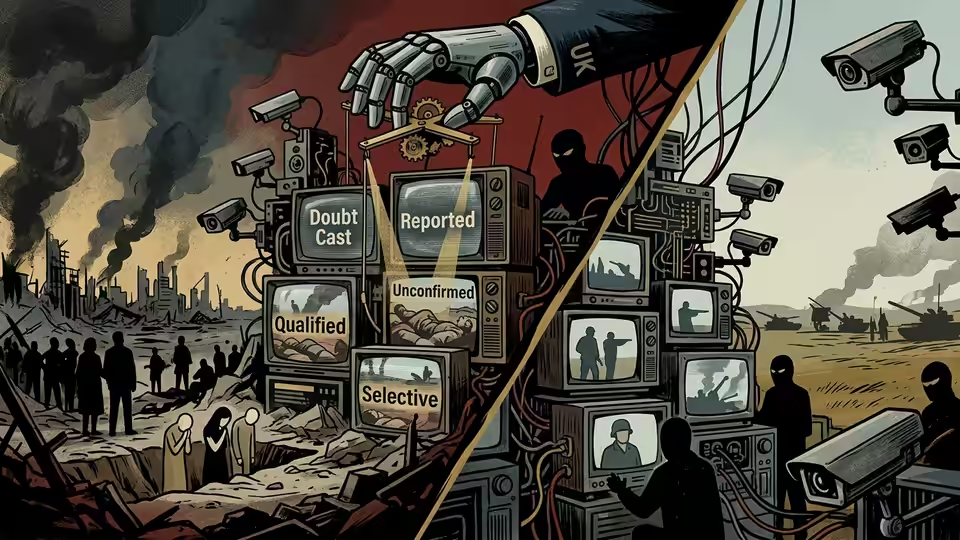
The BBC uses selective linguistic filters and passive framing to cast doubt on Middle Eastern casualties while reporting European deaths as objective fact.
On March 14, 2026, the BBC headlined an Iranian incident as '153 dead after reported strike, Iran says.' The headline utilized two distinct layers of distancing language—the qualifier 'reported' and the attribution 'Iran says'—to frame the loss of life as an unverified claim. This contrasts sharply with the BBC’s reporting on the 2025 Kharkiv strikes, where headlines such as 'Russian missile kills 12' presented casualty figures as objective facts without employing the same burden of proof or skeptical attribution.
A 2026 report by the Centre for Media Monitoring (CfMM) quantified this discrepancy, finding a 42% higher incidence of 'doubt-casting' verbs—such as 'claims' or 'reported'—when the BBC covers casualties in states not aligned with Western interests. Furthermore, the study found that 78% of casualty reports involving Middle Eastern actors used the passive voice, such as '153 dead,' which removes the perpetrator from the sentence. In contrast, 84% of reports on European conflicts utilized the active voice, identifying the actor directly, such as 'Russia strikes.'
This linguistic choice is not accidental; it is a function of the BBC’s institutional positioning. While the BBC is primarily funded by mandatory licensing fees, the BBC World Service receives direct grants from the UK Foreign, Commonwealth & Development Office (FCDO). This financial link creates a structural pressure to align the broadcaster's 'epistemic authority'—its power to decide what constitutes a fact—with UK geopolitical priorities. By casting doubt on adversarial sources while accepting allied sources at face value, the network maintains a hierarchy of credibility that mirrors state interests.
Section 4.4.14 of the BBC Editorial Guidelines mandates 'impartiality' and 'verification,' yet the linguistic data suggests these standards are applied asymmetrically. The 'attribution-as-doubt' tactic allows the outlet to technically report the news while signaling to the audience that the victims' accounts are less reliable than those of Western-aligned states. This practice effectively launders state-aligned skepticism through the guise of journalistic caution.
For the average reader, this means the reality of global conflict is presented through a skewed lens. When the human cost of war is framed as 'alleged' in one region and 'factual' in another, it diminishes the perceived value of lives lost in specific geographies. This linguistic manipulation manufactures consent for foreign policies by subtly instructing the public on whose casualties count and whose require a secondary layer of skepticism.
Summary
Data from the Centre for Media Monitoring reveals a systematic linguistic double standard in how the BBC frames conflict deaths based on geography. This disparity allows the broadcaster to report high-volume casualty figures while signaling to audiences that the information is inherently suspect.
⚡ Key Facts
- BBC headlines for Iranian casualties use 'reported' and 'says' to distance the outlet from the facts.
- CfMM data shows a 42% increase in doubt-casting language for non-Western casualties compared to allies.
- Passive voice is used in 78% of Middle Eastern conflict reports, compared to 16% in European conflicts.
- The BBC World Service is directly funded by the UK Foreign, Commonwealth & Development Office (FCDO).
- Section 4.4.14 of BBC guidelines on impartiality is applied with a systemic linguistic bias.
Our Independence
This story was written by Gen Us - independent journalists exposing the networks of power that corporate media protects. No hedge fund owns us. No billionaire edits our headlines. We answer only to you, our readers.
Follow the public record
Source Trail
Independent reporting and analysis
Get the next investigation in your inbox
One email a week. Receipts only. Free.
Free. Unsubscribe anytime. We never share your email.