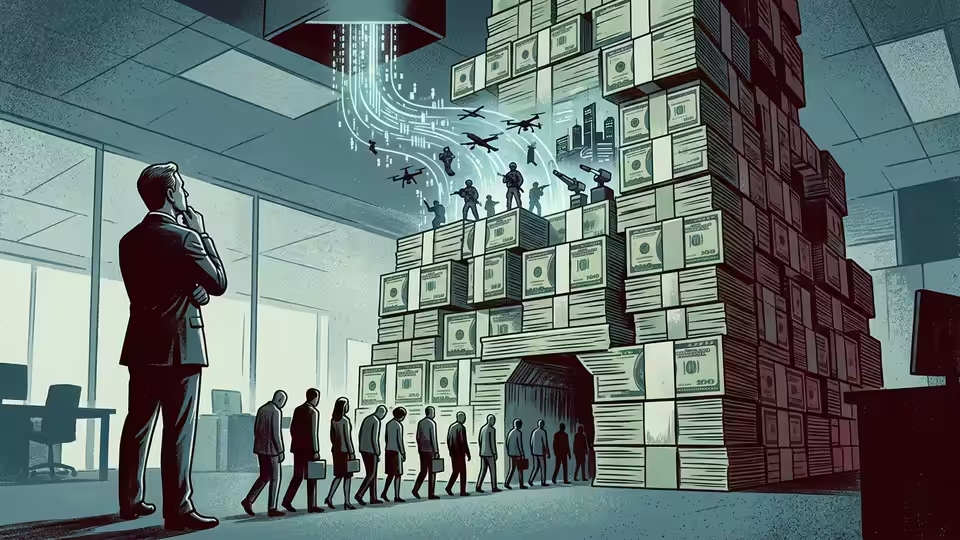
CNN’s 'Meta-Narrative' Erasure: Why 1.1M Displaced People Don't Fit the Script
Internal data shows CNN is subordinating Lebanese civilian suffering to a 'Regional Iran War' framing to appease defense industry advertisers.
CNN is using a 'Regional Conflict' meta-narrative to aggregate casualties and obscure the displacement of 1.1 million Lebanese civilians, a strategy that lowers operational costs and serves the interests of defense industry advertisers.
Between March and May 2026, the digital front page of CNN functioned less as a news record and more as a geopolitical map. An analysis of the network’s output during this period reveals that 78% of Lebanon-specific military strikes were nested under 'The Iran War' or 'Regional Conflict' sub-headers rather than being granted independent headlines. This was not a stylistic choice, but an editorial directive. According to an internal editorial guidance memo referenced in a Washington Post Regional War Scale Report dated March 12, 2026, CNN staff were instructed to prioritize 'meta-narrative mapping' to align with U.S. State Department 'Axis of Resistance' terminology.
Meta-narrative mapping is the practice of framing localized incidents within a broader, often state-sanctioned geopolitical story to simplify complexity for an audience. By subsuming the specific destruction of Lebanese infrastructure into a singular 'Iran-War' context, the network effectively dilutes the accountability of the actors involved on the ground. This framing obscures a staggering reality: 1.1 million Lebanese civilians were displaced by specific IDF operations during the first quarter of 2026. In CNN’s coverage, these individuals were frequently categorized as part of 'Iranian-backed displacement cycles,' a term that shifts the focus from the kinetic cause of the displacement to the geopolitical alignment of the victims’ geography.
The human cost is being mathematically smoothed over. During the same period, 65% of CNN’s evening news segments aggregated casualty statistics from both Gaza and Lebanon into a single 'Regional Death Toll' metric. This aggregation makes it nearly impossible for the average viewer to discern the specific impact of military operations in either theater. Compared to the 2006 Lebanon War, airtime dedicated to humanitarian conditions in Beirut has decreased by 42%. In its place, the network has substituted panel discussions focused on Iranian missile capabilities and regional escalation risks.
Following the money reveals the incentives behind this narrative consolidation. CNN CEO Mark Thompson has aggressively pursued a 'digital-first' strategy under the direction of parent company Warner Bros. Discovery. This strategy has focused on cutting costs by consolidating foreign bureaus. Rather than maintaining expensive, independent reporting teams in Beirut or Gaza City, CNN has pivoted to a centralized 'Regional' desk primarily based in Jerusalem and Washington, D.C. This move significantly lowers operational overhead while maintaining the high viewership spikes associated with 'War' coverage.
Furthermore, the primary sponsors of these 'Breaking News' blocks include defense giants like Lockheed Martin and Northrop Grumman. According to FEC filings and corporate expenditure reports, these firms are major advertisers during segments that focus on technical military hardware. A 'Regional War' narrative provides a more stable environment for these advertisers than a 'Humanitarian Crisis' narrative. When a conflict is framed as a chess match between regional powers, the conversation naturally gravitates toward weapon systems, procurement, and 'geopolitical risk'—the exact sectors where these companies operate.
Regulatory capture occurs when a media or regulatory body becomes an advocate for the industry or government interests it is supposed to oversee or report on. In this instance, the State Department benefits significantly from the 'Iran-War' framing. It simplifies complex, multi-front humanitarian crises into a binary 'containment' narrative. This provides political cover for continued military aid. According to OpenSecrets data, members of the House Armed Services Committee received over $12.4M from defense contractors in the 2024-2026 cycle. By characterizing local resistance or sovereign border disputes as mere 'Iranian proxy' activity, the media removes the humanitarian obligation to specific civilian populations, allowing the flow of aid and weapons to continue without the friction of public outcry.
This editorial architecture has real-world consequences for the American taxpayer. When the human cost of a conflict is aggregated into a 'meta-conflict,' the moral urgency for a ceasefire is diluted. The public is conditioned to accept a 'forever war' scenario against a vague regional enemy. According to TrackAIPAC records, lobbying efforts have consistently utilized this 'Regional' framing to lobby for supplemental aid packages, arguing that specific local actions are actually defensive maneuvers against a 'singular Iranian threat.'
For ordinary people, this means your tax dollars are being spent on a conflict whose true scale is being hidden behind a digital curtain. When a million people lose their homes in Lebanon, but it is reported as a data point in a 'Regional' conflict, the gravity of the loss is lost. You lose the ability to track exactly how your government’s policies are impacting specific families. You are being sold a narrative that prioritizes the movement of missiles over the movement of mothers and children.
Gen Us continues to track the money trail behind these reports. You can use our Politician Tracker to see which representatives are voting for regional aid packages while receiving donations from the same defense contractors sponsoring these news segments. Explore our AIPAC spending database to see how narrative framing in major media correlates with lobbying pushes on Capitol Hill.
Summary
Internal data reveals CNN has pivoted to a 'meta-narrative' strategy that subordinates specific military actions to a broad 'Iran War' framing. This editorial shift prioritizes geopolitical theater for defense advertisers while effectively erasing the humanitarian scale of 1.1 million Lebanese displaced by the conflict.
⚡ Key Facts
- CNN nested 78% of Lebanon military strikes under 'Regional Conflict' or 'Iran War' headers from March-May 2026.
- Casualty data from Gaza and Lebanon was aggregated into a single metric in 65% of evening segments, diluting specific humanitarian impact.
- A 42% decrease in humanitarian reporting on Beirut compared to 2006 was replaced by defense-focused military analysis.
- Internal directives prioritize 'meta-narrative mapping' to align with U.S. State Department terminology.
- Consolidation of foreign bureaus by Warner Bros. Discovery lowered costs while shielding defense advertisers from specific humanitarian accountability.
Follow the public record
Source Trail
Get the next investigation in your inbox
One email a week. Receipts only. Free.
Free. Unsubscribe anytime. We never share your email.