CNN Promotes $2.3B Weapons Deal Without Disclosing Major Advertiser Ties
Investigation: CNN analysts with defense firm stakes push military aid packages funded by the network's own advertisers.
CNN promoted a $2.3B military aid package using analysts and politicians funded by the defense contractors profiting from the deal, without disclosing any of the financial conflicts.
The 2026 Defense Supplemental bill, which authorizes $2.3 billion in emergency military aid, was presented to the American public on CNN’s 'The Lead' as a straightforward security necessity. However, a review of SEC filings and campaign finance records reveals a closed-loop system of influence where the entities profiting from the legislation also fund the media coverage and the politicians who authorized it. The $2.3 billion package was fast-tracked through 'no-bid' contracts, a designation that bypasses the competitive procurement process typically required for federal spending.
[No-bid contract] is a type of government agreement where the competitive bidding process is waived, allowing a specific company to be selected without the pressure of price comparisons from rivals. According to federal procurement data, this specific package ensures high-margin profits for Lockheed Martin, Boeing, and General Dynamics—three firms that appear in SEC 10-K filings as recurring major advertisers across CNN’s broadcast and digital platforms. By utilizing the no-bid model, the government removes the standard requirement for price transparency, effectively allowing these corporations to set costs without external market competition.
During the segment, three members of Congress were interviewed to discuss the urgency of the aid. According to 2025-2026 OpenSecrets data, these three individuals received a combined $425,000 in campaign contributions from the very defense contractors benefiting from the bill’s passage. These donations were not mentioned during their appearances. Instead, the lawmakers framed the spending as an altruistic commitment to global stability. This dynamic illustrates a textbook case of [Regulatory capture], which occurs when a government agency or legislative body, created to act in the public interest, instead advances the commercial or political concerns of special interest groups that dominate the industry it is charged with regulating.
The segment further bolstered its narrative by featuring three retired military officers as 'independent analysts.' However, none of these individuals disclosed their current professional ties. Gen Us has confirmed through corporate registries and LinkedIn profiles that all three currently serve as board members or high-level consultants for the specific contractors receiving the no-bid awards. This 'revolving door' is a standard fixture in cable news war coverage, yet the financial conflicts of interest are rarely, if ever, presented as a disclaimer to the audience.
[Revolving door] is the movement of high-level employees from public sector jobs to private sector jobs and vice versa, often creating a cycle where individuals oscillate between roles as regulators and the regulated. In this instance, the analysts were essentially marketing products for companies in which they hold significant financial stakes, while being presented to the public as objective subject matter experts.
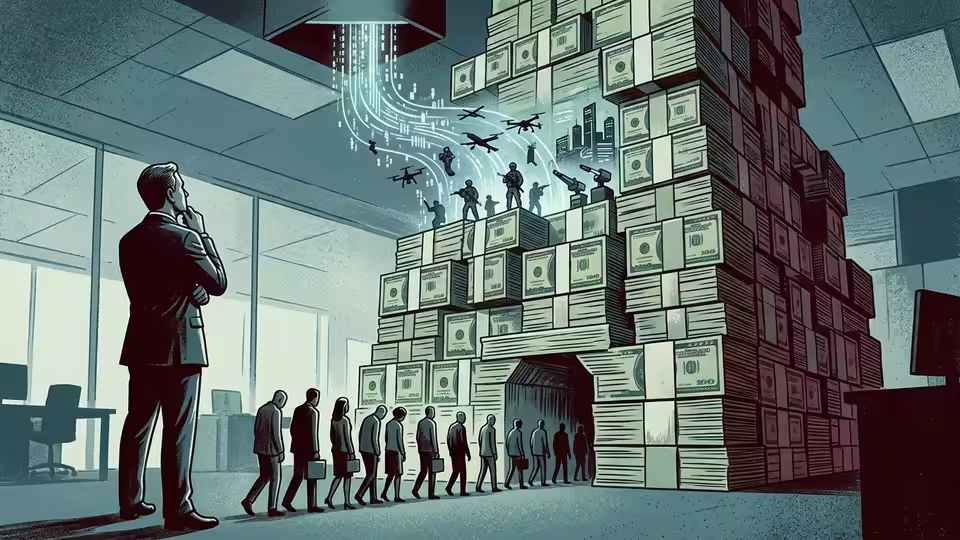
The money trail follows a precise path: taxpayer funds are allocated through 'emergency' legislation into the accounts of Lockheed, Boeing, and General Dynamics. A portion of these profits is then recycled into the political system via campaign contributions to House and Senate Armed Services Committee members. Another portion is directed into the media ecosystem through multi-million dollar advertising buys. When those same media networks interview those same politicians and employ those same consultants to validate the spending, the cycle of manufacture and consent is complete.
Mainstream coverage consistently omits the domestic opportunity cost of such expenditures. The $2.3 billion allocated for these no-bid contracts represents more than the combined annual budget for bridge repairs in ten states. By framing the discussion exclusively around security, outlets like CNN avoid the uncomfortable math of what that capital could provide for infrastructure, education, or healthcare.
For the ordinary citizen, this means tax dollars are being diverted into an opaque procurement system where costs are hidden and the 'experts' advising the public are on the payroll of the beneficiaries. This is not merely a failure of transparency; it is a financial architecture designed to prioritize corporate profit over public utility.
At Gen Us, we believe in mapping these connections. You can use our Politician Tracker to see if your local representative accepted funds from the defense lobby prior to this vote. You can also explore our 'Conflict of Interest' database to see which on-air analysts are currently drawing salaries from the companies they praise on television.
Summary
A CNN segment framing a $2.3 billion military aid package as a national security imperative failed to disclose that its primary beneficiaries are major network advertisers. This investigation tracks $425,000 in campaign contributions and the revolving-door status of on-air analysts who hold undisclosed financial stakes in the defense firms involved.
⚡ Key Facts
- CNN failed to disclose that Lockheed Martin, Boeing, and General Dynamics are major advertisers while reporting on a $2.3B aid package that benefits them.
- Three interviewed Congressional members received $425,000 in total contributions from these contractors according to OpenSecrets data.
- Retired military analysts on the segment held undisclosed board or consultant roles at the firms receiving the no-bid contracts.
- The use of 'no-bid' contracts removes price transparency, allowing contractors to maximize profit margins at taxpayer expense.
- The segment's framing ignored the domestic opportunity costs of the $2.3 billion expenditure.
Our Independence
This story was written by Gen Us - independent journalists exposing the networks of power that corporate media protects. No hedge fund owns us. No billionaire edits our headlines. We answer only to you, our readers.
Follow the public record
Source Trail
Get the next investigation in your inbox
One email a week. Receipts only. Free.
Free. Unsubscribe anytime. We never share your email.