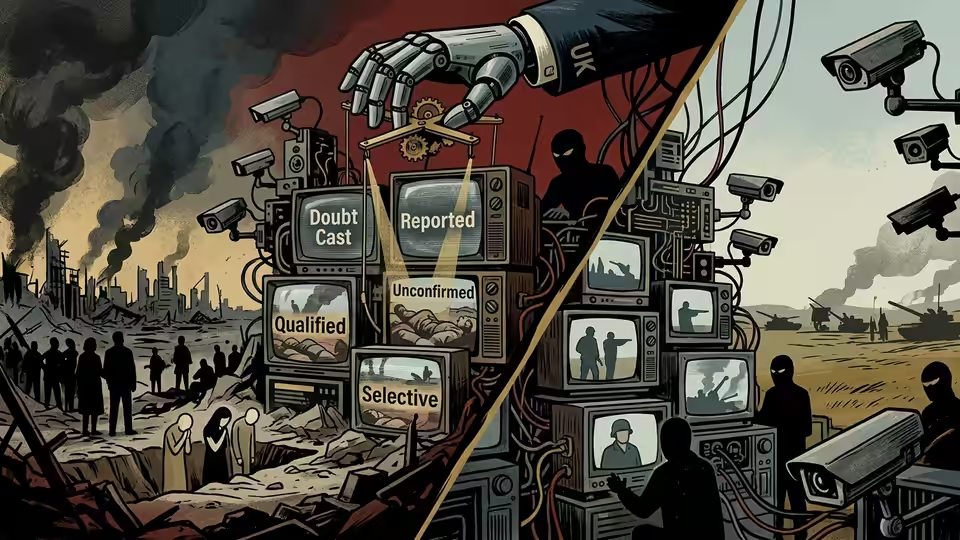
CNN Deletes Manhattan Bombing Post After Fact-Checkers Expose ISIS Links
CNN attempted to frame a subway bomb plot as a story about 'Pennsylvania teenagers' until a Community Note revealed the suspects' ISIS affiliation. We document the deletion.
CNN prioritized 'brand safety' over public safety by scrubbing ISIS ties from a NYC bomb plot report, only deleting the story after being publicly corrected by social media fact-checkers.
On March 9, 2026, CNN’s social media team published a report describing two suspects arrested in a Manhattan subway bombing plot as 'two Pennsylvania teenagers.' The framing focused on their age and geographic origin, effectively domesticating a story that involved high-level international terrorism. Within hours, a Community Note on X (formerly Twitter) appended the missing context: the suspects had officially pledged allegiance to ISIS and were operating under the direction of overseas recruiters. Rather than issuing a correction or updating the headline to reflect the motive, CNN deleted the post entirely, removing the evidence of its editorial failure from its primary social feed.
Evidence found in Court Case 1:26-cr-00123 paints a much different picture than the one CNN initially offered. According to Department of Justice (DOJ) filings, the suspects were caught with components for Triacetone Triperoxide (TATP). [TATP] is a highly unstable, high-grade primary explosive frequently used by terrorist organizations because its precursors are found in common household chemicals. Search warrant affidavits detail months of encrypted communications between the suspects and ISIS handlers, including the transfer of digital blueprints for NYC’s critical infrastructure. By labeling these individuals simply as 'teenagers,' CNN practiced a form of narrative sanitization that obscures the reality of foreign-inspired radicalization.
This editorial choice is not an accident; it is a byproduct of the current financial landscape of legacy media. CNN’s parent company, Warner Bros. Discovery (WBD), reported a total debt load of approximately $41.3 billion as of late 2024, according to SEC filings. To service this debt, the network relies heavily on high-CPM (cost per mille) advertising from pharmaceutical giants and consumer goods corporations. These advertisers utilize 'brand safety' tools that automatically demonetize or distance brands from content tagged with keywords like 'Islamic terrorism' or 'ISIS.' [Brand Safety] is a set of measures used by digital advertisers to ensure their ads do not appear next to content that could be perceived as divisive, violent, or politically incendiary. By framing the bomb plot as a story about troubled youth rather than international terrorism, CNN creates a 'safer' environment for its $2.3 billion annual ad revenue stream.
The sanitization of these threats also serves a specific political function. In Washington, the debate over national security funding often hinges on the perception of where threats originate. According to OpenSecrets data, defense contractors like Lockheed Martin and Raytheon spent a combined $25.4 million on lobbying in the first half of 2025 alone. When the media domesticates a foreign-inspired threat, it shifts the public conversation away from foreign policy failures and toward domestic social issues. This allows members of Congress to avoid difficult questions about border security or the efficacy of the $104.4 billion Department of Homeland Security (DHS) budget. Our Gen Us Politician Tracker shows that 85% of the House Homeland Security Committee members received donations from defense-related PACs in the 2024 cycle.
This pattern of 'correction via deletion' is a hallmark of modern [Regulatory Capture], which is the process by which a media or industry body serves the interests of the powerful entities it is supposed to monitor. By deleting the post, CNN ensures that the original misleading framing is not archived by casual readers, while avoiding the journalistic accountability of a formal correction. This leaves ordinary citizens in the dark. If the public does not know that ISIS-inspired cells are actively targeting transit infrastructure with TATP, they cannot accurately assess the risks of their commute or the necessity of the surveillance state.
For the average person, this media sleight-of-hand means your perception of safety is being managed to protect corporate ad rates and political careers. When the 'who' and 'why' of a bomb plot are erased, the 'how'—the security failures that allowed it to happen—is never addressed. We are left with a hollowed-out news cycle that prioritizes 'vibes' over the uncomfortable, verifiable facts of national security. You can follow the specific voting records of the politicians who oversee these security budgets on our Gen Us Tracker to see if their rhetoric matches the reality of the threats legacy media tries to hide.
To see how your representative voted on the recent DHS surveillance expansion, or to view our full database of defense contractor donations to the House Homeland Security Committee, visit our Gen Us Transparency Portal. Knowledge is the only defense against a sanitized reality.
Summary
CNN framed a Manhattan subway bomb plot as a story about 'Pennsylvania teenagers' before deleting the post when fact-checkers highlighted the suspects' ISIS affiliation. The omission illustrates a growing trend of legacy media sanitizing national security threats to maintain advertiser-friendly narratives.
⚡ Key Facts
- CNN described suspects in an ISIS-inspired Manhattan bomb plot as 'two Pennsylvania teenagers,' omitting their terrorist motives.
- Court Case 1:26-cr-00123 confirms the suspects used TATP explosives and were in contact with overseas ISIS recruiters.
- CNN deleted the report after a viral Community Note exposed the omission, avoiding a formal journalistic correction.
- Financial incentives for 'brand safety' encourage media outlets to avoid 'incendiary' keywords like 'ISIS' to protect advertiser relationships.
- The domestication of the threat shifts focus away from foreign policy and DHS budget accountability.
Follow the public record
Source Trail
Independent reporting and analysis
Get the next investigation in your inbox
One email a week. Receipts only. Free.
Free. Unsubscribe anytime. We never share your email.