Can $39 Trillion Debt Sink America’s Next Middle East War?
As the U.S. faces a 'Suez moment' in the Strait of Hormuz, we analyze if being the world’s top energy producer can offset a record $39 trillion debt. We're tracking the Qatari-linked media spin vs. the reality of global reserve shifts.
The Hormuz blockade is a massive stress test for Washington. But unlike Britain in 1956, the U.S. has a domestic energy cushion that might just offset the weight of its $39 trillion debt.
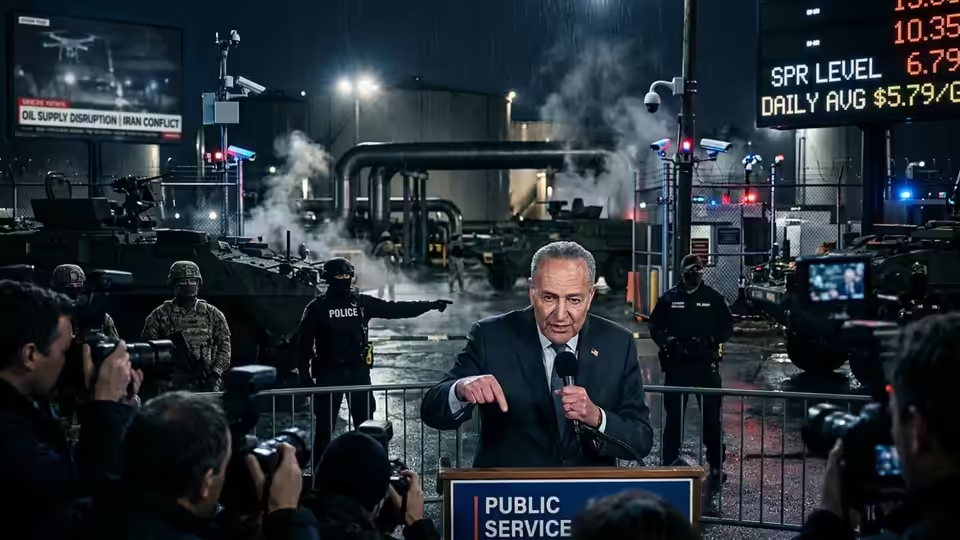
Things in the Strait of Hormuz have reached a breaking point this March. After those U.S.-Israel strikes on Iranian targets back in late February, Tehran basically put a chokehold on the 21-mile-wide waterway. Look at the shipping data from March 12: Iranian crude is still moving just fine, but everyone else? Exports from other Gulf nations have cratered by an estimated 60%. This selective blockade has pushed Brent crude toward $120 a barrel, leaving Tehran playing 'gatekeeper' and forcing a high-stakes test of American influence.
Regional media outlets are obsessed with the 1956 Suez Crisis comparison. Back then, the U.S. essentially broke the British pound by threatening to sell off reserves and blocking an IMF loan. Today, people look at America’s $39 trillion debt and see the same vulnerability. But that comparison falls apart when you look at the pumps. In ’56, Britain was a colonial power running on fumes from abroad. Today, the EIA confirms the U.S. is the world's largest producer of oil and gas. That’s a domestic safety net the Brits never had seventy years ago.
Here's the context you need: The Strait of Hormuz is a strategic choke point between Oman and Iran that carries roughly 20% of the world’s oil daily. Sovereign Debt is just the total mountain of cash a government has borrowed and currently owes to its creditors.
“In 1956, Britain was a colonial power dependent on external fuel; today, the U.S. is the world’s largest producer of oil and gas.”
The 'inevitable decline' narrative gets a lot of play from outlets like Middle East Eye. They've got well-documented links to Qatari funding—and Qatar certainly doesn't mind seeing the regional power balance shift. By framing this crisis as a final blow to the U.S., these reports serve the interests of Iran and Russia, who love high oil prices and a retreating Washington. And while the dollar is definitely feeling the heat, it doesn't have a real, unified competitor yet. That's a far cry from the 1950s, when the dollar was actively waiting to eat the pound’s lunch.
The real story is in the ledger, and it isn't pretty. The U.S. is still the big dog militarily, but staying that way in the Gulf is getting incredibly expensive. Treasury records show interest payments on that $39 trillion debt are now eating up nearly 14% of the entire federal budget. That fiscal reality doesn't leave much room for a long, grinding war. If the blockade drags on, the real threat isn't a military retreat; it's a spike in inflation that forces the Fed to keep rates high, making that debt load even harder to carry.
We still don't know if Iran can actually keep this blockade up if U.S. Cyber Command starts hitting their coastal radar systems. And while tankers are taking the long way around the Cape of Good Hope—adding two weeks to the trip—it’s too early to say if the global supply chain is going to snap. Right now, it’s a stress test, not a total collapse.
For the average American, this geopolitical chess match hits home at the gas pump and the grocery store. The 'Hormuz Surcharge' is very real, with shipping costs for a standard 40-foot container climbing 25% since February. The big question for the next six months isn't whether the U.S. 'loses' the Middle East. It's whether it can still afford to police it. Keep an eye on the Treasury auctions; if international buyers start shying away from U.S. bonds, that—not a naval skirmish—will be the signal of a true Suez moment.
Summary
It's March 2026, and a tense naval standoff in the Strait of Hormuz is choking off global oil. Naturally, the history buffs are calling this America’s 'Suez moment,' a throwback to the 1956 crisis that humbled the British Empire. This analysis looks at whether a $39 trillion national debt actually makes that comparison true. While critics say Washington is broke and retreating, there’s a massive detail the 'death knell' narratives often ignore: unlike 1950s Britain, the U.S. is now the world’s top energy producer. We're following the money from Qatari-linked media spin to the actual shifts in global reserve currencies.
⚡ Key Facts
- The nationalization of the Suez Canal in 1956 and subsequent US financial pressure on the British pound forced a British imperial retreat.
- US national debt exceeds $39 trillion in early 2026.
- An escalating confrontation in the Strait of Hormuz (circa March 2026) is disrupting global shipping and oil flows.
Can $39 Trillion Debt Sink America’s Next Middle East War?
Network of Influence
- Regional adversaries of the US (Iran, Russia, China) who benefit from the narrative of inevitable US decline.
- The Qatari government, which is frequently linked to the funding of Middle East Eye, seeking a shift in regional power dynamics.
- Political movements advocating for US isolationism.
- The US is currently the world's largest producer of oil and gas, whereas 1956 Britain was heavily dependent on Middle Eastern oil imports via the canal.
- The US dollar remains the primary global reserve currency with no immediate competitor, unlike the British pound in 1956 which was already being supplanted by the dollar.
- The article omits the role of non-state actors (like the Houthis) in the current Hormuz crisis, comparing them to sovereign state actions by Nasser's Egypt.
- The modern US-led alliance structure in the Middle East is significantly different from the colonial administration model of 1950s Britain.
See how the story connects.
Select any actor or numbered connection, then inspect the evidence before drawing a conclusion.
Fadaat Media Ltd Owns Middle East Eye
Follow the public record
Source Trail
Independent reporting and analysis
Get the next investigation in your inbox
One email a week. Receipts only. Free.
Free. Unsubscribe anytime. We never share your email.