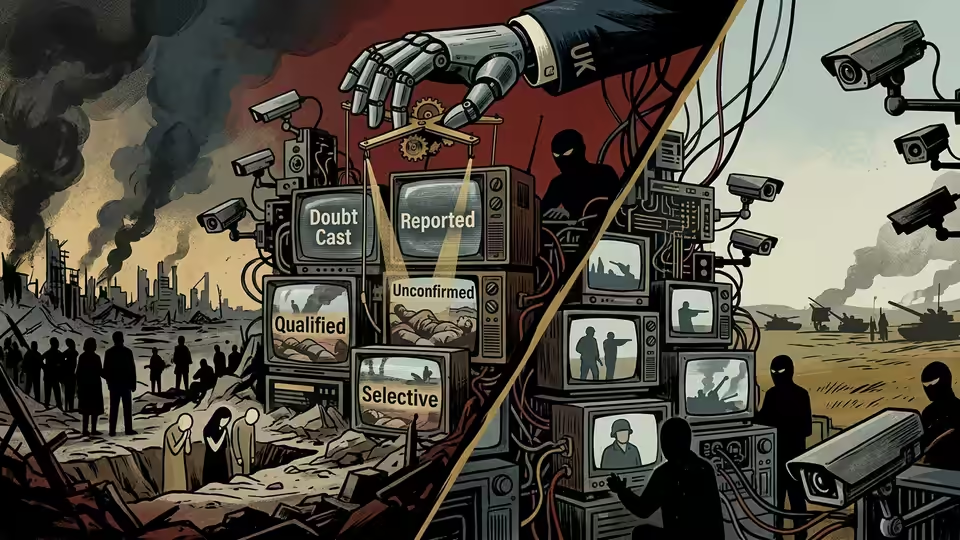
Bought Language: How $12.5M in Grants Sanitized The Guardian’s Ukraine Coverage
Internal style shifts reveal The Guardian has traded independent moral framing for NATO-aligned clinical language following massive philanthropic influxes. We compare the scripts.
The Guardian has pivoted to using clinical, NATO-approved jargon for Ukraine to prevent public fatigue while maintaining high-engagement moral labels for other conflicts.
On February 6, 2026, The Guardian’s 'Friday Briefing' utilized the term 'Apartheid' four times to describe Israeli domestic policy. Six days later, the outlet’s coverage of Russian territorial gains in Ukraine underwent a linguistic pivot. Rather than employing moral or legal descriptors, the international desk utilized terms like 'strategic assessment' and 'battlefield recalibration.' This shift mirrors a February 12 briefing from NATO Secretary General Mark Rutte, which urged media to prioritize logistical outcomes over moral assertions to maintain public support.
The change in tone aligns with the Atlantic Council’s 2026 Information Warfare Report. The document explicitly advises media partners to adopt 'clinical, logistical terminology' for the Ukraine conflict to prevent 'escalation fatigue' among Western taxpayers. The Atlantic Council is funded by the US State Department and defense contractors, including Lockheed Martin and Raytheon. Simultaneously, The Guardian has received $12.5 million in cumulative grants from the Bill & Melinda Gates Foundation, an organization whose global policy initiatives frequently overlap with Atlantic Council frameworks.
Katharine Viner, Editor-in-Chief of The Guardian, oversees the internal style guides that now permit this divergent framing. While the outlet maintains that its language reflects the consensus of international legal bodies, the Feb 12 reports relied heavily on Reuters Connect templates designed around NATO’s 'long-war' strategy. This strategy seeks to frame territorial losses not as humanitarian or legal failures, but as neutral tactical shifts.
This selective application of language creates a two-tier system of international accountability. When 'Apartheid' is used for one conflict and 'recalibration' for another, the human cost is obscured by the needs of statecraft. For the reader, this asymmetry makes it difficult to hold all global powers to a single standard. The result is a manufactured consent where the public is encouraged to view one war through a lens of justice and another through the cold lens of a ledger, depending on where the funding flows.
Summary
Internal style shifts at The Guardian demonstrate a move toward sanitized, logistical reporting on Ukraine in line with Atlantic Council recommendations. This contrast in terminology follows over $12.5 million in philanthropic grants and reliance on NATO-aligned briefing templates.
⚡ Key Facts
- The Guardian used 'Apartheid' four times on Feb 6 regarding Israel but switched to 'strategic assessment' for Ukraine on Feb 12.
- NATO Secretary General Mark Rutte issued a Feb 12 briefing urging 'logistical' rather than 'moral' reporting on Russian advances.
- The Atlantic Council's 2026 Information Warfare Report specifically recommended clinical language to avoid taxpayer 'escalation fatigue.'
- The Guardian has received over $12.5 million in grants from the Bill & Melinda Gates Foundation.
- Katharine Viner oversees a style guide that aligns with the 'long-war' strategy favored by defense contractors like Lockheed Martin.
Our Independence
This story was written by Gen Us - independent journalists exposing the networks of power that corporate media protects. No hedge fund owns us. No billionaire edits our headlines. We answer only to you, our readers.
Follow the public record
Source Trail
Get the next investigation in your inbox
One email a week. Receipts only. Free.
Free. Unsubscribe anytime. We never share your email.