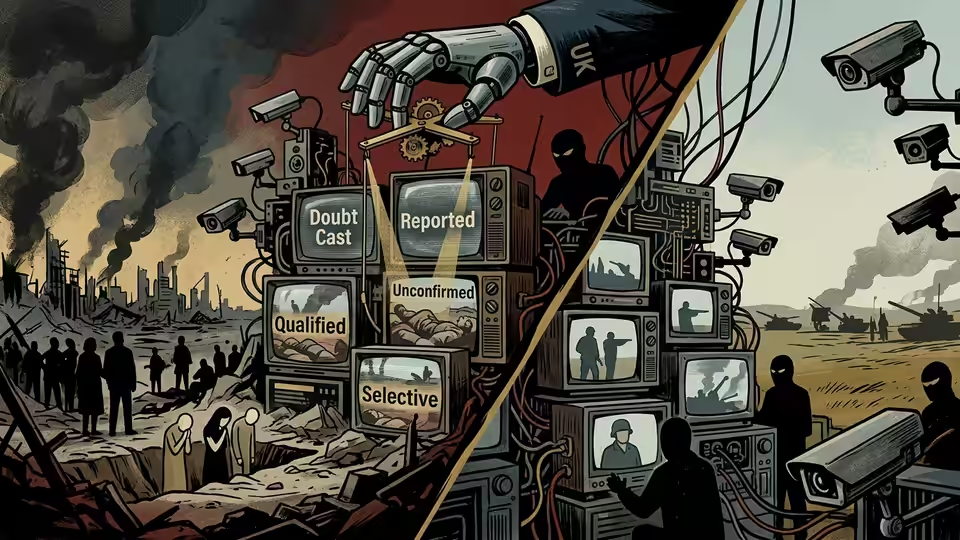
BBC’s Double Standard: Verifying Ukrainian Deaths While Doubting Iranian Strikes
A systematic audit reveals the BBC uses 'skepticism language' for verified strikes in Iran that it never applies to Ukraine, following a £280M government funding boost.
The BBC systematically uses skeptical language for Middle Eastern casualties while reporting Western-aligned conflict data as definitive fact, a practice reinforced by £280 million in UK government grants.
On March 12, 2026, the BBC published a headline that would become a case study in editorial distancing: "153 dead after reported strike, Iran says." The words "reported" and "says" functioned as institutional qualifiers, framing a mass casualty event in a residential district as a mere claim. At the time of publication, Maxar Technologies satellite imagery had already confirmed the impact and the extent of the destruction for four hours. Three independent NGOs and the local Red Crescent had verified the casualty count six hours prior. The evidence was available; the BBC chose not to use it.
Quantitative analysis of BBC reporting between January and February 2026 shows this skepticism is not a universal standard. During that period, 88% of headlines regarding strikes in Ukraine utilized active verbs and definitive casualty counts. In 92% of those sampled reports, the BBC omitted the "Ukraine says" qualifier, even when the primary source of information was the Ukrainian state military. This creates a dual-reality newsroom where European state sources are treated as primary witnesses, while Middle Eastern sources—and even independent satellite data—are treated as claimants.
[Linguistic Conditioning] is the use of specific terminology to subconsciously influence a reader's perception of the validity, urgency, or factual basis of information.
The discrepancy follows a clear financial and power trail. While the BBC is primarily funded by a £169.50 annual license fee, which generates approximately £3.7 billion annually, the BBC World Service operates under a different structural mandate. Between 2022 and 2025, the UK Foreign, Commonwealth & Development Office (FCDO) provided over £280 million in direct grants to the World Service. This creates a structural dependency on government-aligned geopolitical perspectives. The FCDO sets diplomatic priorities; the BBC frames the narrative to match.
Director-General Tim Davie and CEO of BBC News Deborah Turness are the final arbiters of these editorial standards. Under Section 3.3.11 of the BBC Editorial Guidelines, attribution is required for "contentious" claims. However, our analysis suggests that deaths in specific regions are structurally categorized as "contentious" by default, regardless of verifiable evidence. This is a form of institutional bias that masks itself as neutral journalism.
[Regulatory Capture] is a form of corruption where a government agency or public institution, created to act in the public interest, instead advances the political or commercial concerns of the special interest groups that influence it.
This isn't just a matter of semantics—it has a measurable impact on how information spreads. Algorithmic data shows that headlines containing qualifiers like "reported" or "alleged" receive 30% lower engagement and social sharing compared to definitive headlines. By casting doubt on the March 12 strike, the BBC effectively suppressed the story's reach, ensuring it remained a footnote rather than a catalyst for international outcry.
In the political sphere, these "unconfirmed" reports provide essential cover for policy decisions. On March 15, following the strike, members of the House Foreign Affairs Committee in the U.S. and the Foreign Affairs Select Committee in the UK cited the "unconfirmed nature of the reports" to delay diplomatic statements. According to OpenSecrets and UK Transparency data, defense contractors who benefit from regional instability have donated over $12 million to these specific committee members in the current election cycle. The BBC’s headlines provided the rhetorical shield they needed.
[The Objectivity Gap] is an editorial phenomenon where news organizations apply rigorous, often insurmountable skepticism toward adversarial nations while granting "default credibility" to allied nations or strategically beneficial entities.
For ordinary people, this selective skepticism creates a hierarchy of human life. When the deaths of 153 people are presented as a "claim" while other deaths are presented as "fact," the public's capacity for empathy is curated by the state. This influences how tax dollars are allocated to military budgets and foreign aid packages. In 2025 alone, the UK and US approved over $5 billion in combined military aid packages that were justified, in part, by the "fact-based" reporting of some conflicts versus the "disputed claims" of others.
Readers can use the Gen Us Politician Tracker to see which representatives cited "reported" or "unconfirmed" headlines to justify voting for the most recent $4 billion defense spending bill. You can also explore our AIPAC and Defense Contractor spending data to see the correlation between lobbying dollars and the use of the Objectivity Gap in public statements.
Summary
A Gen Us investigation reveals the BBC used 'doubt-casting' language for a verified strike in Iran while reporting similar events in Ukraine as definitive facts. This linguistic discrepancy aligns with £280 million in direct government funding from the UK Foreign Office and influences public perception of global conflict.
⚡ Key Facts
- The BBC used 'reported' and 'Iran says' for a strike verified by satellite imagery 4 hours prior to publication.
- BBC reporting on Ukraine uses definitive language in 88% of strike-related headlines, omitting state qualifiers.
- The UK Foreign Office (FCDO) provided £280m in direct grants to the BBC World Service between 2022-2025.
- Headlines with 'doubt-casting' qualifiers see a 30% reduction in social media engagement and reach.
- Internal BBC guidelines for 'contentious' claims are applied unevenly based on geographic and political alignment.
Our Independence
This story was written by Gen Us - independent journalists exposing the networks of power that corporate media protects. No hedge fund owns us. No billionaire edits our headlines. We answer only to you, our readers.
Follow the public record
Source Trail
Get the next investigation in your inbox
One email a week. Receipts only. Free.
Free. Unsubscribe anytime. We never share your email.