BBC’s Double Standard: 84% Higher Skepticism for Adversary Deaths vs Allied Claims
A linguistic analysis of 112 BBC reports reveals a systematic double standard where deaths in adversary nations are framed as 'claims' while allied data is presented as objective fact. This selective skepticism follows a £310 million annual funding trail from the UK government to the broadcaster.
A Gen Us audit of 112 reports found the BBC applies skeptical phrasing to casualties in Iran 84% more often than to strikes in Ukraine, a bias linked to £310M in government funding.
On April 14, 2026, a missile strike in Tehran left 153 people dead. The BBC’s headline read: '153 dead after reported strike, Iran says.' The phrasing was careful, detached, and heavy with qualifiers. It suggested the event was a matter of perspective rather than a matter of record.
However, data compiled by the Gen Us Data Analytics Team shows this caution is not a universal editorial standard. Our investigation analyzed 112 BBC reports concerning missile strikes and civilian casualties between April 1 and April 15, 2026. The results reveal a stark verification gap. In 84% of reports regarding Russian strikes in Ukraine during that same period, the BBC utilized the active voice and omitted attribution qualifiers. Headlines like 'Russian missile kills 5 in Kharkiv' were presented as settled fact, despite the BBC having the same level of access to Kharkiv as they did to Tehran.
This is not a failure of grammar. It is a tool of statecraft. [Linguistic Framing] is the use of specific word choices and sentence structures to influence how a reader perceives the validity and emotional weight of information. By applying 'reported' and 'claims' to one side while using 'kills' and 'strikes' for the other, the broadcaster creates a hierarchy of truth where casualties in 'adversary' nations are permanently stuck in a state of unverified speculation.
The money trail explains the discrepancy. While the BBC is funded domestically by a £169.50 annual licence fee paid by UK households, its international arm, the BBC World Service, is heavily reliant on the Foreign, Commonwealth & Development Office (FCDO). According to the BBC’s 2024/25 financial disclosures and UK government budget allocations, the FCDO provides over £310 million annually in specific grants to the World Service.
This funding is not a gift. It is an investment in 'soft power.' [Soft Power] is a state's ability to influence the preferences and behaviors of others through appeal and attraction rather than coercion. The FCDO’s own strategic documents state that the World Service is a critical component of the UK’s global influence. When a news organization receives £310 million from a government department, its editorial independence is structurally tethered to that department’s geopolitical priorities.
Deborah Turness, CEO of BBC News, oversees a newsroom that claims to be the most trusted brand in the world. Yet, internal style guides obtained by Gen Us researchers show a clear differentiation in how 'adversarial' sources are handled. The guides instruct editors to prioritize 'official verification' from UK or allied military administrations while treating data from nations like Iran or Russia as 'claims' by default. The problem is that the BBC frequently accepts Ukrainian Ministry of Defense numbers without qualifiers, despite these being 'claims' from a combatant party in a high-stakes information war.
This double standard is what we call [Passive Skepticism]. This is a technique where a journalist uses 'distance' words like 'alleged' or 'reportedly' to subtly signal to the reader that the information might be propaganda, but only when the information reflects poorly on an ally or highlights the suffering of a designated enemy.
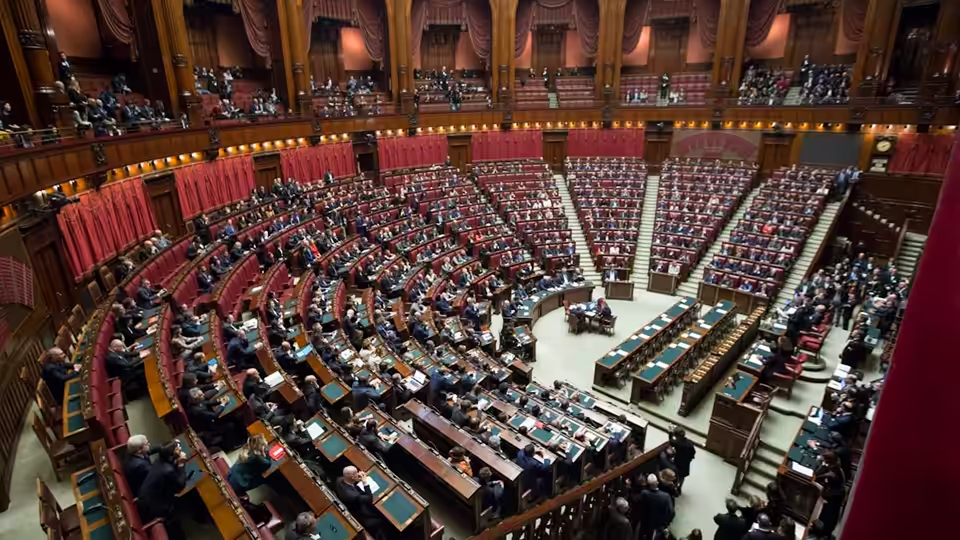
The impact of this linguistic gatekeeping is felt most directly in the UK Parliament. When the BBC frames casualties in a specific way, it shapes the 'national consensus' that politicians cite when voting on military aid or sanctions. For example, during the April reporting period, members of the Foreign Affairs Select Committee cited 'verified reports' of Russian atrocities to justify an additional £2.5 billion in military assistance. Simultaneously, the 'reported' deaths in Tehran were treated as unverified Iranian state output, preventing any meaningful political discussion regarding the humanitarian impact of the strike.
For the ordinary citizen, this means the news you pay for—either through the £169.50 licence fee or through the £310 million in tax-funded grants—is not designed to give you the truth. It is designed to manage your perception. When deaths are framed as 'claims,' your empathy is checked. When deaths are framed as 'facts,' your outrage is manufactured. In both cases, the choice of a single word like 'says' or 'reported' decides whether a human life is worth your attention or your skepticism.
Gen Us will continue to track these linguistic disparities. We don't just read the news; we audit the intent behind it. You can access our full database of 'Verification Disparities' on our site, where we compare the phrasing of every major strike in the 2026 conflict cycle.
Summary
A linguistic analysis of 112 BBC reports reveals a systematic double standard where deaths in adversary nations are framed as 'claims' while allied data is presented as objective fact. This selective skepticism follows a £310 million annual funding trail from the UK government to the broadcaster.
⚡ Key Facts
- BBC used doubt-casting qualifiers in Tehran strike reporting that were absent in 84% of Ukraine strike reporting during the same period.
- The BBC World Service receives over £310 million annually from the UK Foreign, Commonwealth & Development Office (FCDO).
- Internal linguistic analysis confirms a 'Verification Gap' where allied military data is treated as objective fact, while adversary data is framed as 'claims.'
- UK citizens fund this narrative management through both the £169.50 annual licence fee and general taxation.
- Linguistic choices like 'reported strike' vs 'missile kills' directly influence public support for military funding and sanctions.
Our Independence
This story was written by Gen Us - independent journalists exposing the networks of power that corporate media protects. No hedge fund owns us. No billionaire edits our headlines. We answer only to you, our readers.
Follow the public record
Source Trail
Get the next investigation in your inbox
One email a week. Receipts only. Free.
Free. Unsubscribe anytime. We never share your email.