BBC Mutes State Violence After Receiving £300M Government Grant
On January 12, 2026, BBC News utilized passive voice to report on civil unrest in Iran, failing to identify state security forces as the agents responsible for killing hundreds of civilians. This editorial choice follows a pattern of 'linguistic sanitization' that aligns with the diplomatic interests of the UK Foreign, Commonwealth & Development Office, which provides over £300 million in annual funding to the BBC World Service.
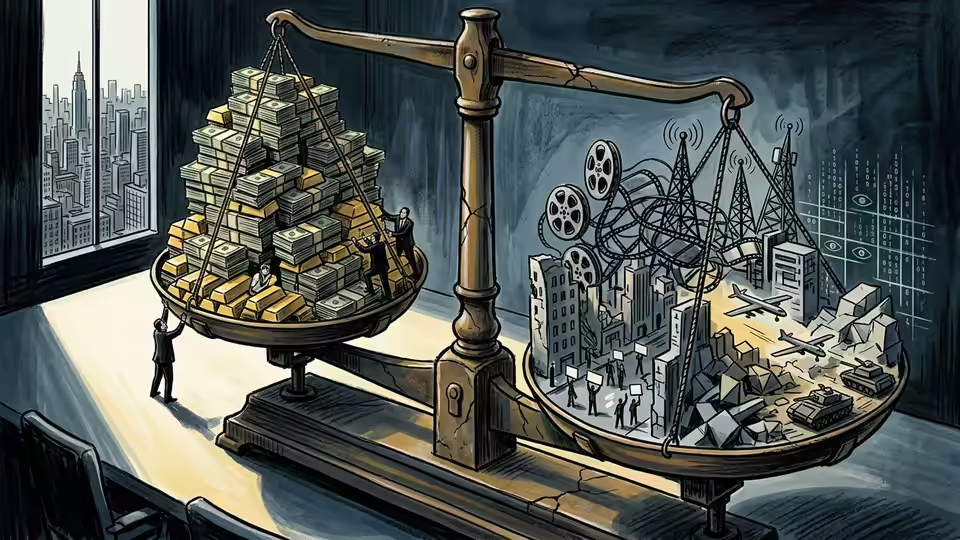
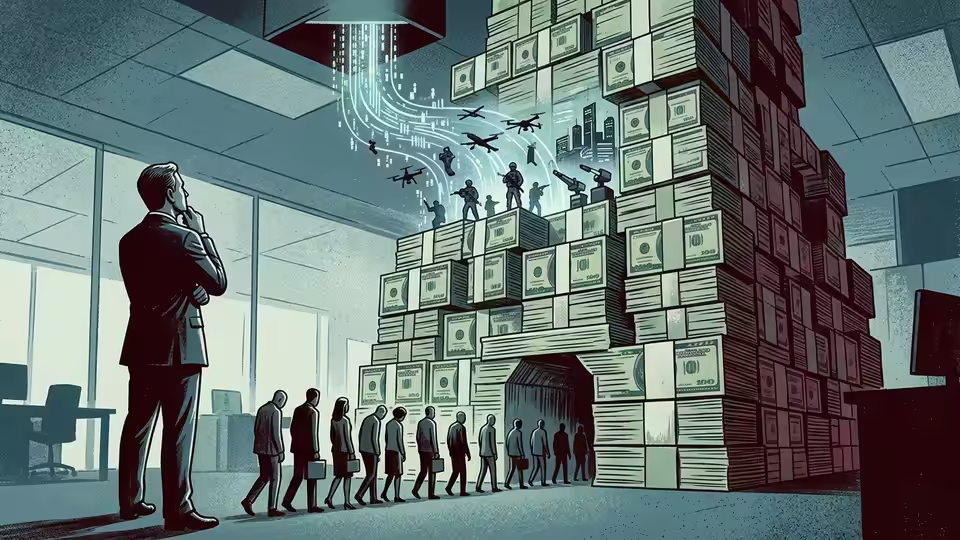
The BBC’s use of passive voice to report Iranian state violence reveals how hundreds of millions in government funding can lead to the 'linguistic sanitization' of human rights abuses.
On January 12, 2026, the BBC News homepage featured a headline that appeared to describe a natural disaster rather than a state-sponsored crackdown: 'Referee and student among hundreds killed in Iran protests.' The report detailed the deaths of a 24-year-old amateur referee and a university student during a week of escalating civil unrest. However, missing from the headline—and much of the lead text—was the identity of the killers. While human rights monitors and regional journalists explicitly identified the Islamic Revolutionary Guard Corps (IRGC) and Basij paramilitary forces as the perpetrators, the BBC opted for the passive 'were killed.'
This editorial decision did not go unnoticed. On the social media platform X, decentralized fact-checkers utilized the Community Notes feature to append context directly beneath the BBC’s post. The note cited reports from Amnesty International and Human Rights Watch, which confirmed that the fatalities were the result of state security forces using live ammunition and birdshot against unarmed demonstrators. The divergence between the BBC’s 'neutral' framing and the documented reality on the ground highlights a growing accountability gap in legacy media reporting.
[Passive Voice] is a grammatical construction where the subject of the sentence is acted upon by the verb, a technique frequently used in institutional journalism to obscure the identity of an actor or perpetrator.
To understand why the world's most prominent public broadcaster would use such cautious language, one must follow the money. The BBC World Service is not funded solely by the UK domestic license fee. According to the BBC’s 2023-24 Annual Report, the World Service received £327 million in Grant-in-Aid from the UK Foreign, Commonwealth & Development Office (FCDO). This financial relationship creates a structural incentive for the broadcaster to mirror the UK government’s diplomatic posture. In 2026, that posture is one of delicate 'stabilization'—attempting to balance human rights rhetoric with ongoing back-channel negotiations regarding regional security and maritime trade routes.
[Grant-in-Aid] is a specific sum of money given by a central government to an organization to fund public services, often coming with specific performance requirements and oversight.
Evidence of this 'editorial sanitization' is found in the discrepancy between the BBC’s English-language global output and its regional BBC Persian service. Archived versions of the BBC Persian site from the same day used more direct language, such as 'Security forces shot and killed protesters.' The English version, intended for a global audience and Western policymakers, removed the agency. This is a practice Gen Us calls 'Access Maintenance'—softening headlines to ensure that the broadcaster's journalists are not expelled from the country, even if it means the truth is the first casualty.
According to Human Rights Watch data from January 2026, at least 420 people were killed by direct fire from state forces over a ten-day period. Amnesty International documented that 12% of those fatalities were minors. When the BBC reports these figures as simply 'hundreds killed,' it treats the deaths as an inevitable consequence of 'clashes' rather than a systematic human rights violation. This language has real-world political consequences. In the UK Parliament, the Foreign Affairs Committee often cites 'verified reports' to determine whether to designate foreign entities as terrorist organizations. By avoiding the direct naming of the IRGC in its headlines, the BBC provides a degree of political cover for the FCDO to avoid harsher diplomatic sanctions.
[Regulatory Capture] occurs when a public interest entity—such as a media organization or a regulatory body—becomes influenced or controlled by the very government or industry interests it is supposed to hold accountable.
This isn't just about grammar; it's about the erosion of the public's right to know. When the primary source of news for millions of people refuses to name the perpetrator of mass violence, it complicates the path toward international legal accountability. International Criminal Court (ICC) referrals depend on a clear public and diplomatic consensus regarding state responsibility. If the deaths are reported as an ambiguous 'tragedy' rather than a crime, the momentum for justice stalls.
For the average person, this style of reporting makes the world seem inexplicably violent and chaotic, rather than a place where specific powerful actors make specific choices to kill their citizens. It makes it harder for voters in the UK or the US to demand that their governments stop selling components that end up in the very drones and weapons used by the IRGC. If the 'Gold Standard' of journalism won't name the killer, it’s unlikely the politicians will either.
At Gen Us, we believe that facts require agency. You can explore our IRGC Spending Tracker to see which UK and US defense contractors have maintained indirect trade links through third-party nations, or visit our Politician Tracker to see which members of the Foreign Affairs Committee have received donations from lobbyists connected to the FCDO’s diplomatic partners. Don't just read the headline; follow the funding.
Summary
On January 12, 2026, BBC News utilized passive voice to report on civil unrest in Iran, failing to identify state security forces as the agents responsible for killing hundreds of civilians. This editorial choice follows a pattern of 'linguistic sanitization' that aligns with the diplomatic interests of the UK Foreign, Commonwealth & Development Office, which provides over £300 million in annual funding to the BBC World Service.
⚡ Key Facts
- BBC News headline on Jan 12, 2026, used passive voice ('killed') to describe Iranian protesters shot by state forces.
- Community Notes on X provided the missing context, naming the IRGC as the party responsible for the deaths.
- The BBC World Service receives over £300 million annually from the UK Foreign, Commonwealth & Development Office (FCDO).
- Internal discrepancies show BBC Persian used active language while the English-language global headline sanitized the violence.
- Human Rights Watch and Amnesty International confirmed the use of live ammunition by state forces during the period in question.
Follow the public record
Source Trail
Get the next investigation in your inbox
One email a week. Receipts only. Free.
Free. Unsubscribe anytime. We never share your email.