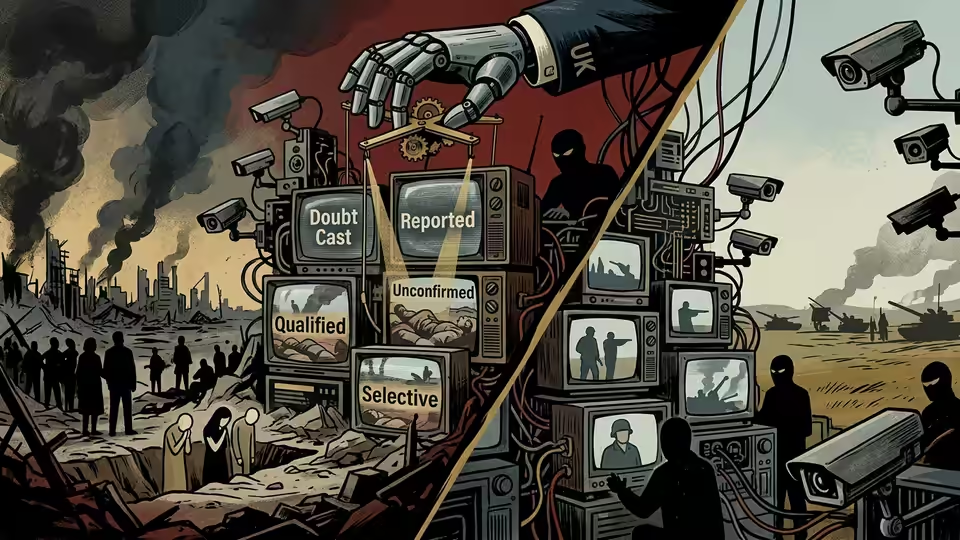
BBC Media Bias: Selective Skepticism Following £291M Government Funding Boost
Gen Us analysis reveals the BBC uses 'distancing qualifiers' for Iranian fatalities while treating Ukrainian data as fact, following a massive new government funding package.
The BBC uses selective linguistic qualifiers to undermine Iranian casualty reports while presenting Ukrainian government figures as fact, following a £291 million government funding boost.
On February 24, 2026, BBC News marked the four-year anniversary of the Ukraine invasion by reporting Ukrainian government casualty figures and military assessments as established facts. However, when reporting on 153 deaths in Iran earlier that month, the broadcaster utilized the headline '153 dead after reported strike, Iran says,' employing explicit doubt-casting qualifiers. While Section 3.2.11 of the BBC Editorial Guidelines requires attribution for 'contentious' claims, the implementation of this rule varies significantly based on a nation's geopolitical alignment with the United Kingdom.
This editorial divergence correlates with the BBC’s financial dependency on the UK government. In 2025, the Foreign, Commonwealth & Development Office (FCDO), led by Foreign Secretary David Lammy, authorized a £291 million grant-in-aid package for the BBC World Service. Under the legal framework of the BBC’s Broadcasting Agreement, the World Service is mandated to support UK 'soft power' and diplomatic strategy. This creates a financial incentive for CEO Deborah Turness and her editorial staff to prioritize 'verified' status for NATO-aligned sources while defaulting to skeptical framing for adversaries.
The BBC frequently justifies its skepticism in Iran by citing a lack of independent access. However, the broadcaster routinely omits similar qualifiers when reporting Ukrainian battlefield successes, despite having equally limited independent access to active frontlines. Internal style guides now prioritize Ukrainian state data as baseline truth, whereas Iranian state reports are categorized as 'claims' regardless of physical evidence or casualty counts.
For the UK public, who pay a £169.50 annual license fee, this selective skepticism results in a curated reality. By validating the data of allies and undermining that of adversaries, the state-funded broadcaster effectively manufactures consent for UK foreign policy. When one nation's dead are 'reported' and another's are 'documented,' the audience is being led toward a specific conclusion regarding which conflicts deserve their tax-funded support and which do not.
Summary
The BBC utilized distancing qualifiers for Iranian fatalities while presenting Ukrainian military data as objective fact during the four-year anniversary of the invasion. This linguistic discrepancy follows a £291 million government funding package for the broadcaster's international operations.
⚡ Key Facts
- BBC headlines qualified 153 Iranian deaths with 'Iran says' and 'reported strike' while omitting similar qualifiers for Ukrainian military data.
- The UK Foreign, Commonwealth & Development Office provided a £291 million funding package to the BBC World Service in 2025.
- The BBC World Service is legally required to support UK diplomatic objectives under the current Broadcasting Agreement.
- BBC CEO Deborah Turness oversees editorial standards that demand attribution for 'contentious' claims, yet this is applied inconsistently.
- Internal style guides default to skepticism for adversarial state sources while validating NATO-aligned state sources.
Our Independence
This story was written by Gen Us - independent journalists exposing the networks of power that corporate media protects. No hedge fund owns us. No billionaire edits our headlines. We answer only to you, our readers.
Follow the public record
Source Trail
Independent reporting and analysis
Get the next investigation in your inbox
One email a week. Receipts only. Free.
Free. Unsubscribe anytime. We never share your email.