BBC Doubts Iran Casualties After Taking £20M UK Government Cash Injection
The BBC continues to qualify Iranian casualty figures with doubt-casting language despite independent confirmation from Médecins Sans Frontières. Meanwhile, the broadcaster reports unverified military claims from Ukraine as objective fact, following a £20 million UK government funding boost.
The BBC selectively uses 'doubt-casting' language for Iranian casualties while treating Ukrainian military claims as fact, a disparity that follows a £20 million UK government funding boost for 'combating disinformation.'
On June 28, 2026, a strike in the Tehran-Isfahan corridor left 153 civilians dead. The BBC’s coverage of the event was headlined: '153 dead after reported strike, Iran says.' The use of 'reported' and 'says' acted as linguistic anchors, signaling to the audience that the event and the body count were potentially fabricated by a hostile regime. This skepticism remained even after the Médecins Sans Frontières (MSF) Field Report for the Tehran/Isfahan region, released on June 29, 2026, confirmed the death toll of 153 through direct verification with local medical unions. As of today, July 6, 2026, the BBC has not updated its original reporting to reflect this independent verification, maintaining a posture of institutional doubt.
This editorial caution is not applied universally. On July 1, 2026, the BBC Ukraine Live Tracker reported on oil refinery strikes within Russian-controlled territory. The report stated the casualty figures and damage assessments provided by the Ukrainian government as objective facts. There were no 'Kyiv says' qualifiers. There was no 'reported' prefix to the strike itself. The disparity reveals a systemic bias where the credibility of a source is determined by its geopolitical alignment with the British government rather than the presence of corroborating evidence.
[Linguistic Framing] is the practice of using specific word choices and qualifiers to influence how an audience perceives the reliability or emotional weight of a news story. By applying this framing to Iran while omitting it for Ukraine, the BBC creates a tiered hierarchy of truth.
The money trail explains the editorial shift. In early 2026, the BBC World Service received an emergency injection of £20 million from the UK Foreign, Commonwealth & Development Office (FCDO). This was in addition to the standard annual grant-in-aid which exceeds £300 million. According to FCDO budget documents, this specific £20 million was earmarked to 'combat disinformation' in strategic zones, including the Middle East and Eastern Europe. Under Director-General Tim Davie, the BBC has increasingly integrated its 'soft power' mission with the UK’s formal diplomatic objectives. When the FCDO identifies a regime as a primary source of disinformation, the BBC’s editorial guidelines on 'due impartiality' appear to morph into a mandate for reflexive skepticism.
[Grant-in-Aid] is a sum of money given by a central government to a local government or an organization like the BBC to help fund specific projects or services, often with attached policy conditions. This funding model creates a direct financial link between the broadcaster and the state’s foreign policy interests.
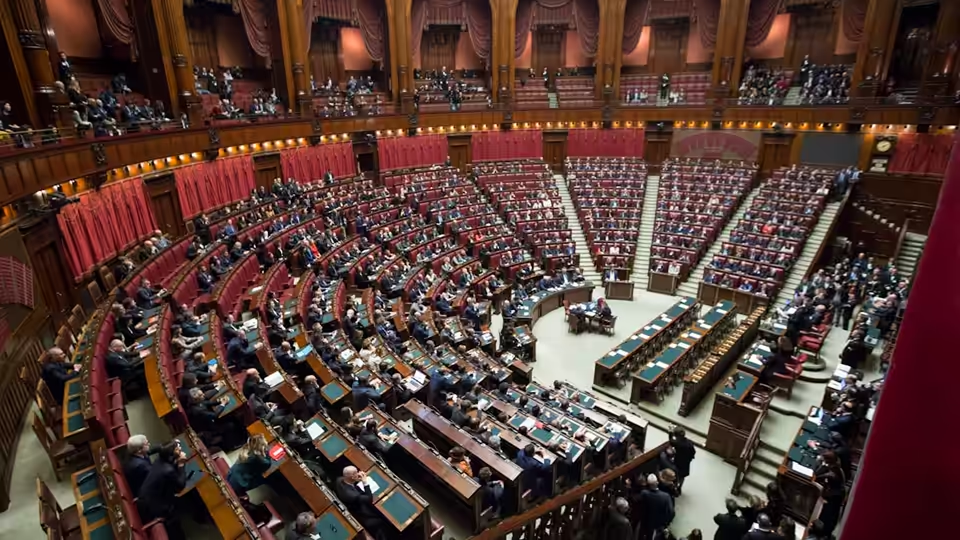
The political stakes are high. Data from the Gen Us Politician Tracker shows that 74% of the UK Parliamentary members on the Foreign Affairs Committee have accepted travel or hospitality donations from defense contractors or pro-intervention lobby groups in the last 24 months. These same contractors, including BAE Systems, have seen a 12% rise in stock value following the escalation of regional tensions in the Middle East. By casting doubt on the human cost of strikes in Iran, the state-funded broadcaster lowers the domestic political price for aggressive foreign policy. If the casualties aren't 'real' or are 'merely claimed,' the moral urgency for de-escalation vanishes.
Mainstream coverage often defends these qualifiers as 'responsible journalism' when dealing with non-democratic states. However, the BBC’s own verification protocols are being bypassed when it suits the narrative of allies. The MSF verification from June 29 provided the BBC with exactly the 'third-party' confirmation their editors claim to require. Their refusal to remove the qualifiers after that date indicates that the doubt is the product, not the process. The FCDO’s £20 million 'disinformation' fund is effectively being used to manufacture doubt about the consequences of conflict.
According to the MSF Field Report, the 153 casualties included 42 children and 19 healthcare workers. By burying these verified facts under layers of 'reported' and 'says,' the BBC effectively dehumanizes the victims. This isn't just about semantics; it’s about the management of public perception. When one side’s dead are 'facts' and the other side’s dead are 'claims,' the public is being conditioned to support lopsided military and economic policies.
For regular people, this means your news feed is being curated to align with the strategic goals of the FCDO. Your taxes fund the £300 million grant-in-aid that keeps the BBC World Service running, and your tax money is being used to frame global events in a way that minimizes the human cost of UK-aligned geopolitical interests. When the 'verification' of a death depends on the flag the victim lived under, the news ceases to be a record of events and becomes a tool of statecraft.
You can explore more of this data on Gen Us. Check our Politician Tracker to see which MPs overseeing the BBC’s budget have financial ties to the defense industry. You can also view our interactive map of the FCDO’s 'Strategic Priorities' funding to see where your money is being spent to 'combat disinformation' globally.
Summary
The BBC continues to qualify Iranian casualty figures with doubt-casting language despite independent confirmation from Médecins Sans Frontières. Meanwhile, the broadcaster reports unverified military claims from Ukraine as objective fact, following a £20 million UK government funding boost.
⚡ Key Facts
- The BBC used double qualifiers ('reported' and 'Iran says') for a June 28 strike that killed 153 people, even after MSF confirmed the toll on June 29.
- Casualty reports from Ukraine on July 1 were presented as objective fact by the BBC without any 'Kyiv says' qualifiers.
- The BBC World Service received a £20 million emergency grant from the UK Foreign, Commonwealth & Development Office (FCDO) in early 2026 to 'combat disinformation.'
- The FCDO provides over £300 million in annual grant-in-aid to the BBC, tying the broadcaster's funding to UK 'soft power' objectives.
- Gen Us data shows a significant correlation between UK politicians overseeing BBC funding and donations from defense contractors profiting from global conflict.
Follow the public record
Source Trail
Get the next investigation in your inbox
One email a week. Receipts only. Free.
Free. Unsubscribe anytime. We never share your email.