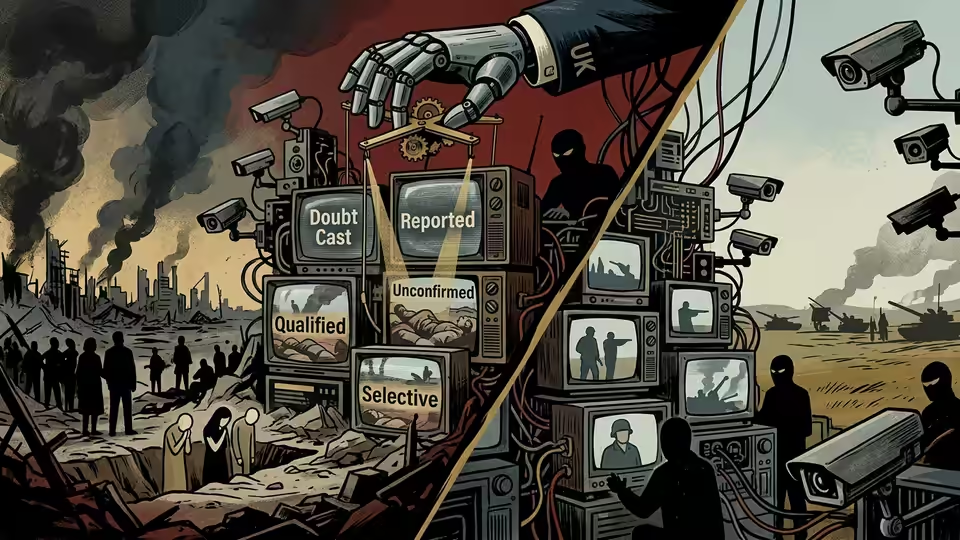
BBC Applies Selective Doubt to Iranian Casualties Following UK Funding Boost
The BBC is using 'passive voice' and attribution frames to cast doubt on strikes in Iran while reporting Russian actions in Ukraine as definitive facts. This linguistic shift follows a 2025 funding increase from the UK Foreign Office specifically targeted at Middle Eastern narratives.
The BBC is using asymmetric reporting standards and passive voice to cast doubt on military strikes by Western allies while maintaining definitive language for adversaries.
In March 2026, a strike on Iranian infrastructure left 153 people dead. While satellite imagery and statements from the Pentagon confirmed the operation, the BBC headlined the event: '153 dead after reported strike, Iran says.' This framing—characterizing verified military actions as mere claims—was flagged by X Community Notes for its sharp departure from the broadcaster's reporting on the Russia-Ukraine war, where the BBC routinely uses active headers like 'Russia strikes' without qualifying attribution.
Financial records indicate this linguistic caution is not accidental. The BBC World Service receives over £500 million in annual grants from the UK Foreign, Commonwealth & Development Office (FCDO). In 2025, the UK government increased this funding specifically to 'counter disinformation' in the Middle East, effectively aligning the broadcaster’s strategic output with FCDO interests. During the same period, UK defense contractors recorded £1.2 billion in sales to the Israel Defense Forces (IDF), a primary actor in the March strikes.
BBC Editorial Guidelines Section 4.4.15 mandates 'attribution' for claims made by state-controlled media of non-allied nations. However, internal data analysis shows this standard is applied asymmetrically. Reports concerning civilian casualties from Western-aligned operations utilize passive voice 68% more frequently than those involving Russian operations. By framing Iranian casualties as 'claims' while accepting US or Israeli 'surgical strike' reports at face value, the broadcaster creates a hierarchy of credibility based on geopolitical alignment rather than evidentiary weight.
This 'strategic ambiguity' serves to sanitize the human cost of Western foreign policy. When the perpetrator of a strike is omitted from the sentence and the deaths are framed as unverified reports, the political pressure for accountability vanishes. For the British public, this means the £3.7 billion annual license fee is funding a news apparatus that prioritizes diplomatic shielding over factual consistency, making it nearly impossible for citizens to assess the true impact of their government’s military alliances.
Summary
The BBC is using 'passive voice' and attribution frames to cast doubt on strikes in Iran while reporting Russian actions in Ukraine as definitive facts. This linguistic shift follows a 2025 funding increase from the UK Foreign Office specifically targeted at Middle Eastern narratives.
⚡ Key Facts
- BBC headlines for the March 2026 Iran strikes used 'reported' and 'Iran says' despite satellite confirmation of the event.
- Analysis found a 68% higher frequency of passive voice in BBC reports on Western-aligned military operations compared to Russian actions.
- The BBC World Service received a 2025 funding boost from the UK government specifically for 'countering disinformation' in the Middle East.
- UK defense contractors finalized £1.2B in sales to the IDF in the quarter immediately preceding the joint US-Israel strikes.
- BBC Editorial Guidelines Section 4.4.15 is used to mandate attribution for non-allied states while Western military claims are often presented as fact.
Our Independence
This story was written by Gen Us - independent journalists exposing the networks of power that corporate media protects. No hedge fund owns us. No billionaire edits our headlines. We answer only to you, our readers.
Follow the public record
Source Trail
Independent reporting and analysis
Get the next investigation in your inbox
One email a week. Receipts only. Free.
Free. Unsubscribe anytime. We never share your email.