Army Rigged $5.5B Salesforce Deal to Lock Out Small Business, Lawsuit Claims
A veteran-owned firm alleges the U.S. Army intentionally bypassed bidding laws to hand Salesforce a sole-source software monopoly worth billions.
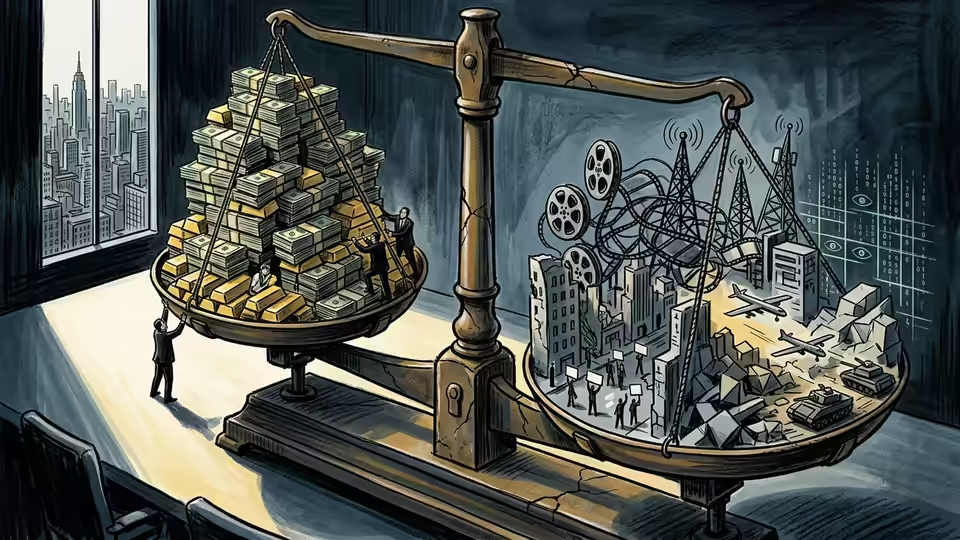
The U.S. Army handed Salesforce a $5.5 billion monopoly over its data systems by using technical loopholes to prevent any other company from bidding on the contract.
On February 6, 2026, the U.S. Army Contracting Command (ACC) bypassed federal competition requirements to award Salesforce a $5.5 billion sole-source contract. The deal, which covers a ten-year period of performance, aims to consolidate Department of Defense (DoD) services under a single proprietary software umbrella. To justify the move, the Army invoked Federal Acquisition Regulation (FAR) 6.302-1. This specific regulation allows the government to skip the bidding process when 'only one responsible source and no other supplies or services will satisfy agency requirements.'
[Sole-Source Contract] is a non-competitive procurement process where the government enters into a contract with a single provider without allowing others to bid.
Internal Justification and Approval (J&A) documents reveal the Army’s logic: officials claimed that Salesforce’s existing API architecture and proprietary data standards made it the only platform capable of integrating the military’s disparate management systems without 'unacceptable delays' or 'substantial duplication of costs.' However, critics and competitors argue these technical hurdles were self-imposed. By writing the requirements around Salesforce’s specific code, the Army effectively disqualified every other software firm in the country before the process even began.
This maneuver has drawn a formal challenge from Niobrara Systems, a veteran-owned small business. In GAO Case #411254, the firm alleges that the Army ignored its own mandates to support small business participation. The protest argues the Army’s 'consolidation' plan is a euphemism for high-priced vendor lock-in that will cost taxpayers billions more in the long run.
[Vendor Lock-in] is a situation where a customer becomes dependent on a single vendor for products and services, unable to use another vendor without substantial switching costs or technical barriers.
The money trail leading to this award is direct. According to OpenSecrets data, Salesforce increased its federal lobbying expenditures by 40% between 2024 and 2026, reaching an estimated $12.8 million annually. This spending surge specifically targeted the House Armed Services Committee and the Subcommittees on Defense. FEC filings show that Salesforce-linked PACs and executives contributed over $640,000 to members of these committees during the 2024 and 2025 election cycles. These are the same lawmakers who oversee the DoD’s Operation and Maintenance (O&M) funds—the very pool of money being used to pay for this $5.5 billion contract.
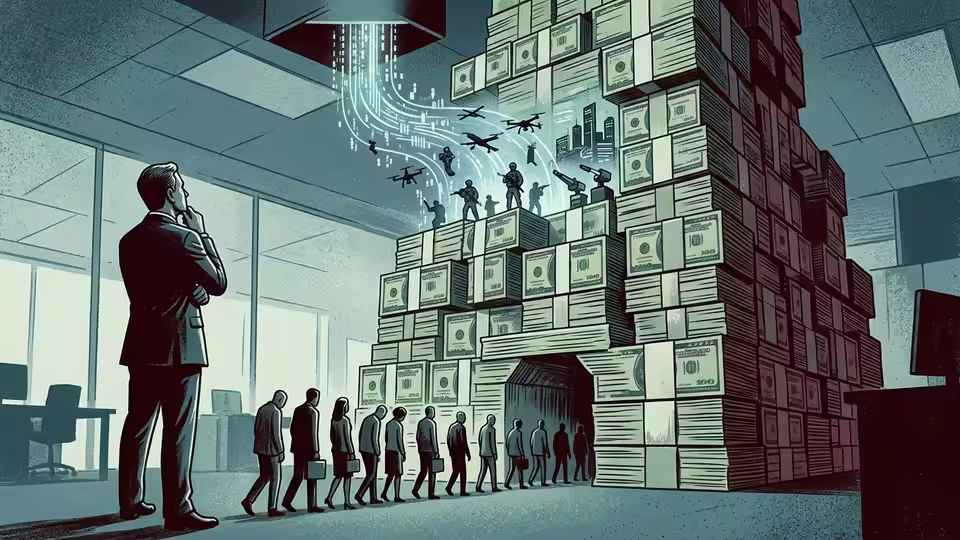
While mainstream outlets like Bloomberg have framed this deal as a necessary step toward 'digital transformation,' the missing context is the cost of proprietary capture. By moving away from open-standard government data systems, the Army is handing the keys to its internal infrastructure to a private corporation. Once the data is stored within Salesforce’s proprietary cloud, the cost of migrating that data to a competitor or an in-house system becomes prohibitively expensive. This creates a permanent, taxpayer-funded monopoly.
[Regulatory Capture] is a form of corruption where a government agency, created to act in the public interest, instead advances the commercial or political concerns of special interest groups that dominate the industry it is charged with regulating.
The impact on the American public is two-fold. First, the $5.5 billion price tag is a fixed cost derived without the downward pressure of a competitive market. In a standard bidding environment, competitors frequently undercut each other on price, saving the Treasury millions. Second, this deal signals the expansion of the 'defense-industrial complex' from hardware like tanks and jets into the digital realm. Small tech firms, often more innovative and cost-effective, are being squeezed out by the same lobbying tactics that have long benefited legacy defense contractors.
For the average person, this isn't just a technical dispute. It is the story of how public funds are committed to private monopolies behind closed doors. When the government claims 'only one source' can provide a service, it usually means the rules were written to ensure only one source was invited to the table.
At Gen Us, we are continuing to track the GAO's decision on Case #411254. You can visit our Politician Tracker to see which members of the Armed Services Committee received Salesforce contributions in the months leading up to this award, or explore our 'Revolving Door' database to see which former Pentagon officials now hold executive or lobbying roles at Salesforce.
Summary
The U.S. Army awarded a $5.5 billion software contract to Salesforce without competition, claiming only one vendor could meet its technical requirements. A formal protest by a veteran-owned business alleges the Army intentionally rigged the specifications to favor the tech giant and lock out smaller innovators.
⚡ Key Facts
- The $5.5 billion award was issued as a sole-source contract, bypassing the Competition in Contracting Act.
- The Army cited 'proprietary data standards' as the reason for excluding other vendors, a move critics call engineered vendor lock-in.
- Salesforce lobbying spending rose 40% in the two years preceding the contract award.
- A veteran-owned small business, Niobrara Systems, has filed a formal GAO protest (Case #411254) against the deal.
- The contract uses Operation and Maintenance (O&M) funds, which are increasingly diverted to long-term software licensing agreements.
Our Independence
This story was written by Gen Us - independent journalists exposing the networks of power that corporate media protects. No hedge fund owns us. No billionaire edits our headlines. We answer only to you, our readers.
Follow the public record
Source Trail
Get the next investigation in your inbox
One email a week. Receipts only. Free.
Free. Unsubscribe anytime. We never share your email.