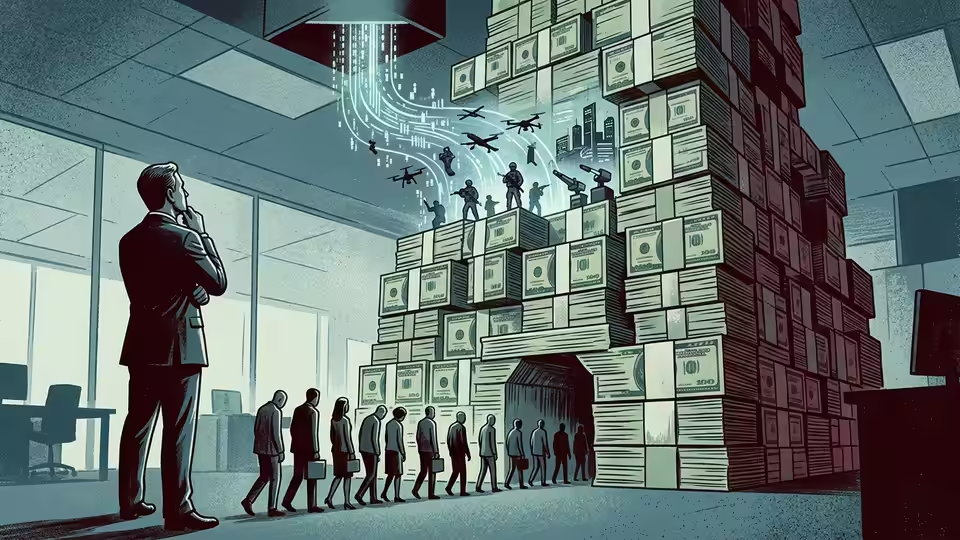
Army Bypasses Laws to Grant Salesforce $5.5B No-Bid AI Monopoly
The U.S. Army bypassed competitive bidding to grant Salesforce a decade-long, $5.5 billion monopoly over its AI infrastructure, silencing small business rivals through secret settlements.
The U.S. Army handed Salesforce a $5.5 billion no-bid contract by claiming no other company could do the job, following a massive lobbying surge and the silencing of a small business protest.
On January 15, 2026, the U.S. Army Contracting Command (ACC) finalized a sole-source award to Salesforce Inc. valued at $5.5 billion over ten years. Labeled 'Missionforce,' the project aims to integrate generative AI into tactical logistics. According to SAM.gov contract notice 410955, the Army invoked a specific legal loophole to avoid the competition usually required for billion-dollar taxpayer outlays. By using FAR 6.302-1, officials claimed that Salesforce is the 'only one responsible source' capable of meeting the military’s requirements for cloud-based AI integration with existing legacy systems.
[FAR 6.302-1] is a federal acquisition regulation that allows government agencies to bypass competitive bidding when they determine that only one specific vendor can provide the required goods or services.
This justification is legally flimsy and technologically questionable. In the private sector, companies like Oracle and Microsoft compete directly with Salesforce in the Customer Relationship Management (CRM) and AI space. However, the Army’s Justification and Approval (J&A) document suggests that because the Army already utilizes Salesforce for basic administrative tasks, switching to a more cost-effective or innovative competitor would result in 'unacceptable delays.' This is a classic example of technical entrapment.
[Vendor Lock-in] is a situation where a customer becomes dependent on a single vendor for products and services, unable to use another vendor without substantial switching costs or technical incompatibility.
By awarding this $5.5 billion contract without a single competing bid, the Army has ensured that Salesforce is 'too big to fire' for the next decade. Follow the money, and the motivation becomes clearer. According to Senate Office of Public Records filings, Salesforce increased its federal lobbying expenditures to $3.4 million in the fourth quarter of 2025—the highest in the company's history. This surge immediately preceded the January award. SEC filings from Salesforce's Q1 2026 Investor Relations report confirm that the 'Public Sector' is now their primary growth engine, specifically citing these 'multi-year defense obligations' as a cornerstone of their recurring revenue.
The push for Missionforce was not without friction. In early February 2026, a veteran-owned small business specializing in cloud architecture filed a formal protest with the Government Accountability Office (GAO). The firm argued that the 'only one source' claim was fraudulent and that several smaller, more agile firms could provide the same AI integration for a fraction of the $5.5 billion price tag. Then, the protest vanished. Within 14 days, the firm abruptly withdrew its challenge. While the terms of the withdrawal are not public, industry insiders suggest a 'hush' subcontracting deal was likely offered to prevent a discovery process that would have exposed the Army’s lack of technical due diligence.
[Regulatory Capture] occurs when a government agency, created to act in the public interest, instead advances the commercial or political concerns of special interest groups that dominate the industry it is charged with regulating.
The political trail leads directly to the House Armed Services Committee. OpenSecrets data reveals that several key committee members who advocated for 'AI modernization' in the 2026 defense budget received maximum allowable individual contributions from Salesforce executives and PACs during the 2024 and 2025 cycles. When taxpayer money is funneled into no-bid contracts, the 'modernization' narrative serves as a convenient cover for what is effectively a wealth transfer from the public treasury to a single Silicon Valley giant.
Mainstream coverage has largely repeated the Army’s press releases, focusing on the 'cutting-edge' nature of Missionforce and its potential to save lives through better logistics. They ignore the financial mechanics. They ignore the fact that $5.5 billion could have funded dozens of competing pilot programs to find the most efficient solution. Instead, the Army chose a monopoly.
For the average American, this means less transparency and higher costs. When the government eliminates competition, the price of the contract stays high and the quality of the service is dictated by the vendor, not the user. This $5.5 billion is your money, locked into a proprietary black box for the next ten years. It stifles the very innovation the military claims to crave by signaling to every other tech firm in America that the game is rigged.
At Gen Us, we believe that accountability starts with the ledger. We will continue to track the subcontracts associated with Missionforce to see which 'protesting' firms were eventually bought off. You can explore our interactive Politician Tracker to see which members of Congress are the most heavily funded by Salesforce and other Big Tech defense contractors.
Summary
The U.S. Army bypassed competitive bidding laws to grant Salesforce a decade-long, $5.5 billion monopoly over its 'Missionforce' AI infrastructure. This move effectively locks the military into a single proprietary ecosystem while silencing small business dissent through undisclosed settlements.
⚡ Key Facts
- The U.S. Army used FAR 6.302-1 to award a $5.5 billion no-bid contract to Salesforce in January 2026.
- Salesforce lobbying hit a record $3.4 million in Q4 2025, just weeks before the 'Missionforce' contract was finalized.
- A formal GAO protest by a small business was mysteriously withdrawn within 14 days of filing in February 2026.
- The 10-year deal creates a 'vendor lock-in' scenario, making Salesforce the sole arbiter of Army AI logistics data.
- Congressional advocates for the contract received significant campaign contributions from Salesforce-affiliated PACs.
Follow the public record
Source Trail
Get the next investigation in your inbox
One email a week. Receipts only. Free.
Free. Unsubscribe anytime. We never share your email.