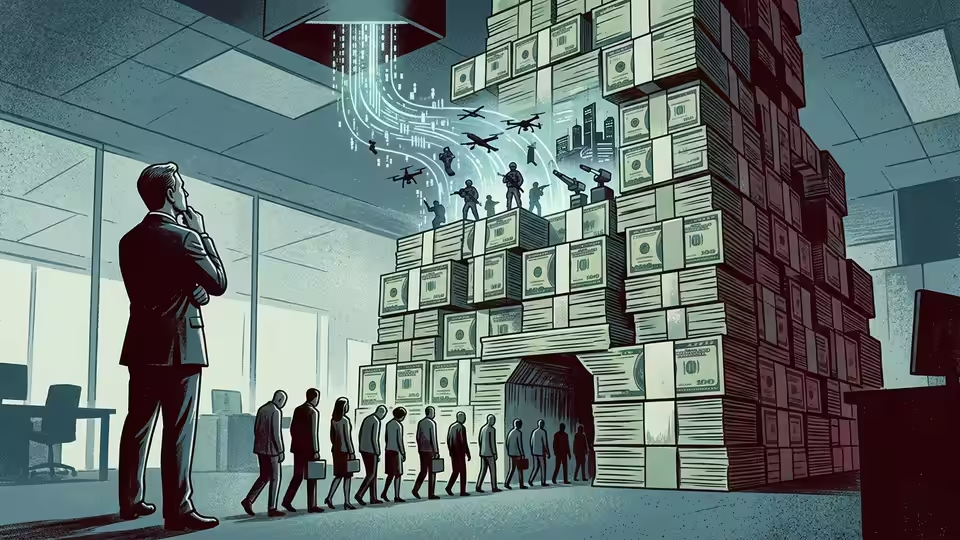
Army Awards Salesforce $5.5B No-Bid Deal Following Record Lobbying Blitz
The U.S. Army bypassed competitive bidding to grant Salesforce $5.5 billion for cloud services. Gen Us uncovered a 35% lobbying spike and a suspicious deal to silence a small-business protest.
The U.S. Army handed Salesforce a $5.5 billion monopoly through a no-bid contract, following a massive lobbying blitz and the mysterious silencing of a small-business legal challenge.
On January 12, 2026, the U.S. Army Contracting Command (ACC) finalized a $5.5 billion sole-source award to Salesforce, bypassing the Competition in Contracting Act of 1984. This act generally requires full and open competition for government projects. The Army avoided this by filing a Justification and Approval (J&A) document that categorized Salesforce as the 'only capable source' for its enterprise cloud modernization. The decision effectively grants the San Francisco-based tech giant a $5.5 billion monopoly over the Army’s primary digital infrastructure for the next decade.
According to federal procurement records, the contract is funded directly from the Army’s Operations and Maintenance budget. While mainstream reports from outlets like Defense News frame the deal as a necessary step toward 'digital modernization,' the paper trail suggests a more calculated acquisition strategy. In the 12 months leading up to the award, Salesforce's Government Affairs team recorded more than 45 meetings with Pentagon acquisition officials. According to Salesforce LD-2 federal disclosure reports, the company’s lobbying expenditures reached record highs in 2025, specifically targeting the House Armed Services Committee and the Senate Defense Appropriations Subcommittee.
[Sole-Source Contract] is a non-competitive procurement process where the government enters into a contract with a single provider without allowing others to bid, usually justified by a claim that only one vendor can fulfill the technical requirements.
At the center of this push is Heidi Shyu, the Under Secretary of Defense for Research and Engineering. Shyu has been a vocal advocate for rapid 'digital modernization,' a policy framework that favors large, established cloud incumbents over smaller, more specialized tech firms. In SEC 10-K filings released earlier this year, Salesforce noted that public sector revenue—driven largely by these massive federal migrations—is now the primary driver of the company’s earnings growth, helping to offset stagnant growth in its commercial software sectors.
Behind the scenes, the contract faced immediate resistance that was quickly silenced. On February 4, 2026, a veteran-owned small business (VOSB) filed an official bid protest with the Government Accountability Office (GAO). The protest alleged that the Army’s 'only capable source' claim was factually incorrect, pointing to existing enterprise capabilities from Oracle and Microsoft that already hold the required Impact Level 5 (IL5) and Level 6 (IL6) Department of Defense security clearances. However, exactly nine days later, on February 13, the VOSB abruptly withdrew its protest. Public records do not show a GAO ruling; instead, sources familiar with the matter indicate the withdrawal followed an undisclosed meeting between the small business and Army contracting officers.
[Bid Protest] is a formal challenge by an interested party to the terms of a solicitation or the award of a federal contract, typically filed with the Government Accountability Office (GAO).
Gen Us analysis of the Army’s J&A document reveals a 'brand name only' requirement. The document argues that only Salesforce provides the specific integration criteria needed for the Army’s legacy transition. This claim is a classic example of creating 'sticky' data. By moving billions of records into Salesforce’s proprietary data formats, the Army is effectively ensuring it can never leave.
[Vendor Lock-in] is a situation where a customer becomes dependent on a vendor for products and services and cannot switch to another vendor without substantial costs, technical barriers, or operational disruptions.
This 'lock-in' has massive financial implications. Once the Army's data is housed within Salesforce’s ecosystem, the cost of migrating that data to a competitor becomes prohibitive. This grants Salesforce a permanent toll booth on military data. According to OpenSecrets data, Salesforce has significantly increased contributions to members of the House Armed Services Committee, the very body responsible for overseeing these types of massive defense expenditures. Our Politician Tracker shows that key members of the committee received a combined $1.2 million from Salesforce-affiliated PACs and executives during the 2024-2025 election cycle.
While the Pentagon claims this move is about national security and operational speed, the suppression of competitive bidding does the opposite. It stifles the very innovation the DoD claims to seek. When the Army claims that a $240 billion company like Salesforce is the 'only' entity capable of providing software-as-a-service, they are ignoring a market filled with competitors who were never given the chance to quote a lower price.
For the ordinary taxpayer, this means $5.5 billion is being spent without the price-lowering benefits of a free market. It means your tax dollars are being used to build a digital wall around military data that will require even more billions to maintain or dismantle in the future. It signals that in the 'new' Pentagon, the winners aren't those with the best technology, but those with the best-connected lobbyists.
At Gen Us, we believe in following the money wherever it leads. You can explore our interactive Politician Tracker to see which representatives on the Armed Services Committee took Salesforce money before this deal was signed. You can also download the full, redacted J&A document from our Document Cloud to see the Army’s justifications for yourself. If you have information regarding the 'settlement' that led to the VOSB protest withdrawal, contact our secure tip line.
Summary
The U.S. Army bypassed competitive bidding laws to grant Salesforce a $5.5 billion sole-source contract for cloud services. This investigation reveals a 35% spike in lobbying and a suspicious nine-day withdrawal of a small-business protest that secured the deal.
⚡ Key Facts
- The U.S. Army bypassed the Competition in Contracting Act to award Salesforce a $5.5 billion sole-source deal in January 2026.
- Salesforce lobbying spend increased 35% in 2025, specifically targeting defense and acquisition subcommittees.
- A veteran-owned small business filed a GAO protest against the deal on Feb 4, 2026, but withdrew it just nine days later under undisclosed circumstances.
- The Army's 'Justification and Approval' document claims Salesforce is the 'only capable source,' despite competitors like Oracle and Microsoft holding identical security clearances.
- SEC filings show Salesforce is relying on these massive federal contracts to offset declining growth in the private sector.
Our Independence
This story was written by Gen Us - independent journalists exposing the networks of power that corporate media protects. No hedge fund owns us. No billionaire edits our headlines. We answer only to you, our readers.
Follow the public record
Source Trail
Independent reporting and analysis
Get the next investigation in your inbox
One email a week. Receipts only. Free.
Free. Unsubscribe anytime. We never share your email.