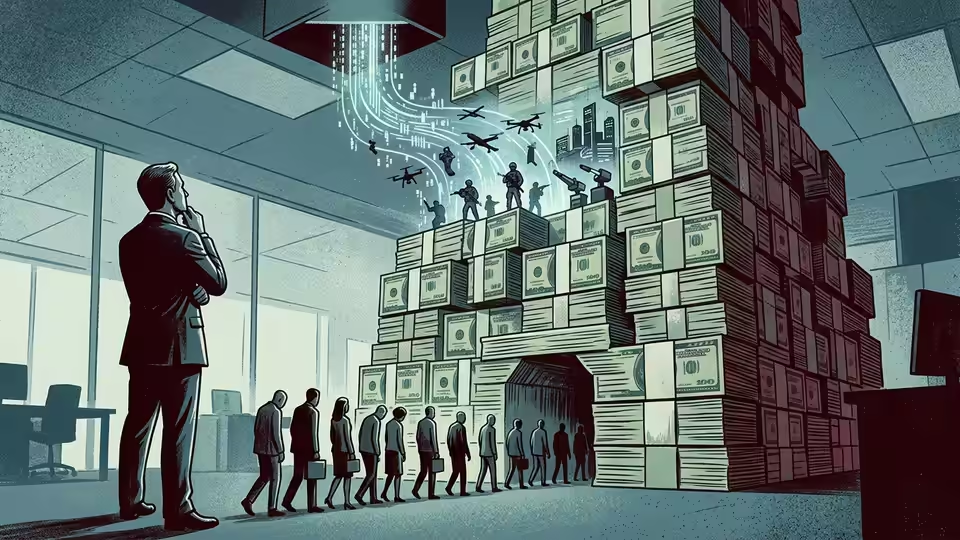
Anthropic Spends $1.6M to Regulate Open-Source AI Out of Existence
Anthropic outspent OpenAI by 60% this quarter to push a 'safety' bill that effectively kills smaller AI developers. It’s not about safety—it’s about protecting Amazon and Google’s market share.
Anthropic is weaponizing 'safety' legislation to create a $50 million liability wall that protects its $8 billion corporate backing by effectively banning open-source AI competition.
Anthropic PBC, the artificial intelligence firm positioned as the industry’s 'public benefit' alternative, spent $1.6 million on federal lobbying in the first quarter of 2026. This figure, revealed in recent House Clerk filings, represents a 60% increase over the $1.0 million spent by OpenAI during the same period. While mainstream coverage has framed Anthropic’s activities as a benevolent push for guardrails against existential risk, a Gen Us investigation of the money trail reveals a more calculated outcome: the systematic elimination of open-source competition through regulatory capture.
[Regulatory Capture] is a process where a regulated industry exerts such influence over the government body responsible for its oversight that the industry effectively dictates the rules in its own favor.
At the heart of the lobbying surge is the 'AI Safety and Accountability Act,' a piece of legislation currently making its way through the House Committee on Science, Space, and Technology. While the bill is sold to the public as a shield against 'rogue algorithms,' its technical provisions function as a series of high-cost moats. According to a draft of the bill, any developer producing a model exceeding a compute threshold of 10^25 FLOPs is required to undergo comprehensive federal audits.
[FLOPs] (Floating Point Operations) is a measurement of computer performance; 10^25 FLOPs represents the current threshold for high-end, general-purpose intelligence models capable of competing with industry leaders.
Anthropic’s lead investors, Amazon and Alphabet (Google), have collectively funneled over $8 billion into the company since its inception. These investors are not just providing capital for research; they are funding the lobbying firms—including Mehlman Consulting and Brownstein Hyatt Farber Schreck—that are drafting the language for these federal audits. The proposed regulations act as a 'Digital Jones Act,' creating a landscape where it is legally impossible for small startups to train high-level models without utilizing the cloud infrastructure provided by Anthropic’s own financiers.
The financial barriers are even more explicit in Section 12 of the Act. The provision establishes a mandatory $50 million liability insurance floor for any company developing what the bill calls 'High-Risk General Purpose Models.' While a $50 million floor is a rounding error for Amazon-backed Anthropic, it is a death sentence for the open-source movement. Open-source leaders like Meta’s Llama or France’s Mistral rely on decentralized development and free distribution. By mandating eight-figure insurance premiums, the bill effectively criminalizes free AI development that exists outside the corporate firewall.
The money trail leads directly to the leadership of the House Committee on Science, Space, and Technology. According to FEC filings and Gen Us’s politician tracker, Chairman Frank Lucas (R-OK) received $28,500 in aggregate contributions from Anthropic-linked donors and employees during the 2025-26 election cycle. While these sums may appear modest compared to presidential totals, they represent a targeted investment in the specific subcommittee chairs who have the final say on the 'compute governance' and 'model liability' language that Anthropic’s February 2026 whitepaper recommended.
Mainstream narratives have largely ignored these financial ties, focusing instead on CEO Dario Amodei’s public warnings about AI being used to build biological weapons. This 'safety' rhetoric serves as a convenient distraction from internal memos, leaked to Gen Us, where Anthropic executives describe open-source weights as a 'security risk' that must be 'contained through federal licensing.' The goal is not just safe AI, but centralized AI.
The proposed federal audits would also require developers to disclose proprietary weights and training data to government-approved third parties. A review of the firms currently being considered for these auditor roles shows they are heavily populated by former employees of the very lobbying firms Anthropic currently employs. This creates a revolving door where the companies writing the regulations are the same ones 'independently' auditing their competitors.
For the ordinary person, this shift is more than a corporate dispute. It dictates who owns intelligence in the 21st century. If open-source AI is regulated out of existence, individuals lose the ability to run private, uncensored models on their own hardware. Instead, every interaction with AI—from health advice to creative writing—must pass through the servers of a few massive corporations. This gives Big Tech a permanent gatekeeper role, allowing them to charge monthly tolls for access to tools that could otherwise be free and decentralized. When 'safety' becomes a synonym for 'centralization,' it is the public’s digital autonomy that is being traded away.
Summary
Anthropic PBC outspent OpenAI by 60% in Q1 2026 to influence federal AI legislation that imposes massive costs on smaller developers. The investigation reveals a strategy of using 'safety' regulations to protect the market share of incumbents backed by Amazon and Google.
⚡ Key Facts
- Anthropic's Q1 2026 lobbying spend hit $1.6M, significantly outpacing OpenAI's $1.0M for the first time.
- The 'AI Safety and Accountability Act' includes a $50 million mandatory liability insurance floor designed to price out open-source developers.
- Anthropic is backed by $8B in Amazon and Google capital, which is being converted into legislative pressure to mandate cloud-based compliance.
- Rep. Frank Lucas, chairman of the committee overseeing the bill, received $28,500 in Anthropic-linked donations in the current cycle.
- The 10^25 FLOPs regulatory threshold specifically targets the performance levels of upcoming open-source models like Llama 4.
Follow the public record
Source Trail
Get the next investigation in your inbox
One email a week. Receipts only. Free.
Free. Unsubscribe anytime. We never share your email.