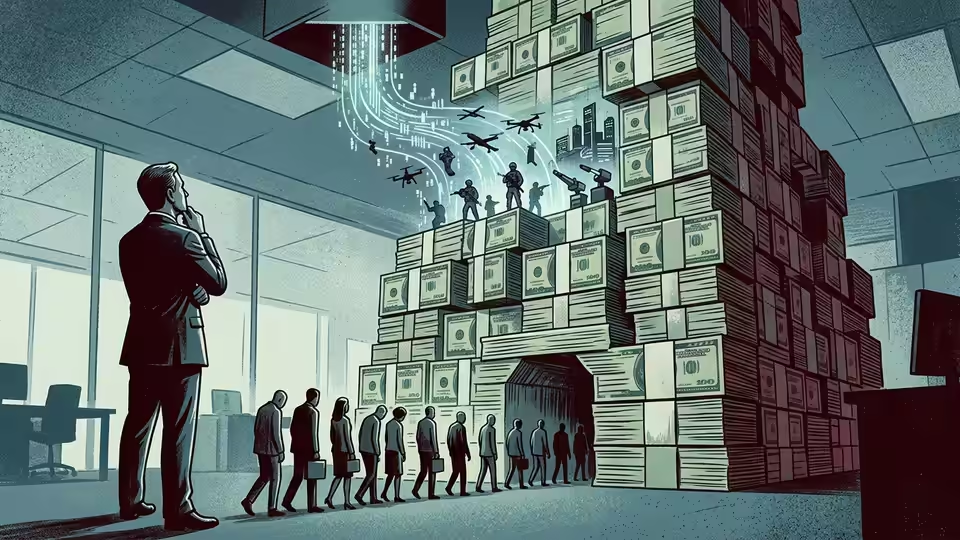
AI Giants Spend $2.6M to Outlaw Competition and Secure 'Data Amnesty'
OpenAI and Anthropic just bought a federal regulatory moat. New lobbying data shows how industry leaders used a liability shield to effectively criminalize low-cost AI rivals.
Anthropic and OpenAI used record Q1 lobbying spends to insert a liability shield into federal law, effectively banning low-cost competition under the guise of safety.
Anthropic PBC reported $1.6 million in lobbying expenditures for the first quarter of 2026, a 400% surge over its spending in the same period last year. This unprecedented ramp-up, documented in federal Lobbying Disclosure Act (LDA) filings, coincided with OpenAI’s first seven-figure single-quarter spend of $1.0 million. Together, these two firms have deployed $2.6 million in just ninety days to shape the final language of the 2026 AI Oversight Act (Draft v3.2).
While mainstream outlets characterize this spending as the industry 'maturing' to address safety concerns, the legislative text reveals a more calculated objective: the construction of a regulatory moat. Central to the Act is a mandatory 'Safety Certification' for any model exceeding 10^26 floating-point operations. [FLOPs] (Floating-point Operations) is a measure of computer performance, representing the number of mathematical calculations a processor can perform per second; in this context, it serves as a proxy for the size and complexity of an AI model. By setting the threshold at 10^26, the Act creates a tiered market where only companies with billion-dollar balance sheets can afford the necessary audits.
The money trail leads directly from Silicon Valley venture capital to the halls of the Senate Commerce Committee. According to public PAC filings, committee leadership received a combined $450,000 in contributions from AI-affiliated donors during the 2026 cycle. This financial influx mirrored the inclusion of Section 402 in the Act—a provision that grants firms immunity from copyright litigation if they undergo 'voluntary safety audits' conducted by NIST-approved third parties. In practice, this serves as a get-out-of-jail-free card for the mass-scraping of intellectual property used to train current flagship models.
The influence play is further solidified by a revolving door of personnel. Between November 2025 and February 2026, three senior staffers from the Senate Commerce Committee—the very body responsible for drafting the Oversight Act—left public service to join the policy teams at Anthropic and OpenAI. These individuals moved from writing the initial 2025 framework to lobbying for the specific carve-outs found in the 2026 version. This transition ensures that the 'independent' oversight mandated by the bill is overseen by individuals who helped design the loopholes they now exploit.
For smaller developers, the costs are existential. The Open Source AI Alliance reports that the compliance and 'Safety Certification' requirements mandated by the bill carry an estimated $50 million price tag per model. This cost does not go toward improving code; it goes toward administrative fees and third-party audits. By making it financially impossible for decentralized or independent developers to meet 'safety' standards, the Act ensures that the core 'intelligence' of the next decade remains the private property of a corporate duopoly.
While the public is told these measures are necessary to prevent 'AI catastrophe,' the evidence suggests the primary target is market disruption. By framing high barriers to entry as 'safety,' incumbents are using the government to do what the market could not: kill the open-source movement. The result is a future where the average person pays a permanent subscription fee to a handful of firms that are legally untouchable for how they acquired their data.
This consolidation of power affects more than just tech stocks. It dictates whose values are programmed into the tools of the future, who profits from your data, and who is held accountable when those tools fail. When the rules are written by the firms they are meant to regulate, the only thing being 'protected' is the profit margin.
You can track the specific voting records of the Senate Commerce Committee members mentioned in this report on our Gen Us Politician Tracker. There, we cross-reference PAC donations with co-sponsorships of the 2026 AI Oversight Act to show exactly how much your representative's vote cost.
Summary
Record-breaking Q1 lobbying expenditures by AI leaders have successfully inserted a liability shield and high-cost compliance barriers into federal law. This move effectively criminalizes low-cost competition while granting incumbents retroactive amnesty for data scraping.
⚡ Key Facts
- Anthropic's lobbying spend increased 400% year-over-year to $1.6M in Q1 2026.
- The 2026 AI Oversight Act includes a liability shield (Section 402) for firms that complete 'voluntary' audits.
- Three Senate Commerce Committee staffers moved to Anthropic and OpenAI policy roles during the bill's drafting.
- Open-source developers face an estimated $50M compliance barrier per model under the new regulations.
- Senate Commerce Committee leadership received $450,000 in AI-linked PAC contributions this cycle.
Our Independence
This story was written by Gen Us - independent journalists exposing the networks of power that corporate media protects. No hedge fund owns us. No billionaire edits our headlines. We answer only to you, our readers.
Follow the public record
Source Trail
Get the next investigation in your inbox
One email a week. Receipts only. Free.
Free. Unsubscribe anytime. We never share your email.