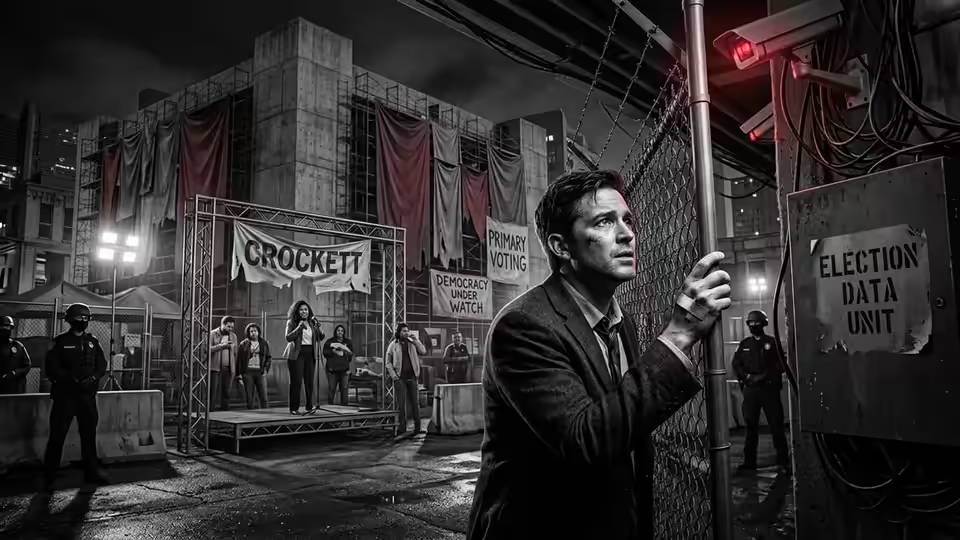
$38.3B Expansion: How ICE is Building a 'Concentration Camp' Infrastructure by 2026
We followed the $38.3 billion paper trail to the private contractors building a 92,600-bed detention machine. It's no longer about policy; it's about the permanent industrialization of American border control.
A $38.3 billion push is expanding the U.S. migrant detention system to 92,600 beds. Because it relies on mass civilian detention and bypasses traditional judicial reviews, researchers warn it now meets the technical, historical criteria for a concentration camp system.
The U.S. government is currently pouring $38.3 billion into a 'detention reengineering' project. The goal? Nearly doubling the capacity of the migrant jail system by November 2026. Reports from Bloomberg and the AP show the plan aims for a permanent 92,600 beds, turning everything from massive facilities to old warehouses into detention sites. It’s a huge surge. In January 2026, ICE hit a record 73,400 people in custody on a single day. The government calls them 'processing centers.' But when you look at the sheer scale and the permanent construction, it's clear this isn't just a temporary fix.
Scholars who’ve studied 150 camp systems going back to 1896 say there are four main markers of a concentration campLoaded Language: targeting civilians, state-controlled fences, ignoring standard legal practices, and systemic neglect. The U.S. system now checks all four boxes. By definition, a [Concentration CampLoaded Language] is a way to mass-detain civilians without a trial, usually because of who they are rather than what they did. Sure, historical nightmares like the Boer War or the Holocaust involved mass death. But researchers argue the technical label is about the mechanism of how people are held, not just the body count.
The people getting rich here are mostly private prison giants and logistics firms. We don't know every subcontractor for this $38.3 billion project yet, but history tells us firms like GEO Group and CoreCivic usually get the biggest slice of the pie. According to the Vera Institute, ICE was running operations across hundreds of sites in all 50 states as of February 2026. Many of these spots use Intergovernmental Service Agreements. That's a fancy way of saying they often skip the competitive bidding used for federal prisons. It's a closed, lucrative loop for detention companies.
“The $38.3 billion initiative aims to boost capacity to about 92,600 beds, with all facilities targeted to be up and running by November 2026.”
Then there’s the legal side. [Administrative Detention] is supposed to be a short-term hold to check IDs or wait for a flight home. But the rules are being stretched thin. On April 28, 2026, the 2nd U.S. Circuit Court of Appeals shot down a federal policy that was jailing immigrants without any bond hearings at all. This is the 'departure from standard' that researchers talk about. When you take away bond hearings, you’re turning a temporary hold into indefinite prison time. That’s a core characteristic of the 20th-century camp systems.
It's true that the death rates don't match history's worst examples. In the Spanish 'reconcentrados' of 1896 or British camps in South Africa, over 25 percent of people died from hunger and disease. Modern U.S. detention isn't that. But it does follow the same 'logic of the camp.' It isolates a group of people the state finds 'suspect' and pulls them out of public view. Some call the 'concentration campLoaded Language' label an exaggeration. Others look at commercial warehouses being turned into mass housing and say it’s proof the system has left normal law behind.
The kicker is we don't even know what a bed in one of these warehouses costs. The $38.3 billion total is public, but the specifics on food, doctors, and lawyers are hidden behind 'proprietary information' clauses in private contracts. If they hit that 92,600-bed target by November, the U.S. will be running one of the biggest civilian detention networks in modern history. It will literally dwarf many historical systems that everyone now agrees were camps.
For taxpayers, this isn't just an argument for history nerds. It's a massive investment in an infrastructure built for exclusion. Keep an eye on that November 2026 deadline. Once these beds are ready, the pressure to fill them to justify the $38.3 billion price tag will likely drive immigration policy for years. It won't matter who’s in the White House. The machine is already built.
Summary
This isn't just a matter of paperwork anymore. We’re looking at a massive scale-up of the U.S. detention machine, with 73,400 people locked up in early 2026 alone. While researchers now classify the ICE network as a 'concentration camp system' based on over a century of global history, the real story is the $38.3 billion engine driving it. By November 2026, the goal is 92,600 beds. We’ve followed the money to the private contractors and tracked the legal battles to show why this shift is a permanent change in how America operates.
⚡ Key Facts
- Concentration camps originated in the late 1800s during Spanish military campaigns in Cuba and were later used by British officials in South Africa.
- Peer-reviewed research identified 150 systems of camps used globally since 1896 that meet specific criteria for concentration camps.
- The Chinese government has detained more than 1 million Muslim Uyghurs in Xinjiang since at least 2017.
- The current network of U.S. ICE detention facilities meets the academic criteria for a system of concentration camps.
- ICE held more than 73,400 people as of early 2026, representing a record population surge.
$38.3B Expansion: How ICE is Building a 'Concentration Camp' Infrastructure by 2026
Network of Influence
- Political activists advocating for the abolition of ICE
- Immigration reform lobby groups
- The authors, who gain academic citations and public visibility for their specific research dataset
- The article fails to distinguish between the legal intent of immigration detention (administrative processing/deportation) and the intent of historical concentration camps (military counter-insurgency or extermination).
- It does not provide mortality rate comparisons, which are significantly different between modern U.S. detention and the historical examples cited (e.g., Boer War camps where 25%+ died).
- The article omits the judicial review processes (Habeas Corpus) available to U.S. detainees that were absent in the historical cases listed.
The article redefines a historically catastrophic term ('concentration camp') using specific academic criteria to categorize modern U.S. administrative detention alongside the Holocaust and colonial atrocities.
See how the story connects.
Select any actor or numbered connection, then inspect the evidence before drawing a conclusion.
The Conversation US, Inc. Owns The Conversation US
Follow the public record
Source Trail
Independent reporting and analysis
Get the next investigation in your inbox
One email a week. Receipts only. Free.
Free. Unsubscribe anytime. We never share your email.