21 Dead in Colombia: How Election Politics Killed the Peace Deal
As 21 die in a Cauca bombing, candidates are already cashing in on the tragedy. We expose the $3.5B cocaine trade and government power vacuum that Bogotá's 'Total Peace' rhetoric ignores.
The April 25 massacre in Cauca isn't just a security failure: it's a symptom of a stalled peace process and a $3.5 billion cocaine economy that's now fueling the rise of hard-right candidates before the May 31 election.
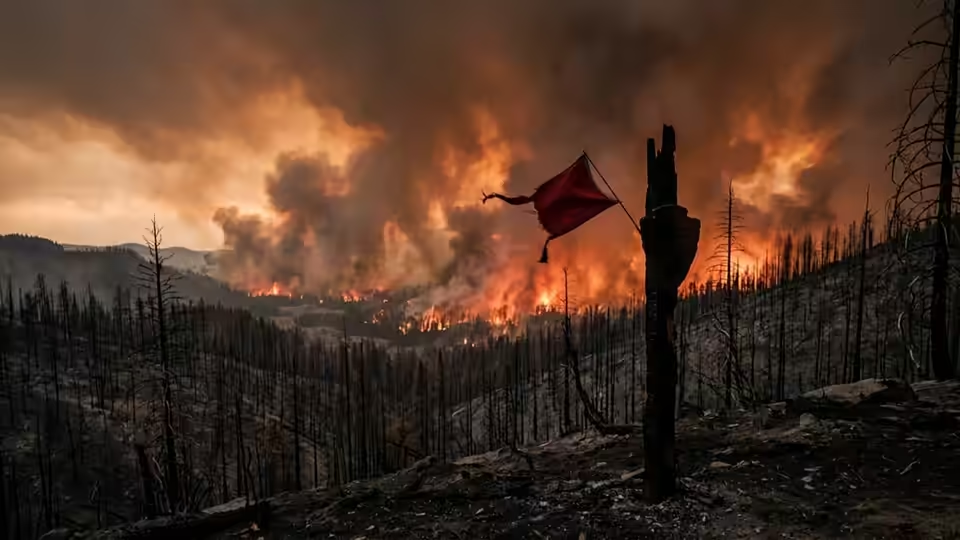
The blast in Cajibío, Cauca, wasn't just some random act of malice. It was a surgical strike on the country's most vital economic artery. By blocking the Pan-American Highway with a bus before detonating a charge that left a 200-cubic-meter crater, the attackers ensured two things: maximum civilian deaths and total logistical chaos. President Gustavo Petro was quick to call the killers 'fascistsLoaded Language' and 'terrorists,' but that rhetoric hides a much uglier truth. His 'Total Peace' policy is bleeding out. Dissident groups, flush with cash from a cocaine trade that the UNODC says brings in $3.5 billion a year, aren't interested in talking when the business of war is so profitable.
If you want to understand why that highway turned into a graveyard, you have to follow the money and the land. Cauca is one of the most ignored regions in Colombia, and the gap between the rich and the poor is staggering. The Kroc Institute, which keeps tabs on the 2016 peace deal, says only 30% of the big-picture stuff, like land reform and crop substitution, has actually been done. This failure is a gift for Iván Mordisco’s Estado Mayor Central (EMC). They have a never-ending supply of recruits because, for a lot of people in Cauca, there's no real economic choice besides the drug trade or illegal mines.
[Total Peace] is Petro's big bet. It's his attempt to negotiate ceasefires with every armed group in the country at the same time to finally end the fighting. But the plan is falling apart as security gets worse, and the political opposition is loving it. Right-wing candidates like Abelardo de la Espriella and Paloma Valencia have already shifted their entire campaigns toward 'Iron Fist' platforms. They're winning over voters by promising a return to the heavy military crackdowns of the early 2000s, which usually comes at the expense of the very social programs that could actually stop the violence.
“The bombing left a crater 200 cubic metres in size, turning a vital economic artery into a graveyard.”
[FARC Dissidents] are the splinter groups that either didn't sign the 2016 deal or went back to the mountains when the government didn't deliver on its promises. The stakes here go way beyond Colombia's borders. As long as the rest of the world keeps buying cocaine at record levels, groups like the EMC, the ELN, and the 'Clan del Golfo' will always have enough cash to outgun the local cops. Major news outlets love to use the 'trafficking' label, but they almost never talk about the $10 billion market in the Global North that's actually paying for the explosives used on the highway.
Then there are the 'phantom actors' to consider. Mordisco is the main suspect, but Cauca is currently a three-way shootout between FARC dissidents, the ELN, and cartels with paramilitary links. The authorities haven't actually shown forensic proof that this specific bomb fits Mordisco’s usual style. In a part of the country where intelligence is often traded for political favors, you can't ignore the possibility of a 'false flag' or a provocation meant to kill off the peace talks for good.
According to the Defense Ministry, 1,500 more troops have been sent to Cauca since the April 25 attack. But we've seen this movie before. Sending in soldiers without building schools, roads, or giving people land titles is just putting a lid on a boiling pot. As the May 31 election gets closer, these 21 deaths are becoming a polling statistic rather than a reason to fix the system. It's about optics, not reform.
Here's what to watch for: The first round of voting on May 31 will be a referendum on whether Colombians still believe Petro can talk his way to peace or if they think he’s just surrendering to a $3.5 billion criminal economy. If the bombs keep going off through May, a hard-right turn for the country isn't just possible: it’s almost a certainty.
Summary
The April 25 bombing on the Pan-American Highway was the deadliest civilian hit in decades, leaving 21 dead and dozens more wounded. While Bogotá points the finger at FARC dissidents, the real story is about the collapse of the 2016 peace deal and a power vacuum in Cauca that the government hasn't filled. Now, with the May 31 elections looming, right-wing candidates are using the tragedy to tear down President Petro’s 'Total Peace' agenda. Meanwhile, the $3.5 billion cocaine trade and the lack of land reform continue to drive the recruitment of new insurgents.
⚡ Key Facts
- A bomb blast on the Pan-American Highway in Cauca, Colombia, killed 21 people and injured 56 others.
- The attack was carried out by stopping traffic with a bus and a secondary vehicle before detonating the explosive.
- Colombian authorities and President Gustavo Petro blame FARC dissidents led by Iván Mordisco for the attack.
- The attack occurred on Saturday, April 25, 2026, shortly before the scheduled May 31 presidential elections.
21 Dead in Colombia: How Election Politics Killed the Peace Deal
Network of Influence
- Right-wing political candidates (Abelardo de la Espriella, Paloma Valencia) who leverage security crises to advocate for hardline military policies.
- The Colombian military and defense sector, which can justify increased budgets and autonomy.
- Political opponents of President Gustavo Petro, as the violence discredits his 'Total Peace' negotiation policy.
- Lack of explanation regarding the failure of previous administrations to implement the 2016 peace accord, which contributed to the rise of dissident groups.
- No mention of the socio-economic conditions or land inequality in the Cauca department that drive local recruitment into armed groups.
- Absence of information regarding the role of paramilitary groups or other cartels competing for the same territory.
- Omission of international drug demand (Global North) as a primary driver of the 'cocaine-trafficking' narrative mentioned.
The story is framed as a clash between a democratically-elected (though 'controversial') government and 'fascist' cocaine-trafficking terrorists, centering security and criminality while marginalizing the structural roots of the insurgency.
See how the story connects.
Select any actor or numbered connection, then inspect the evidence before drawing a conclusion.
Scott Trust Limited Owns Guardian Media Group (GMG)
Follow the public record
Source Trail
Independent reporting and analysis
Get the next investigation in your inbox
One email a week. Receipts only. Free.
Free. Unsubscribe anytime. We never share your email.