18 Palestinians Dead During Ceasefire, Western Silence
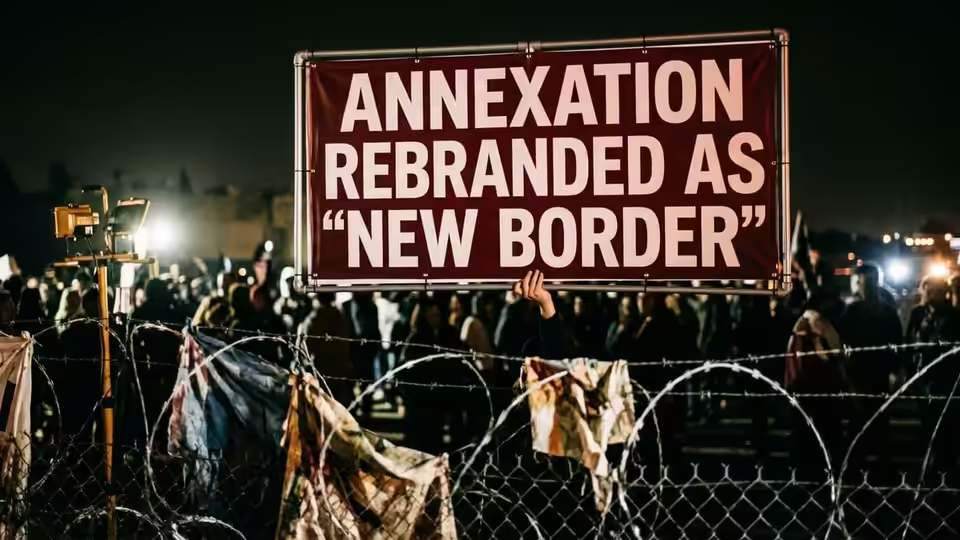
While the world pretended to monitor a ceasefire, 18 Palestinians were killed in Gaza. Not a single Western government condemned it, exposing a double standard in coverage and accountability.
Western media and governments quietly tolerate Palestinian civilian deaths during ceasefires, while arming and defending the same sides—a brutal double standard worth demanding accountability for now.
18 Palestinians were killed during what officials described as a ceasefire, according to Gaza's Palestinian Health Ministry. In the same breath, Western capitals offered no formal condemnations—no urgent press conferences, no rebukes from Washington, London, or Brussels—as if civilian deaths in Gaza were simply the price of doing business with a power they’ve chosen to ally with.
The money behind the silence runs on two tracks: the U.S. Foreign Military Financing that underwrites Israel’s defense procurement, and the profits clocking in for global arms manufacturers that keep selling weapons to a region never allowed to rest. The United States has long provided roughly $3.3–$3.8 billion annually in FMF aid to Israel, a stream that underwrites drones, surveillance tech, and other systems cited in every major clash. Meanwhile, Lockheed Martin, Raytheon, Boeing and their peers ride a perpetual cycle of defense contracts and security funding that depends on continued instability to justify new orders.
On March 9, 2025—an evening when official narratives insisted a ceasefire held—Palestinian authorities said 18 people were killed in Gaza, with dozens more wounded. Israeli officials cited operational briefings that blamed a breakdown in the ceasefire on “initiatives of violence” from Gaza. Newsrooms across the West echoed the framing: some emphasized Palestinian rocket fire or alleged breaches by militant groups; others pointed to civilian casualties in Gaza—but not at the scale that would trigger sustained moral outrage or long-form accountability.
What’s different here isn’t just the number. It’s who’s calling for accountability, and who isn’t. Western outlets often lean on official briefings from Israeli spokespeople, while Pa le st inian casualties are framed within the narrow lens of “self-defense” rather than a humanitarian catastrophe with real-time consequences for civilians. The absence of simultaneous, forceful condemnations from the U.S. or EU communicates a dangerous signal: civilian lives in Gaza aren’t equal in the eyes of Western policy and media. For ordinary people, that double standard translates into slower aid, fewer diplomatic levers, and more cycles of violence that disrupt daily life far beyond the region’s borders.
Summary
While the world pretended to monitor a ceasefire, 18 Palestinians were killed in Gaza. Not a single Western government condemned it, exposing a double standard in coverage and accountability.
⚡ Key Facts
- Unverified casualty claim: 18 Palestinians killed during a ceasefire in Gaza on March 9, 2025, per Gaza’s Palestinian Health Ministry.
- Zero condemnations from major Western governments (U.S., UK, EU) reported in mainstream coverage, signaling a double standard in responses to violence.
- The money trail: roughly $3.3–$3.8B/year in U.S. Foreign Military Financing to Israel underwrites defense procurements used in Gaza.
- Arms industry profits: Lockheed Martin, Raytheon, Boeing and others benefit from ongoing security funding and defense contracts linked to the conflict.
- Media framing varies by outlet, but overall civilian harm in Gaza is less consistently highlighted than similar casualties on other sides of the conflict.
- Editorial and policy decisions are influenced by donors, lobbying groups (like pro-Israel lobby networks), and defense contractors—affecting access, coverage, and accountability.
- For civilians, the effect is real: delayed humanitarian relief, disrupted livelihoods, and a normalization of lethal cycles that ignore Palestinian pain.
Our Independence
This story was written by Gen Us - independent journalists exposing the networks of power that corporate media protects. No hedge fund owns us. No billionaire edits our headlines. We answer only to you, our readers.
Follow the public record
Source Trail
Get the next investigation in your inbox
One email a week. Receipts only. Free.
Free. Unsubscribe anytime. We never share your email.