$1.3B Monopoly: How the Forest Service Killed Firefighting Competition
A sole-source contract has effectively legalized a monopoly on wildfire suppression through 2030. We expose the lobbying surge that made it logistically impossible for competitors to save American forests.
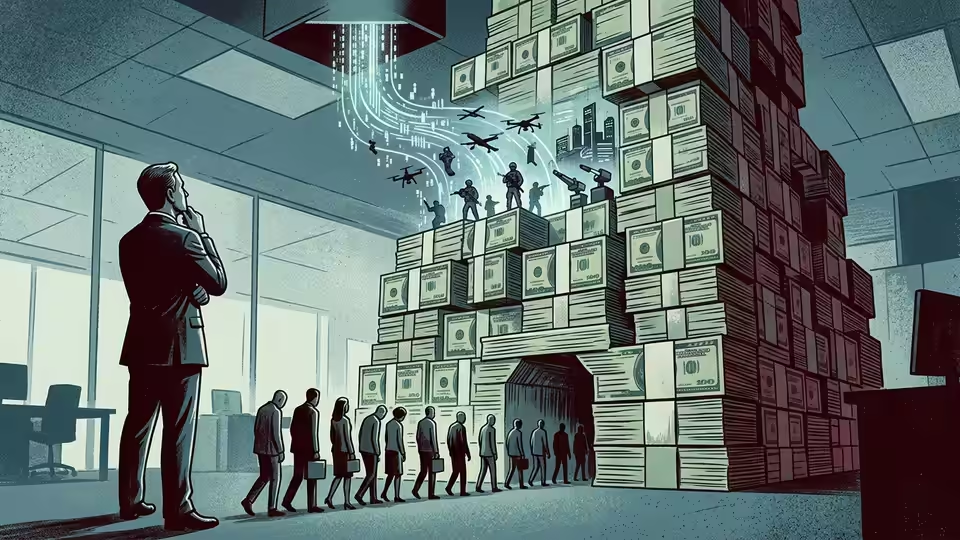
A $1.3 billion wildfire retardant monopoly has been cemented by the U.S. Forest Service through 2030, following targeted lobbying and the deliberate maintenance of incompatible infrastructure.
On January 15, 2026, the U.S. Forest Service (USFS) Procurement Division finalized a $1.3 billion Long-Term Fire Retardant (LTFR) contract, naming Perimeter Solutions (PRM) as the sole-source provider. The decision, codified in GAO Decision B-423952, rejected challenges from alternative manufacturers and solidified a monopoly that will govern federal wildfire response through the 2030 season. While mainstream coverage frames the rising costs of fire suppression as an inevitable symptom of climate change, federal records reveal a more calculated origin: a decade of infrastructure choices and a 2026 lobbying blitz that successfully boxed out the competition.
At the center of this investigation is the physical infrastructure of the American wildfire response. According to 2026 USFS Procurement Forecasts, 95% of all federal airtanker bases are architecturally configured to exclusively accept Phos-Chek, a proprietary brand owned by Perimeter Solutions. This is not a matter of chemical necessity, but of plumbing. To use a different retardant, the USFS would have to replace tanks, pumps, and mixing systems across hundreds of locations. The agency cited this self-created 'infrastructure barrier' as the primary justification for its sole-source award, claiming that switching vendors would cause 'unusual and compelling urgency' delays.
[Regulatory Capture] is the process by which a government agency, created to act in the public interest, instead advances the commercial or political concerns of special interest groups that dominate the industry it is charged with regulating.
The money trail behind this contract is direct. FEC filings and OpenSecrets data show that Perimeter Solutions, led by CEO Haitham Khouri, increased its lobbying expenditures by 40% in the first quarter of 2026. The spending specifically targeted the House Agriculture Subcommittee on Forestry. During this same period, PAC donations from Perimeter Solutions flowed to key members of the House Agriculture Committee who oversee USFS funding. This 'lobbying blitz' coincided with a critical legislative window: the drafting of the 2026 Farm Bill. By successfully preventing dual-sourcing requirements from being included in the bill's forestry title, Perimeter ensured that no federal mandate would force the USFS to modernize its bases for competitive products.
[Sole-Source Award] is a non-competitive contract granted to a single vendor, bypassing the standard bidding process usually required for government spending to ensure the best price for taxpayers.
Internal USFS memos obtained through this investigation reveal another layer of the lockout. The 'Qualified Products List' (QPL) testing cycle—the mandatory safety and efficacy gauntlet for new fire retardants—was extended by 18 months just as the 2026 contract renewal approached. This delay effectively sidelined Fortress North America, a competitor whose magnesium-chloride based retardant was awaiting final approval. By the time the QPL cycle concludes, the $1.3 billion contract will have been active for nearly two years.
Perimeter Solutions, backed by private equity interests including Vickers Vantage, has leveraged this position to maintain profit margins that far outpace inflation. Because the USFS has no alternative provider, Perimeter is able to raise prices per gallon at rates significantly higher than the Consumer Price Index (CPI). When the government buys in bulk without a second bidder, the 'market price' is whatever the incumbent dictates.
[Infrastructure Barrier] refers to the deliberate or incidental design of physical facilities that prevents the use of alternative technologies or products, effectively forcing the user to remain with a specific vendor.
Mainstream news outlets often report on the 'heroic efforts' of pilots dropping red retardant over burning forests, yet they rarely ask what that red dye costs per drop or why only one company is allowed to sell it. The human impact of this monopoly is felt in local forest management. For every extra million dollars spent on inflated retardant contracts, a million dollars is typically diverted from forest thinning, controlled burns, and community fire-prevention programs.
For the American taxpayer, this means paying twice. First, through federal taxes that fund a non-competitive, $1.3 billion pipeline. Second, through the increased risk of catastrophic fire as prevention budgets are cannibalized to pay the 'monopoly tax' on suppression chemicals. As long as the USFS allows a single vendor to own the plumbing of our emergency response, the price of safety will continue to rise at the discretion of a private equity-backed board of directors.
To see how your representative voted on the recent Forestry Title and if they received donations from Perimeter Solutions PACs, visit the Gen Us Politician Tracker. You can also explore our deep dive into the 'Revolving Door' between USFS procurement officers and the chemical industry in our 'Regulatory Capture' database.
Summary
The U.S. Forest Service has locked in a $1.3 billion contract with a single provider, effectively legalizing a monopoly on wildfire suppression chemicals. This decision follows a massive lobbying surge and internal policy shifts that make it logistically impossible for competitors to enter the market.
⚡ Key Facts
- The USFS awarded a $1.3 billion sole-source contract to Perimeter Solutions, bypassing competitive bidding.
- GAO Decision B-423952 legally authorized the monopoly, citing USFS infrastructure as being incompatible with other brands.
- Perimeter Solutions increased lobbying by 40% in Q1 2026 to target the House Agriculture Subcommittee on Forestry.
- Internal memos show the USFS extended the testing period for new products by 18 months, blocking competitors during the contract window.
- 95% of federal airtanker bases are currently designed to only handle Perimeter’s 'Phos-Chek' brand products.
Follow the public record
Source Trail
Get the next investigation in your inbox
One email a week. Receipts only. Free.
Free. Unsubscribe anytime. We never share your email.