$100M Purge: Private Equity Titans Target Anti-War Congress Members
A $100 million war chest is being deployed to unseat incumbents who voted against foreign military aid. See the private equity names funding the primary takeovers.
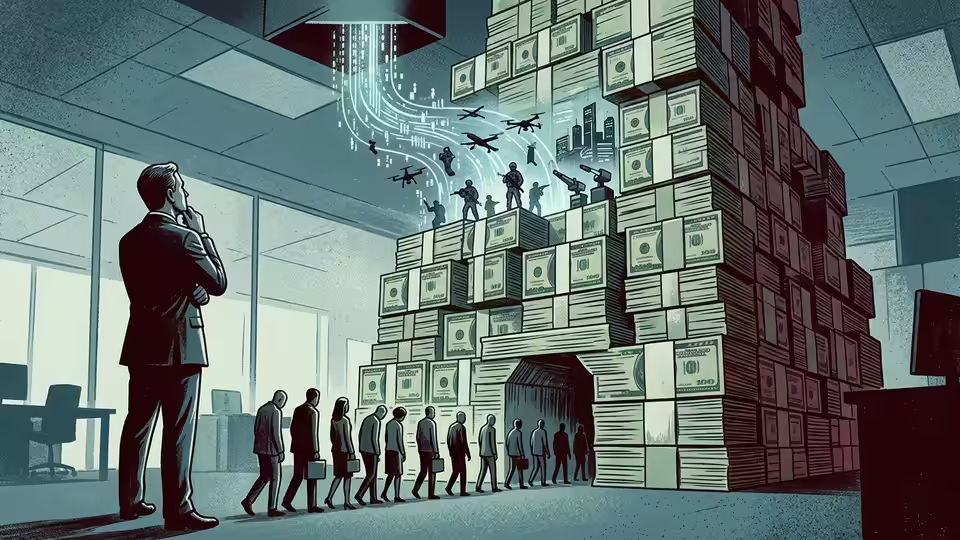
A handful of private equity billionaires are using a $100 million Super PAC to systematically unseat any member of Congress who votes against massive defense spending packages.
The United Democracy Project (UDP), the Super PAC arm of AIPAC, has signaled a record-breaking $100 million spending target for the 2026 election cycle. This figure, projected to surpass the $93 million raised during the 2024 cycle, is not merely a fundraising milestone; it is a deployment of capital designed to exercise a financial veto over the United States Congress. According to FEC Form 3X filings, the strategy centers on penalizing incumbents who deviate from a specific defense and foreign aid orthodoxy, regardless of their party affiliation or constituent service record.
The money trail begins with a handful of high-net-worth individuals from the financial sector. FEC records show that Paul Singer, founder of Elliott Management, contributed $5 million to UDP in the current cycle. Jan Koum, the WhatsApp co-founder, matched that with another $5 million. [Super PAC] is a political action committee that can raise unlimited sums of money from corporations, unions, associations, and individuals, then spend unlimited sums to overtly advocate for or against political candidates. For donors like Singer, whose firm often holds significant positions in sovereign debt and defense-related assets, the stability of international military funding is not just a policy preference—it is a business necessity.
The primary 'litmus test' for the upcoming 2026 cycle was established on April 20, 2024, during the House Roll Call vote on the $26.3 billion Israel Security Supplemental Appropriations Act. While mainstream media characterized the vote as a test of 'moderate' vs. 'progressive' values, the internal logic of UDP spending suggests a more transactional reality. Data from OpenSecrets and TrackAIPAC indicates that the timing of massive ad buys correlates directly with 'non-compliant' votes on these supplemental packages. When a representative votes 'No' on a multi-billion dollar defense appropriation, they are effectively flagging themselves for a multi-million dollar primary challenge.
We saw the blueprint for this in the 2024 primaries. UDP spent approximately $14.5 million in New York’s 16th Congressional District to unseat Jamaal Bowman and $8.5 million in Missouri’s 1st District to defeat Cori Bush. In both cases, the spending ratio relative to the candidates’ grassroots fundraising was nearly 10-to-1. [Independent Expenditure] is a political communication that expressly advocates for the election or defeat of a clearly identified candidate but is not made in coordination with any candidate or party. By saturating local media markets with negative advertising—often focusing on domestic character issues or unrelated controversies—UDP can shift polling numbers without ever mentioning the foreign policy votes that actually triggered the intervention.
The 2026 targets are already in the crosshairs. Representative Thomas Massie (R-KY) has been publicly targeted by AIPAC/UDP for his consistent votes against foreign aid packages, which he frames as a matter of fiscal responsibility. On the other side of the aisle, Representative Summer Lee (D-PA) remains a primary target after surviving multi-million dollar UDP challenges in previous cycles. This creates a bipartisan laundering mechanism: Republican mega-donors like Paul Singer can effectively pick the winners of Democratic primaries by funding the 'moderate' challenger, ensuring that whoever wins the seat is beholden to the same donor-aligned defense priorities.
Beyond the individual donors, there is the matter of 'dark money' transfers. IRS Form 990 data for AIPAC-affiliated 501(c)(4) organizations shows a surge in non-disclosing transfers to UDP. [501(c)(4)] is a social welfare organization that is not required to disclose its donors, allowing for 'dark money' to be moved into political campaigns through Super PACs. This layer of opacity makes it impossible for voters to know exactly whose interests are being served when they see a saturation of television ads in the weeks leading up to a primary. It is a system of regulatory capture that ensures the revolving door between the defense industry, private equity, and the halls of Congress remains well-oiled.
Mainstream coverage of these races tends to focus on identity politics or the internal 'civil wars' of the two major parties. They ignore the mathematical reality: when $100 million is dropped into a handful of local primary races, the democratic process ceases to be a competition of ideas and becomes a measurement of financial endurance. The focus on 'moderate' vs. 'extremist' labels is a smoke screen for the fact that these PACs are enforcing a 'pay-to-play' model of foreign policy.
For ordinary people, this means their local representative is increasingly incentivized to prioritize the demands of out-of-state billionaires over the needs of their own district. When a Representative knows that a single vote on a defense bill could trigger a $10 million attack campaign, they are less likely to push for that money to be spent on local infrastructure, healthcare, or housing. Your vote is being diluted by a flood of capital that you cannot match, funded by people you will never meet, to protect interests that do not include yours.
At Gen Us, we believe in radical transparency. You can use our Politician Tracker to see exactly how much money your representative has taken from UDP-affiliated donors and how their votes on defense spending correlate with those contributions. Our AIPAC Spending Data tool allows you to explore the flow of dark money from 501(c)(4)s into your local primary. The first step toward reclaiming representation is knowing exactly who bought it in the first place.
Summary
The United Democracy Project is leveraging a $100 million war chest to unseat Congressional incumbents who voted against massive foreign military aid packages. Backed by private equity titans and hedge fund managers, the PAC effectively bypasses local constituent preferences to enforce a donor-approved foreign policy consensus.
⚡ Key Facts
- UDP is projecting $100 million in spending for the 2026 cycle, surpassing its $93 million 2024 total.
- Major funding is provided by private equity executives, including $5 million from Paul Singer (Elliott Management) and $5 million from Jan Koum.
- The April 2024 $26.3 billion Israel Security Supplemental serves as the primary litmus test for identifying 2026 primary targets.
- Past spending patterns show ratios of 10-to-1 against incumbents like Jamaal Bowman ($14.5M) and Cori Bush ($8.5M).
- UDP utilizes 501(c)(4) 'dark money' transfers to mask the original sources of funding for early-cycle media buys.
Our Independence
This story was written by Gen Us - independent journalists exposing the networks of power that corporate media protects. No hedge fund owns us. No billionaire edits our headlines. We answer only to you, our readers.
Follow the public record
Source Trail
Get the next investigation in your inbox
One email a week. Receipts only. Free.
Free. Unsubscribe anytime. We never share your email.